- 15/10/2025
- Category: Press Release
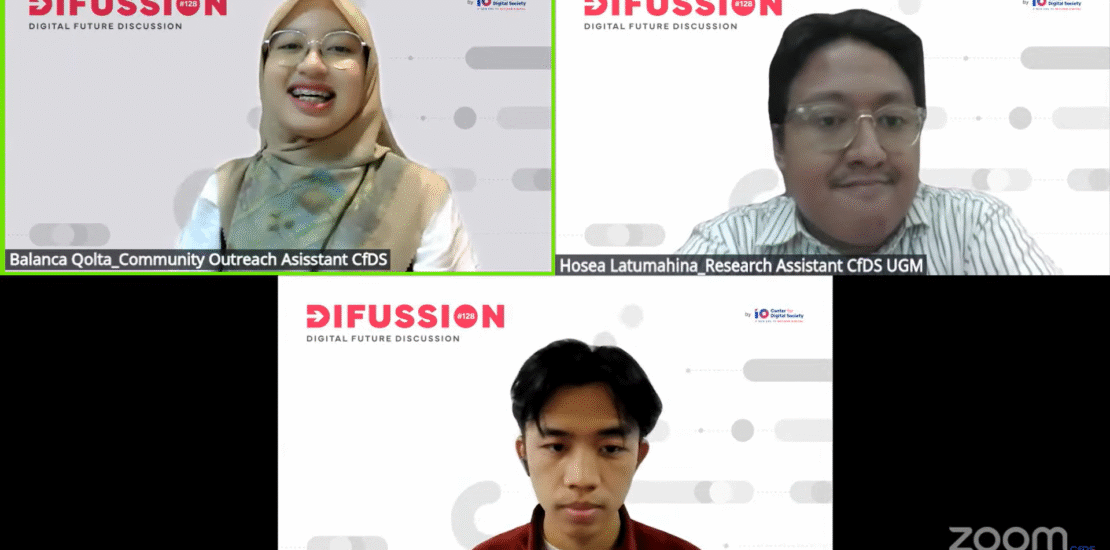
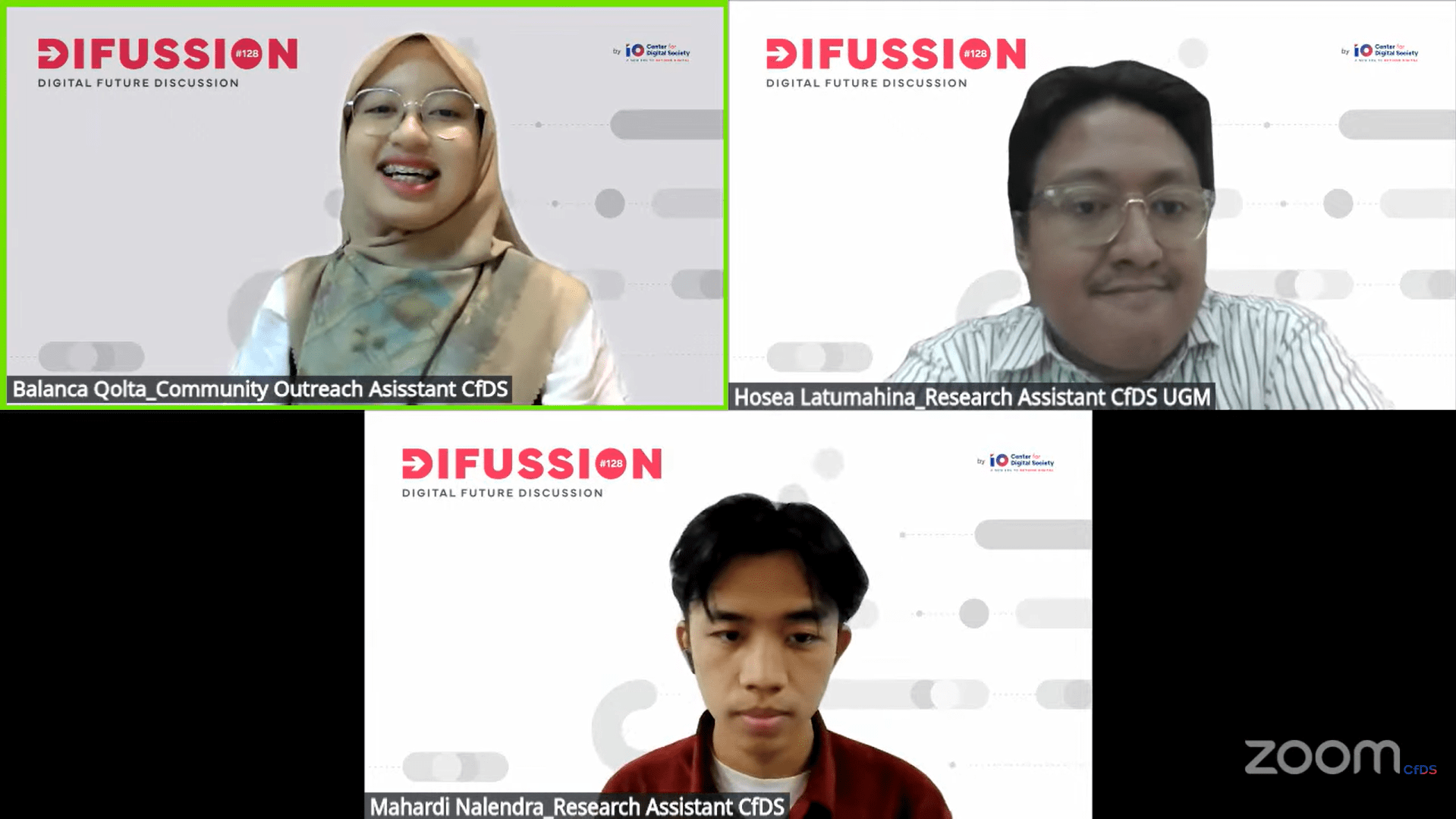
Yogyakarta, October 15, 2025 – The growing enthusiasm surrounding Artificial Intelligence (AI) in Indonesia is increasingly met with a more complex reality. Amidst the strong narrative of technological advancement, a crucial question arises: to what extent can the hype surrounding AI translate into sustainable economic and social value? Addressing this issue, the Center for Digital Society (CfDS), Faculty of Social and Political Sciences, Universitas Gadjah Mada, held Difussion #128 under the theme “Indonesia’s AI Trajectory: From Hype to Investment Challenges.” The discussion featured CfDS researchers Hosea Immanuel Latumahina and Mahardi Nalendra Syafa, moderated by Balanca Qolta, who together examined Indonesia’s AI development from the perspectives of investment, governance, and socio-cultural impact.
In his presentation, Hosea highlighted the government’s plan to strengthen Indonesia’s position within the global AI ecosystem through the establishment of a “Sovereign AI Fund.” The fund is expected to serve as a national financing instrument and catalyst for research, infrastructure, and digital market development. While this initiative aligns with global trends observed in countries such as the United States, India, and Singapore, Hosea emphasized that Indonesia still faces fundamental challenges, including the absence of a strong legal framework, unclear policy direction, and potential overlap with existing funding instruments such as the Indonesia Investment Authority (INA) and Merah Putih Fund. He warned that without legally binding regulations and transparent governance mechanisms, the Sovereign AI Fund risks becoming an inefficient policy tool that could fragment inter-agency coordination and open possibilities for misuse of public funds. “Without a specific and binding legal framework, the establishment of Sovereign AI may lack legal legitimacy. Moreover, its implementation is also vulnerable to weak governance practices,” he asserted.
Meanwhile, Mahardi examined the social and cultural dimensions of AI through a case study on the “Ghiblification” phenomenon, a viral trend on X/Twitter where users employ Generative AI to recreate imagery in the style of Studio Ghibli. Based on sentiment and topic modeling analyses of online discourse, Mahardi found that negative sentiment dominated 69% of the discussion, with anger (45%) and sadness (24%) emerging as the most prominent emotional responses. The public largely perceived this trend as an expression of “fear of missing out” (FOMO) that disregards artistic originality and the creative labor of human artists. Concerns were also raised regarding copyright violations, ethical implications of training AI models on copyrighted artworks without consent, and data security risks for users of such platforms.
Mahardi argued that this phenomenon marks a critical juncture in the relationship between technology and culture. “We’re seeing a lot of excitement around creativity made possible by AI, but it’s also sparked heated debates about originality, copyright, and what this means for artists,” he explained. He further noted that Indonesia’s Copyright Law (Law No. 28/2014) does not yet recognize works created entirely by machines, meaning that AI-generated content remains legally unprotected and susceptible to misuse.
The discussion concluded that the trajectory of AI development in Indonesia should no longer be viewed solely as an economic opportunity, but also as a test of the nation’s institutional, regulatory, and ethical preparedness in managing innovation. From an investment standpoint, greater transparency and inter-agency coordination are needed to prevent policy overlaps. From a socio-cultural perspective, adaptive regulation is necessary to protect artists and the public without stifling innovation. The two presentations collectively underscored that Indonesia’s AI future will depend on how effectively the nation balances technological ambition with ethical responsibility and sound governance.
The Center for Digital Society (CfDS) remains committed to fostering critical dialogues at the intersection of technology, public policy, and social impact. Through the Difussion series, CfDS continues to promote evidence-based discussions that encourage the public to understand Indonesia’s rapidly evolving digital landscape in a more reflective and informed manner.
Writer: Azzallea Ega Riesta Christsanda
Editor: Dhivana Anarchia Ria Lay
Center for Digital Society
Political Sciences, Universitas Gadjah Mada
For more information, please contact +62 857-9931-2383 (Masgustian) or email cfds.fisipol@ugm.ac.id
The Center for Digital Society (CfDS) is a research center under the Faculty of Social and Political Sciences, Universitas Gadjah Mada. CfDS FISIPOL UGM focuses on the study of digital society. Through various research initiatives and public discussions, CfDS FISIPOL UGM provides educational resources to the public about the impact of technology on various aspects of life, including social, political, and economic dimensions.
