- 19/10/2026
- Categories: Digital Expert Talks, Press Release
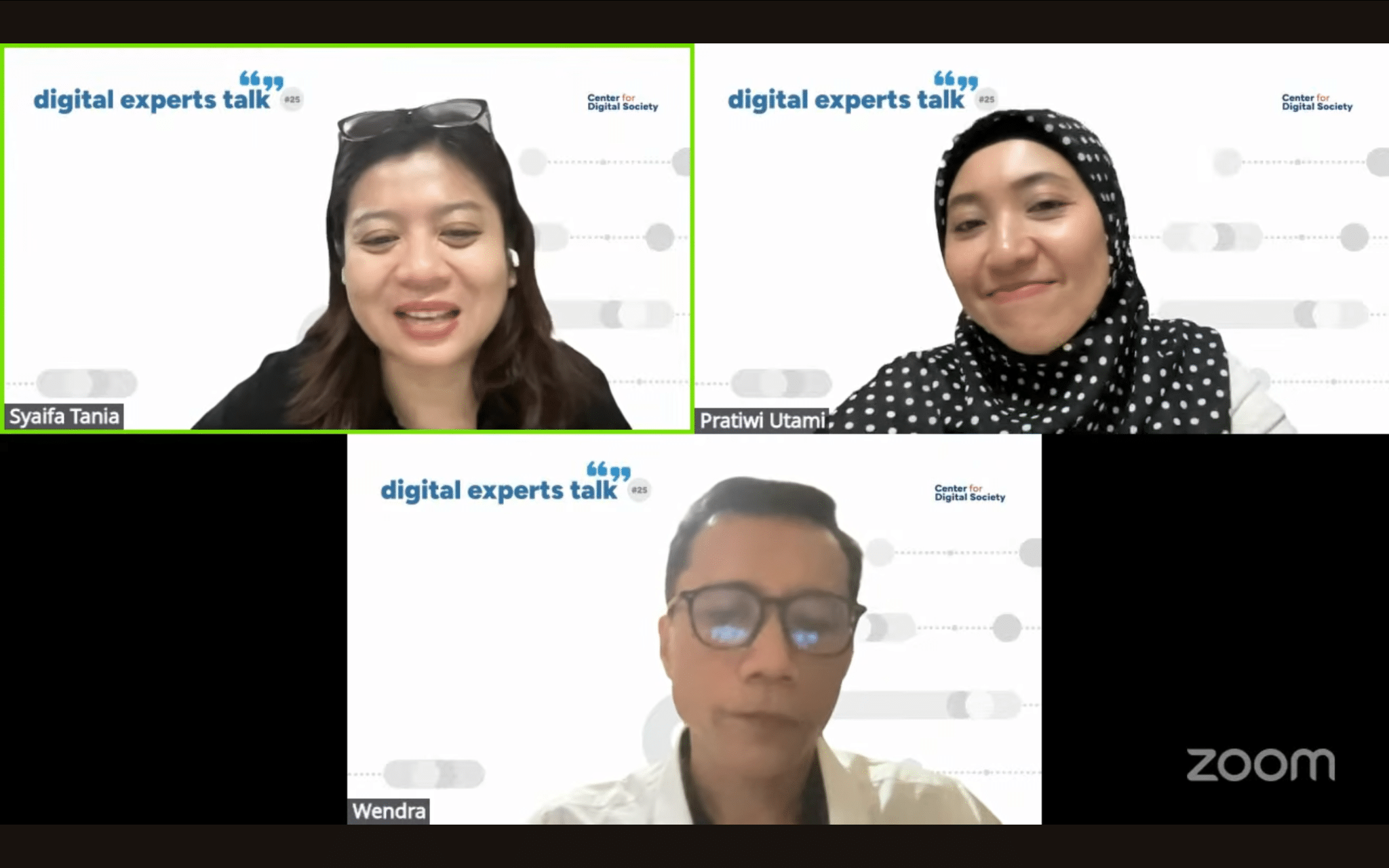
Yogyakarta 7 October, 2026 – The Center for Digital Society (CfDS), Faculty of Social and Political Sciences (FISIPOL), Universitas Gadjah Mada (UGM), held Digital Experts Talk (DET) #25, an online discussion titled “Democracy and Digital Rights: Do We Still Have Freedom of Speech?”. The discussion, moderated by CfDS Executive Secretary Syaifa Tania, featured two experts, including Lecturer in Communication Science at UGM, Pratiwi Utami, Ph.D., and Researcher at PR2Media, Engelbertus Wendratama.
The discussion responds to the global decline in internet freedom reported in Freedom on the Net 2024, while highlighting how the protection of freedom of expression is changing amid the challenges of content moderation regulation in Indonesia.
In her presentation, Pratiwi Utami, Ph.D., assessed that the high level of public participation in the digital space today is reflected only in its quantity, not in its quality. Polarization, disinformation and buzzer operations often distort public conversation. “Democracy cannot be measured by how trending an issue is, but by whether citizens can form opinions freely, receive quality information honestly, and channel it back,” she said. She further diagnosed Indonesia’s digital democracy as currently being in a state of “conditional freedom” due to structural pressures and ambiguous regulations.
Responding to the dilemma between maintaining public safety and protecting civil liberties, Engelbertus Wendratama said, “Respecting citizens’ freedom is easy to say, but finding common ground is the hard part. The main challenge is how authorities can keep protecting citizens and vulnerable groups from harmful content such as disinformation and hate speech, without violating human rights and citizens’ freedom of opinion.” He added that this is a global challenge.
Wendra added that content governance and moderation in Indonesia focus on the downstream part of the problem, namely content takedowns. Indonesia needs to shift from a content-based approach to a systemic one, like the European Union’s Digital Services Act (DSA). According to him, future regulation must require large platforms (Very Large Online Platforms) to mitigate systemic risks, undergo independent audits, and provide transparent content-moderation appeal channels handled by human moderators. Wendra also welcomed the Constitutional Court’s ruling in late September requiring the government to include a specific legal basis in every content takedown request.
The question-and-answer session further explored issues on social media algorithms, criminal defamation reports, and digital campaigns. Both speakers called for the importance of building rights literacy, not just digital literacy. It is hoped that this discussion will encourage government, civil society, academia, and the public to work together toward a digital space that protects our rights.
Watch the full webinar is available at the following link:
Writer: Palupi Esfandiany Widihartanto
Editor: Masgustian & Eka Nur Raharja
Center for Digital Society
Fakultas Ilmu Sosial dan Ilmu Politik Universitas Gadjah Mada
Informasi lebih lanjut dapat menghubungi +62 857-9931-2383 (Masgustian) atau cfds.fisipol@ugm.ac.id Faculty of Social and
Center for Digital Society (CfDS) adalah pusat penelitian di bawah Fakultas Ilmu Sosial dan Ilmu Politik, Universitas Gadjah Mada. CfDS FISIPOL UGM berfokus pada kajian masyarakat digital. Melalui berbagai penelitian dan acara diskusi publik, CfDS FISIPOL UGM menyediakan sumber daya edukasi kepada masyarakat tentang dampak teknologi terhadap berbagai aspek kehidupan, termasuk dimensi sosial, politik, dan ekonomi.
