- 19/11/2024
- Category: Press Release
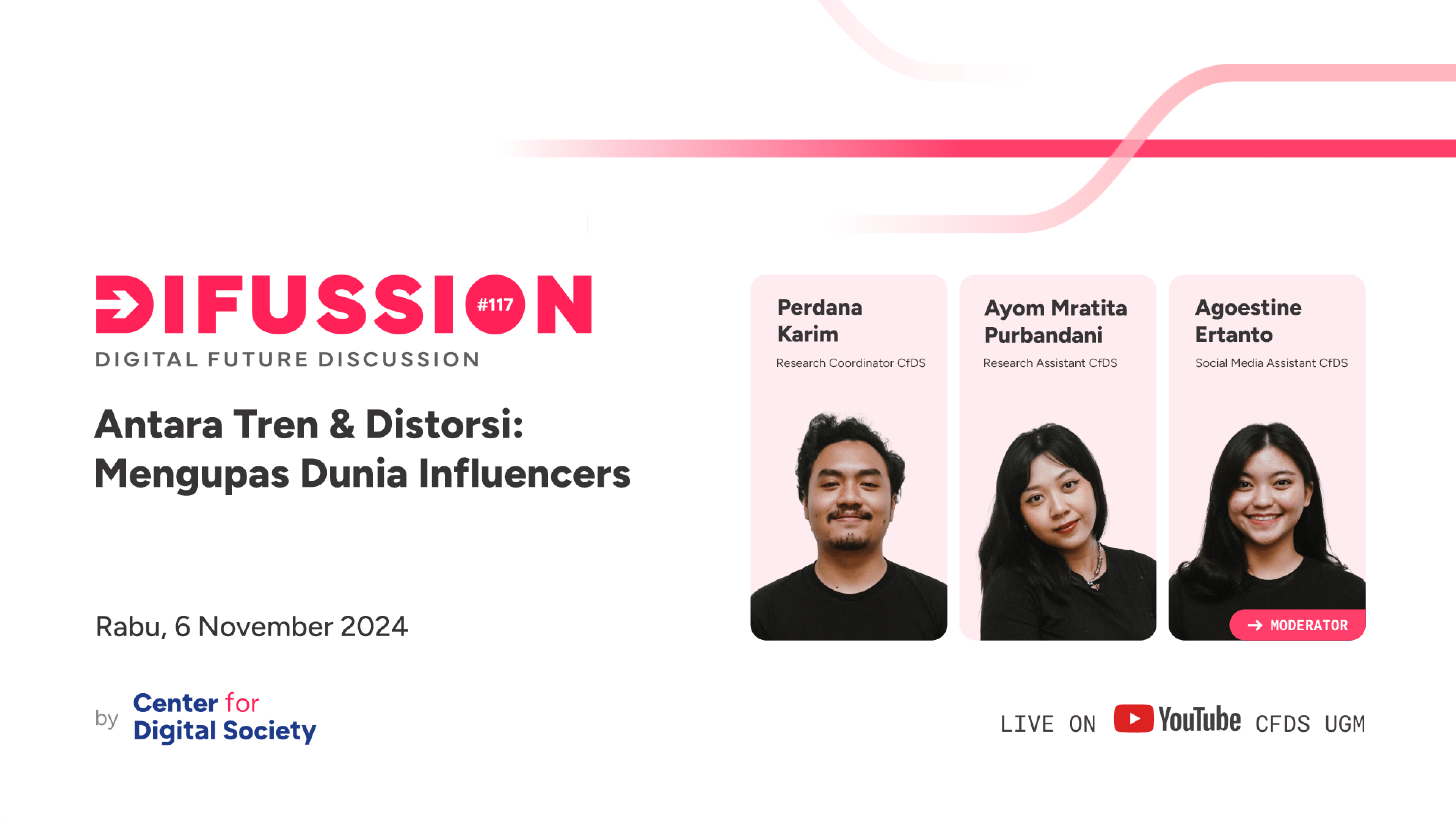
Yogyakarta, November 3, 2024 – The phenomenon of ‘social media influencers’ that has grown rapidly along with the advancement of social media in the digital era has had a major impact on shaping public opinion and people’s lifestyles. Social media influencers are individuals with a large following on digital platforms who are able to influence the opinions, lifestyles, and decisions of their followers, often through collaboration with brands to promote products or services. This phenomenon has given rise to new challenges in today’s public consumption patterns, such as the distortion of reality and the lack of transparency in the content shared. As a result, the role of social media influencers is not only to provide inspiration, but also to influence the way people view the authenticity and credibility of the information they receive. To discuss this topic, the Center for Digital Society (CfDS) held a discussion entitled Difussion #117: “Between Trends & Distortions: Unraveling the World of Influencers” by Perdana Karim, Research Coordinator CfDS, and Ayom Mratita Purbandani, Research Assistant CfDS. This discussion can be watched on the CfDS YouTube channel through the following link: https://www.youtube.com/live/1hW5fpnu_O4?si=ZVZRNLaBgyZjkTiY

Authenticity and Commerciality of Social Media Influencers
Karim opened the discussion by explaining the position of social media influencers who play an important role in the digital realm to influence lifestyle, consumption choices, and public opinion. Through content with titles that have appeal to their audience, social media influencers must be re-evaluated. “There is a complexity to their existence, such as the increasingly blurred boundaries between organic content and paid promotions, as well as the risk of false hopes that can trigger social pressure, especially among teenagers,” explained Karim. Exacerbated by several factors, such as audience reach, collaboration networks with fellow social media influencers, and endorsement status, they produce visible tastemakers who not only advertise products, but also influence consumption tastes and lifestyles.
From Karim’s study, this phenomenon can be described through the concept of Korposen introduced by Bollmer and Guinness (2024), namely the era of capitalism in which individuals strive to become “corporations in human form.” In this context, social media influencers not only act as product promoters, but also as personal brands that must consistently manage their image and persona. “This platform reflects a form of ‘aspirational work,’ where creators seek to transform digital and cultural capital into economic gain. They pursue financial success through content that reflects personal interests and is shared on social media,” Karim explained.
Strategies for Dealing with the Negative Impacts of Social Media Influencer Trends
Social media influencers often say, “If I can do it, so can you” as a motivational drive. However, the reality is not always that easy. The difference between the image displayed and the complex reality of life can actually encourage people to see the lifestyle of social media influencers as a standard to be achieved, even though it is often unrealistic or easy to achieve. This phenomenon creates a distortion of reality and false hope that success can be achieved easily. “The younger generation is starting to feel social pressure because they are susceptible to the influence of social media, which fosters unrealistic expectations that popularity and success can be achieved quickly without hard work,” Ayom said.
The public is urged to improve digital literacy so that they can understand that content on social media is often curated and does not reflect the real lives of social media influencers. With better digital literacy, it is hoped that the public will be able to sort information and not make social media a standard that must be achieved. “The concept of de-influencing can also be applied as an effort to combat excessive dependence on social validation and increase consumer awareness,” Ayom explained. “This concept encourages individuals not to focus too much on external achievements, but to value themselves more, so that people can become wiser consumers and avoid impulsive purchases due to momentary trends,” he concluded.
Writer: Alfasya Syabil Sholatar
Editor: Allysa Putri Rendry
