- 05/08/2025
- Category: Press Release
Yogyakarta, 5 August 2025 – The emergence of Generative Artificial Intelligence (GenAI) marks a new chapter in the education sector. On one hand, this technology is feared to replace the critical thinking and reasoning process of the younger generation. On the other hand, GenAI also opens up great opportunities for innovation in the teaching and learning process. In this context, it is important for students to not only be passive users of technology but also to critically understand its impact. Therefore, the direct involvement of students in discussions about the potential and risks of GenAI becomes an essential step in equipping them as a generation ready to face the future.
Responding to this dynamic, the Center for Digital Society (CfDS) at Universitas Gadjah Mada, in collaboration with Methodist Girls’ School (MGS) Singapore and SMA Stella Duce 1 Yogyakarta, organized a collaborative program entitled “The Methodist Girls’ Schools (MGS) ASEAN Programme (MAP).” This program is designed as a cross-country learning space to deeply explore the challenges and potential of GenAI usage in education. MAP was launched with an online learning class on 4 August 2025 attended by 40 students from MGS Singapore and Stella Duce 1 Yogyakarta.
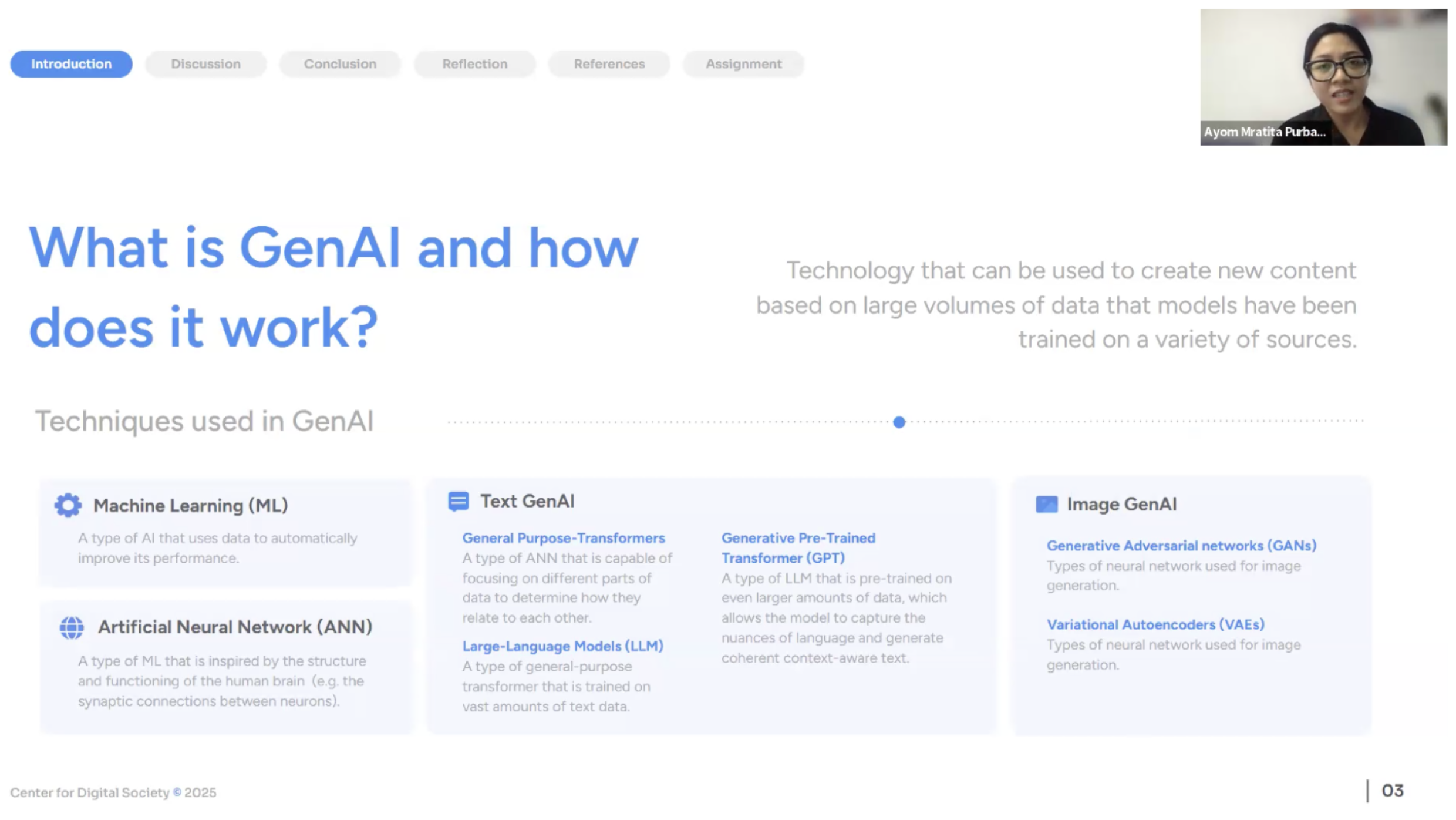
In this session, CfDS Researcher Ayom Mratita P. delivered a presentation titled “AI and Your Education: Hype or Real Change?” which encouraged students to view the use of GenAI more critically and reflectively. Ayom explained that unlike conventional AI, GenAI is designed to create something new but lacks contextual human understanding. “We are often amazed that GenAI can pass the bar exam or the GRE (Graduate Record Examination), but it’s important to remember that it doesn’t truly understand. It only imitates patterns,” she explained. Ayom also emphasized that students need to be aware of the risks of using GenAI, such as excessive dependence, misuse for negative purposes, and the spread of misinformation. However, if used wisely, GenAI can become a tool that supports learning—for instance, in designing more personalized learning materials, providing additional support to students, and encouraging creativity among teachers and students. “If used appropriately, GenAI can help design a more adaptive learning system tailored to each student’s needs,” Ayom stated.

To further explore the topic, the students were assigned to group projects where they were tasked with writing a short essay and delivering a brief presentation on predetermined topics. The first group will discuss how GenAI affects the learning process, exploring how AI influences changes in the way students learn, write, and solve problems. The second group will highlight the challenges of false information currently circulating on social media, particularly in Singapore and Indonesia. The third group will examine the positive and negative impacts of AI in education, focusing on the issue of unequal access to the internet. The fourth group will compare how the governments and educational institutions of both countries address the use of AI in the education sector. The fifth group will formulate ideas on building a positive and inclusive digital future for students. Through these five topics, students are encouraged to develop a deeper and more critical understanding of AI technology.
At the end of the program, participants will conduct an on-site visit to the CfDS office and the Faculty of Social and Political Sciences (FISIPOL) at Universitas Gadjah Mada on November 5, 2025. During this visit, each group will present the results of their discussions and analyses. This collaboration serves as a concrete manifestation of CfDS’s commitment to upholding the pillars of education, research, and community service as part of the university’s Tridharma.
Writer: Muhammad Alfasya Syabil Sholatar
Editor: Dhivana Anarchia Ria Lay, Masgustian
