- 23/06/2025
- Category: Commentaries

Author: Afra Hanifah Prasastisiwi
Editor: Achmed Faiz Yudha Siregar
Affiliate-based marketing practices have transformed into one of the most widespread promotional strategies on social media. Affiliate programs are performance-based marketing schemes that allow individuals or third parties to earn commissions through link clicks and purchases from sellers.[1] On various social media platforms such as X, TikTok, and Instagram, content that at first glance appears informative, funny, or inspirational but turns out to be mere clickbait leading to a “link in bio” or other affiliate links. The trending and viral nature of a post is now being exploited to gain financial profit, even if it means reducing the quality of the content.
Alongside this trend, advertisers of affiliate programs are also massively promoting their programs with the lure of tempting earnings. The promised selling point is quite convincing, often accompanied by screenshots of allegedly substantial income, reaching millions or even tens of millions of rupiah.
Figure 1. Screenshot of Affiliate Advertisement
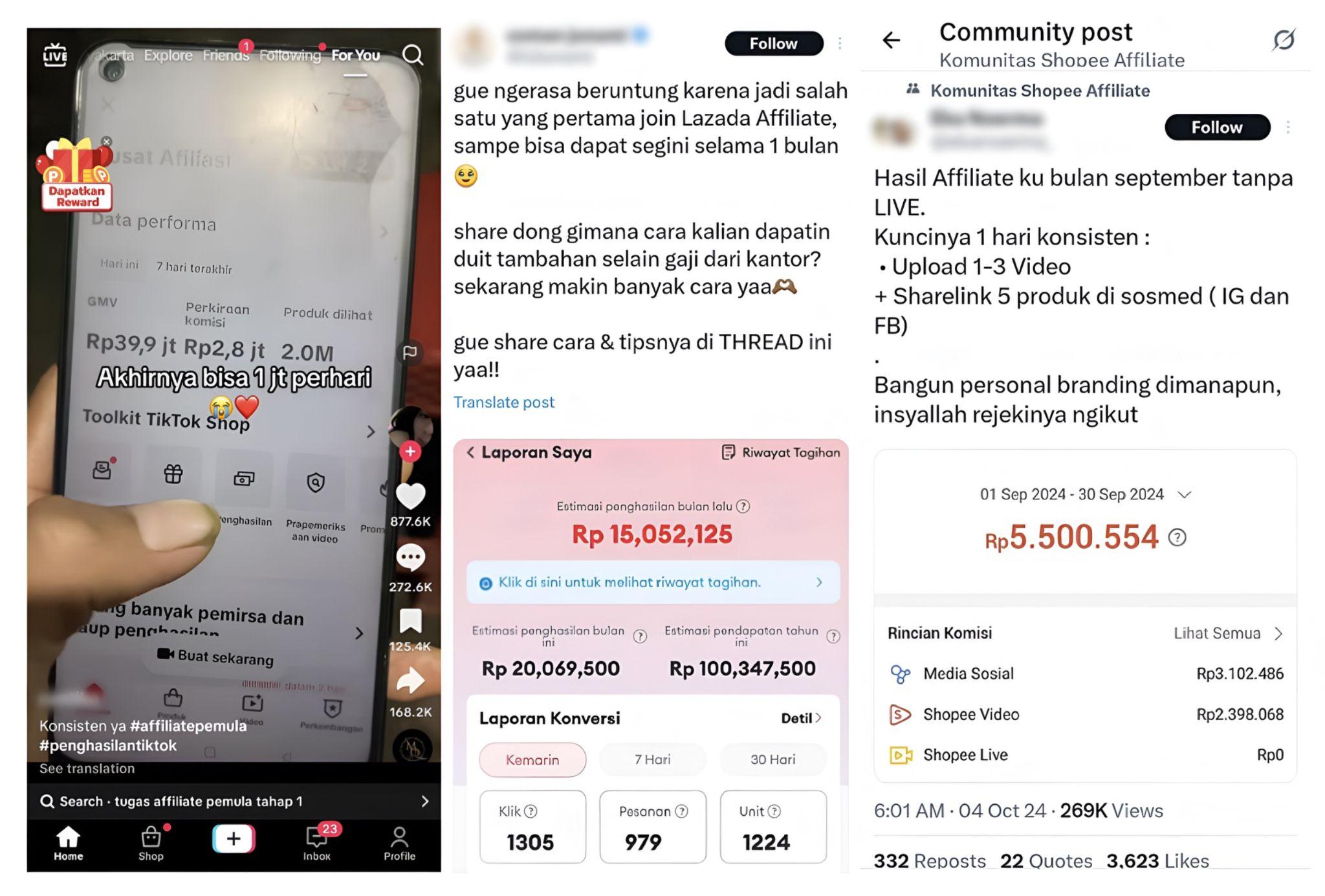
This type of content is easy to find across various platforms. By taking advantage of algorithms that prioritize high-click-potential content, such posts are not only persuasive but also invasive. Affiliators (those who share affiliate content) are neither influencers nor brand employees, but their work relies entirely on clicks, conversions, and the “luck” of the algorithm, reflecting a new and precarious form of labor. Even so, many are still interested in becoming affiliators because it offers income with minimal capital and high flexibility.
Affiliators and the Algorithmic Power Behind Them
Behind the image of “light” work, being an affiliator actually carries major risks with minimal rewards that often go unnoticed. Two major e-commerce platforms in Indonesia, Shopee and Tokopedia, offer affiliate programs with commissions no higher than 10% per product transaction.[2] As of the latest update in February 2025, Shopee’s affiliate commission through social media is only 2% for non-electronic products and 0.5% for electronic products, with a maximum commission of Rp10,000 per transaction. For official affiliators (Shopee Affiliate Partners), the commission can increase to 4% (max up to Rp50,000), with the requirement of having at least 2,000 followers.[3] As independent promotional agents, affiliators can only comply with the systems set by the platforms.
The platform system itself relies on network effects, meaning the more parties involved, the higher the value and dominance of the platform in the market.[4] Within this scheme, affiliators not only function to attract consumers through their content, but also enrich the data and engagement that are then processed into algorithms to optimize the platform’s value. E-commerce platforms, in this case, become the main actors who benefit the most from affiliate programs. For instance, the Tokopedia Affiliate Program recorded a nearly fivefold increase in active users in Q3 2022 compared to Q1, along with a fourfold increase in transactions during the same period.[5] Meanwhile, Shopee Affiliate experienced more than a twofold growth in users throughout 2022, with transactions tripling.[6] Ironically, despite their significant contribution, affiliators are in the most vulnerable position due to their dependence on algorithms.
Working as an affiliator becomes increasingly precarious when algorithmic power favors larger players or those who are skilled at manipulating the system. Affiliators must constantly produce content, promote products, and follow market trends, yet if there are no clicks or conversions, they receive no payment. This differs from other digital gig workers (such as online freelancers or ride-hailing drivers) who generally receive compensation per order. In addition, algorithmic manipulation by dishonest actors presents another challenge for smaller affiliators, including practices such as cookie stuffing, attribution fraud, typosquatting, and click fraud.[7] These practices harm both brands and honest affiliators by eroding their potential earnings. Not to mention competition from major players like Honey, a browser extension that automatically inserts coupon codes at checkout and hijacks affiliate cookies. This practice causes smaller affiliators, who may have built trust with their audience, to lose commissions at the final moment of a transaction.[8] This business model clearly illustrates how algorithmic loopholes can be exploited by major players to dominate earnings in the digital marketplace.
Pseudo-claims of Affiliate Programs
Although affiliate programs have significant systemic weaknesses, they are often packaged with exaggerated narratives and promises of instant income. The term pseudo-claim refers to these appealing claims, tempting promises of large earnings as if they can be achieved simply by sharing a link, without explaining the existing competition and algorithmic traps. In reality, the greatest profits are enjoyed by the platforms and brands, followed by well-established super affiliators who still receive a significant share, while individual affiliators generally earn only “receh” (meager) or minimal amounts.
Many creators join affiliate programs hoping to earn big, but only a few succeed in maximizing their income potential. Data from Snapcart (2023) shows that 59% of Shopee transactions come from affiliate links.[9] However, only the top 5% of affiliators contribute 55% of total affiliate sales, revealing a stark imbalance in outcome distribution among creators.[10] On Instagram and Facebook, most affiliators still rely on organic posts despite the availability of tools like ShopMy or Pixlee. Yet algorithmic changes now increasingly limit the reach of affiliators’ content. Socialinsider reports that the average engagement rate based on reach on Instagram is only 3.00%, while on Facebook it’s even lower, with a maximum rate of around 1.20%.[11] This phenomenon underscores that earning income through affiliate programs is not as easy as they make it seem in advertisements.
An unequal digital ecosystem, governed by algorithmic logic, creates disparities in opportunity. For large accounts (such as influencers), affiliate programs can indeed serve as an additional source of income. However, for newcomers, expecting instant results is not a realistic hope. Unfortunately, the impressive figures shown in advertisements are often deliberately highlighted as testimonials to attract new sign-ups, even though such achievements may only represent exceptional cases (top affiliators), not the average (most affiliators). This is already a form of deceptive advertising, or the manipulation of facts to make something appear more promising than it actually is. This type of claim, which is not entirely truthful (pseudo-claim), can pose risks to consumers, especially the naive one who are easily persuaded by exaggerated narratives.[12]
In the context of Indonesian regulation, the Consumer Protection Law (Law No. 8 of 1999, Article 9) already prohibits promotions with exaggerated promises that are not supported by sufficient information.[13] However, pseudo-claims (half-truth claims) in affiliate program advertisements remain widespread, as these types of claims exist in a gray area that is difficult to classify as fraud (they are not direct over-claims). Furthermore, promotional content that promises large earnings is usually clickbait in nature, resulting in high click-through rates and rapid spread across timelines. This pattern creates a kind of algorithmic loop: the bigger the claim > the more people are interested > the more the algorithm amplifies it. Even though in reality not everyone can achieve the same good results, but many still click the content. Thus, pseudo-claims in affiliate programs continue to thrive and circulate within algorithmic logic, even if the actual benefits do not always match the expectations they create.
This serves as a reminder, potential affiliators must adopt a critical and informed approach when considering affiliate program offers, especially those accompanied by exaggerated claims of easy income. Improving digital literacy is essential to help individuals recognize manipulative marketing tactics disguised as success stories. Potential affiliators should not be persuaded solely by testimonials or impressive earnings displays but must carefully examine how these programs operate, including the potential risks. At the same time, stricter oversight and enforcement by regulatory authorities are necessary to limit misleading advertisements and curb the unchecked spread of pseudo-claims in the digital marketplace.
-
Mangiò, F., & Di Domenico, G. (2022). All that glitters is not real affiliation: How to handle affiliate marketing programs in the era of falsity. Business Horizons, 65(6), 765–776. https://doi.org/10.1016/j.bushor.2022.07.001; Edelman, B., & Brandi, W. (2015). Risk, information, and incentives in online affiliate marketing. Journal of Marketing Research, 52(1), 1–12. https://www.jstor.org/stable/43832338 ↑
-
Shopee Indonesia. (2025). Shopee Affiliates Program. [Online] Retrieved June 17, 2025, from https://shopee.co.id/m/affiliates; Tokopedia Affiliates. (2025). Extra Commission. [Online] Retrieved June 17, 2025, from https://affiliate.tokopedia.com/komisi-ekstra ↑
-
Shopee Indonesia. (2025). Shopee Affiliates Program. [Online] Retrieved June 17, 2025, from https://shopee.co.id/m/affiliates ↑
-
Kim, J., & Ahn, S. (2024). The platform policy matrix: Promotion and regulation. Policy & Internet. https://doi.org/10.1002/poi3.414 ↑
-
Anggoro, B. (2022). Pengguna program Tokopedia Affiliate naik lima kali lipat. Media Indonesia. [Online] Retrieved June 17, 2025, from https://mediaindonesia.com/ekonomi/540783/pengguna-program-tokopedia-affiliate-naik-lima-kali-lipat ↑
-
Nurhaliza, S. (2023). Pengguna program Shopee Affiliate naik dua kali lipat. Antara News. [Online] Retrieved June 17, 2025, from https://www.antaranews.com/berita/3535959/pengguna-program-shopee-affiliate-naik-dua-kali-lipat ↑
-
Mangiò, F., & Di Domenico, G. (2022). All that glitters is not real affiliation: How to handle affiliate marketing programs in the era of falsity. Business Horizons, 65(6), 765–776. https://doi.org/10.1016/j.bushor.2022.07.001 ↑
-
Davis, W. (2024, December 23). Honey’s deal-hunting browser extension is accused of ripping off customers and YouTubers. The Verge. [Online] Retrieved June 17, 2025, from https://www.theverge.com/2024/12/23/24328268/honey-coupon-code-browser-extension-scam-influencers-affiliate-marketing ↑
-
Snapcart. (2023). Era baru industri e-commerce gaet lebih banyak pasar lewat strategi afiliasi. [Online] Retrieved June 17, 2025, from https://snapcart.global/era-baru-industri-e-commerce-gaet-lebih-banyak-pasar-lewat-strategi-afiliasi-shopee-affiliate-program-menjuarai-pilihan-masyarakat-melampaui-tiktok-affiliate-tokopedia-affiliate-dan-lazada-affiliat/ ↑
-
WeCanTrack. (2025). Affiliate program performance statistics: Revenue, trends, and insights. [Online] Retrieved June 17, 2025, from https://wecantrack.com/insights/affiliate-program-performance-statistics/ ↑
-
Cucu, E. (2025). What Data Says: Social media reach has a 12% YoY decrease on Instagram. Socialinsider. [Online] Retrieved June 22, 2025, from https://www.socialinsider.io/blog/social-media-reach/ ↑
-
Gupta, A. (2023). Deceptive advertising, regulation and naive consumers. International Journal of Industrial Organization, 88, 103026. https://doi.org/10.1016/j.ijindorg.2023.103026 ↑
-
Republic of Indonesia. (1999). Law of the Republic of Indonesia Number 8 of 1999 concerning Consumer Protection (Article 9). Retrieved June 20, 2025, from https://gatrik.esdm.go.id/assets/uploads/download_index/files/e39ab-uu-nomor-8-tahun-1999.pdf ↑
