- 23/09/2024
- Category: Press Release
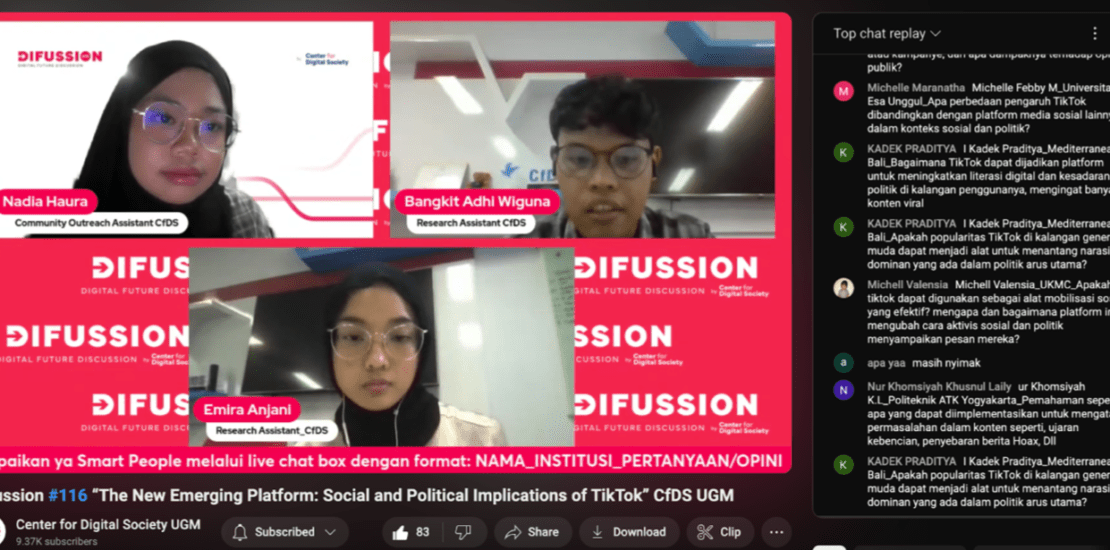
Yogyakarta (13/9/2024) – Digital content in the form of short video is increasingly popular among social media users. This has prompted the increasing use of social media platforms that facilitate the production of this type of content, such as TikTok. By 2022, TikTok was downloaded more than 670 million times, making it the most downloaded entertainment social media platform worldwide (Dunn, 2024). On the other hand, Indonesia is the largest TikTok user in the world, based on one survey conducted until July 2024, with more than 157 million users (Ceci, 2024). The massive use of TikTok affects the social and political lives of the Indonesian population and the world. Participating in responding to this phenomenon, the Center for Digital Society (CfDS) UGM held the 116th edition of the Digital Future Discussion (Difussion) entitled “The New Emerging Platform: Social and Political Implications of TikTok”. The discussion was held on Friday (13/9) featuring Emira Anjani and Bangkit Adhi, research assistants of CfDS UGM. This activity was broadcast live through the official YouTube account of CfDS UGM at the link https://www.youtube.com/live/-0t7y6NvO0o?si=qlvZiJr6yQRvXjhH.
Emira Anjani delivered a presentation about the TikTok era and language diaspora as a socio-cultural phenomenon driven by the use of TikTok application. She explained the emergence of paralanguage on social media, which is a meta-communication component that contains non-verbal aspects, such as emojis and abbreviations that have been proliferating on the internet. TikTok encourages the development of internet language to be increasingly diverse and colorful. This application sparked the emergence of terms that are more unique, random, and relatively more difficult to understand. TikTok also triggers word shifts or the creation of new words.
Emira discussed that understanding the language on TikTok requires a contextual and cultural approach. Semantic shifts are not new but are part of the evolution of language that occurs naturally. She quoted Nicole Holliday, who argued that TikTok triggered more rapid semantic shifts due to the characteristics of video-based content that more closely reflects conventional human interaction patterns, which is a face-to-face interaction (García-Penn 2021). “The proof is, ya, for a word like ‘roman empire’, for example, it was successfully adopted into a term that is used daily, only in a few weeks or months after the original video,” said Emira. The impact caused by TikTok on language development has generated a variety of public responses, which tend to be optimistic or pessimistic.
Bangkit Adhi delivered a presentation on the development of TikTok into a dominant social media platform in the context of elections. He discussed that in Indonesia and the Philippines, TikTok tends to be associated with the victory of candidates who have politically problematic backgrounds, as well as the use of this application for political purposes in Europe. He cited McLuhan (1964), who argues that the form and characteristics of a messaging medium are what influence people’s mindset and behavior, beyond merely the message. Thus, the characteristics and structure of user interaction on TikTok is also a determinant of popularity in elections, not just the message conveyed in its content.
Bangkit explained three specific characteristics in TikTok’s social media structure that make it so popular: the specialized artificial intelligence (AI) technology, Toutiao, that has the ability to deliver specific content to specific users; the short video content model that creates an addictive effect on users; and the unusual global marketing techniques that can attract many new users in a short period of time. TikTok’s short videos, which can feature political content with minimal substance but lots of image-building, have helped many politicians with troubled backgrounds in polishing their image. “If content with minimal substance [and] full of image building will continuously be produced, [this] will hinder the function of political education. The function of political education should be the responsibility of the state and political parties,” said Bangkit. Aside from its negative implications on the political dynamics, TikTok also has the potential to facilitate emancipatory politics, such as in the case of the Palestinian struggle and activism, through utilizing TikTok as its communication medium.
Author : Carmelia Gaby
