- 24/06/2024
- Category: Press Release
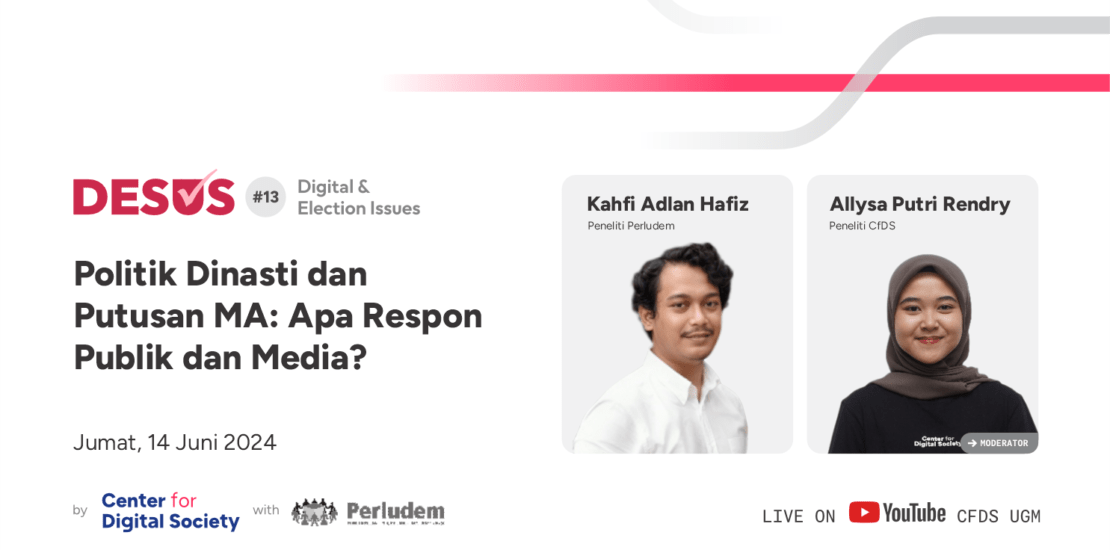
Yogyakarta, June 14, 2024 – The decisions of the Supreme Court (MA) and Constitutional Court (MK) in 2024 have sparked various reactions from different segments of society, particularly regarding the age requirements for candidates for regional head and deputy, as well as presidential and vice-presidential candidates. These decisions have raised public questions about the background of these approvals, perceived as leaning towards the establishment of political dynasties and undermining democracy in Indonesia. In response to this controversy, the Center for Digital Society, in collaboration with Perludem, held Desus #13: “Political Dynasties and Supreme Court Decisions: What Are the Public and Media Responses?” to explore Indonesian society’s reaction to these decisions. Kahfi Adlan Hafiz (Perludem Researcher) was the speaker at this event, moderated by Allysa Putri Rendry (CfDS Researcher). The discussion can be viewed again via the following link: [YouTube Live](https://www.youtube.com/live/1nkxx8ii_5g?si=0tXiDhUOaS5pMDpx).
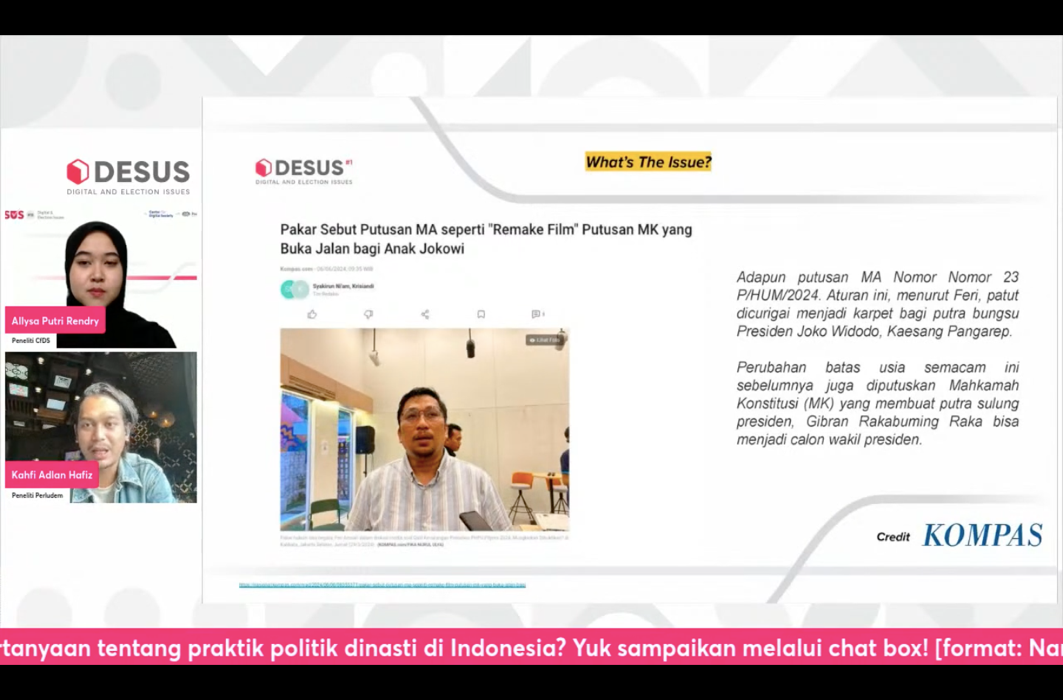
Controversy and Potential Impact of the Supreme Court and Constitutional Court Decisions
Kahfi opened the discussion by explaining that the Supreme Court has the authority to review regulations below the law. In this case, the Supreme Court reviewed the General Election Commission’s (KPU) regulation on the age requirement for regional head candidates, setting a minimum age of 30 for gubernatorial candidates and 25 for mayoral candidates, to be calculated from the time they are elected, not from the candidacy announcement. This contrasts with the previous rule, which stated that the age calculation should be at the time of the candidacy announcement. This decision is reminiscent of the 2034 Presidential Election, where the Constitutional Court also altered the minimum age requirements for presidential and vice-presidential candidates; this was ethically controversial because the Constitutional Court chairman at the time was the uncle of one of the vice-presidential candidates, raising public perceptions of nepotism. Many have urged the Judicial Commission (KY) to thoroughly investigate what is happening behind the scenes in some of these governmental legal bodies.
This Supreme Court decision has inevitably sparked public speculation about its influence on specific political figures who might contest in regional elections, such as Kaesang Pangarep, the second son of President Joko Widodo (Jokowi), who has not yet reached the age of 30 but will do so by the time of inauguration. This decision is seen as a manipulation of regulations for certain political interests. “Public reactions are varied; many believe this decision can create legal uncertainty, especially for political parties and candidate pairs who will compete in regional elections. This uncertainty potentially disrupts the democratic process and the credibility of legal institutions,” added Kahfi.
Public Perception and Its Implications for Democracy in Indonesia
The overarching narrative of political dynasties post-decision has become more pronounced during President Joko Widodo’s administration. Public polarization between those opposing political dynasties due to their detrimental effects on democracy and those supporting them in the name of individual political rights colors Indonesian politics. This is exacerbated by inadequate political education and the effects of social media bubbles or echo chambers, leading many to normalize political dynasties. This threatens the political participation rights of other parties and the general public, as power concentrated within a family tends to overlook a healthy and transparent cadre process.
Moreover, the media plays a crucial role in shaping public opinion, necessitating criticism and oversight of this decision to maintain the integrity of democracy and law in Indonesia. “In the future, there is concern about public distrust in legal order, similar to the misuse of social assistance funds which became controversial and could change election outcomes, indicating the government’s neglect of governance and allowing abuse of state resources. Unfortunately, this has not been followed up by the Constitutional Court. The worry is that regional election candidates might emulate this,” said Kahfi, closing his discussion.
Author: Muhammad Alfasya Syabil Sholatar
Editor: Allysa Putri Rendry
