- 14/06/2024
- Category: Press Release
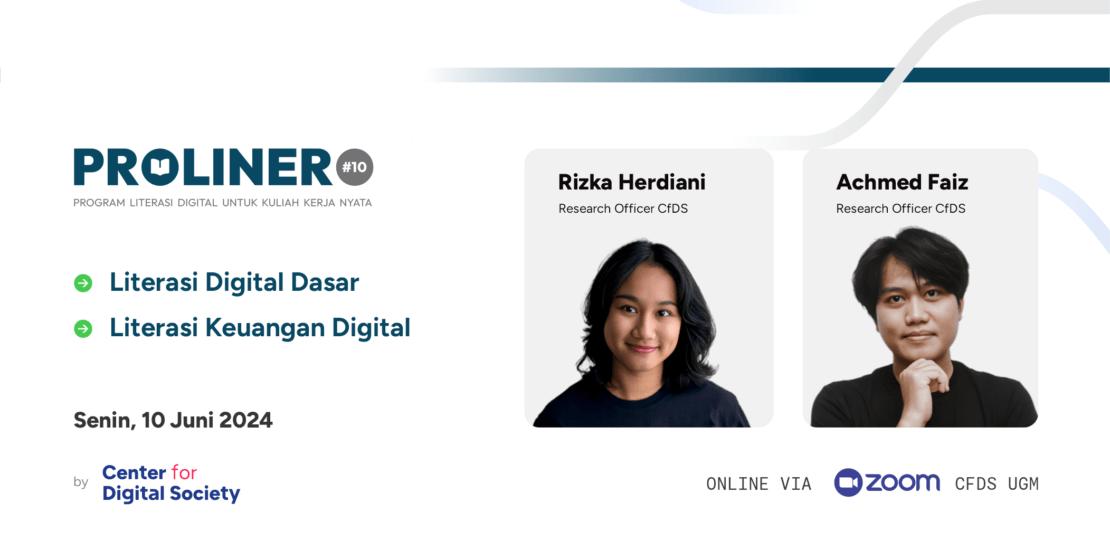
Yogyakarta (11/6/24) – Every mid-year, many Indonesian university students are preparing for their participation in the university’s Kuliah Kerja Nyata (KKN) program, as a form of community service. Through KKN programs, Indonesian students seek to work together with local communities to solve local social problems and increase the capacity of local residents. In response to this need, the Center for Digital Society (CfDS) UGM organized a training of trainers program aimed at raising the level of digital literacy of local communities in the 10th series of the Digital Literacy Program for Student Community Service (PROLINER). The event, which was conducted from Monday (10/6) to Tuesday (11/6), featured Ayu Pratiwi, Achmed Faiz, Arifatus Sholekhah, and Imanuel Silalahi as presenters, and was held in the Zoom room of CfDS UGM.
Ayu Pratiwi presented the material entitled Digital Literacy and Social Media Ethics. She explained the pillars of digital literacy which consist of digital skills, digital culture, digital ethics, and digital safety. Ayu also discussed the operation of social media, where users need to know how to protect sensitive personal data, confirm the truth of information and its source, avoid spreading sensitive contents related to ethnicity, religion, race and intergroup (SARA), pornography, and acts of violence, as well as showing good ethics in online communication. She also elaborated cases of hoaxes, misinformation, disinformation, and malinformation, along with how to avoid them in daily internet use.

Achmed Faiz delivered a presentation entitled Optimizing Digital Financial Literacy. He reviewed various digital financial service innovations in Indonesia and their functions, such as mobile banking, wealth tech, financial planner, and so on. He also discussed the history of QRIS usage in Indonesia and its development plan. Achmed described online lending (pinjol), PayLater, and investment, along with important aspects that need to be considered in utilizing these services to prevent harm. “Uneven digital literacy level, which has led to the proliferation of illegal online lending and investment, often results in victims, and [there are] loopholes for fraud through the use of fintech,” said Achmed.
Arifatus Sholekhah explained the material on Personal Data Security on the Internet. She introduced the definition of personal data, described its types, and emphasized the importance of safeguarding personal data. Arifatus also conveyed the development of data security crime schemes, the demographic distribution of internet users and its influence on data security crimes, and cases that are currently happening, such as social engineering, phishing, account breaches, online gender-based violence (GBV), and so on. To prevent cases of data security crimes, she urged the digital society to raise personal awareness about the operation of applications and the threats inherent to them, to use social media wisely, to frequently change passwords of their digital accounts, as well as suggested that the government continue to play a role in protecting the security of citizens’ personal data through the Personal Data Law.

Imanuel Silalahi addressed the topic of Smart Politics in the Digital Information Era. He emphasized the importance of digital literacy in the socio-political field, as the field that is most affected by hoax cases on digital platforms. He encouraged the public to use digital media responsibly, to be aware of related legal consequences such as Law No. 19 of 2016, to recognize the disruption of information dissemination, and to be proficient in assessing the validity of information. He elaborated the topics of misinformation and disinformation related to politics that are prevalent on digital platforms, such as conspiracy, background, fraud, and chaos. He also explained how to identify socio-political-themed hoaxes and how to prevent them. Imanuel said, “The challenge now is no longer about seeking information, but rather about assessing information. In this era, we must not lose in terms of how we think and act. Learn to be fair and right, beyond our personal preferences.”
Through the trainings and presentation of the 10th PROLINER materials, CfDS has been involved in supporting the participants (prospective ‘trainers’) to be more prepared to participate in the student community service program and bring about good changes in their respective deployed regions. With the role of each student participant of PROLINER #10 trainings, it is hoped that the level of digital literacy of local communities in many regions in Indonesia will increase.
Author : Carmelia Gaby Talia Editor : Allysa Putri Rendry
