- 10/06/2024
- Category: Press Release
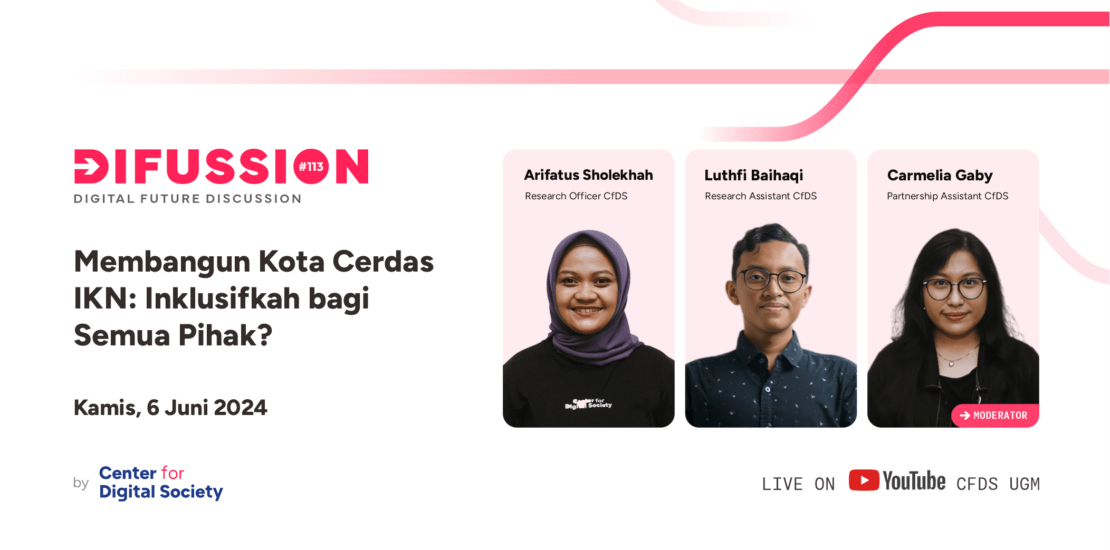
Yogyakarta, (10/06/2024) – The Indonesian government is seriously working on the ambitious New National Capital (IKN) Nusantara project to prepare for modern and digital urbanization in the future. This project is divided into five main stages, initially focusing on infrastructure, technology, and social inclusivity. This initiative reflects the government’s vision to create a city that is not only smart but also fair to all levels of society. However, this is contradicted by narratives of indigenous land displacement for the IKN development project. To discuss this, the Center for Digital Society presents Arifatus Sholekhah & Luthfi Baihaqi (Research Officers CfDS), in Difussion #113 with the theme “Building a Smart City IKN: Inclusive for All Parties?”. This discussion is moderated by Carmelia Gaby Talia S. (Partnership Assistant CfDS) and can be re-watched on the CfDS UGM YouTube channel via the link https://www.youtube.com/watch?v=wdLEzlsPTxw

Transformation Towards a Smart and Digital City
Luthfi opened his discussion by explaining the government’s massive efforts to build the IKN according to its deadline in September 2024. At this stage, the government emphasizes urgent infrastructure development, such as hospitals, flats, and roads. The development continues with the relocation of 11,000 civil servants (ASN) from 38 ministries and institutions in Indonesia. In interviews with related parties, IKN is mentioned to be designed to become a ‘smart city’ and a ‘digital city’ by the third phase in 2030. Implementing digital facilities will be a priority to create a modern and interconnected environment.
Along with this concept, the term “smart people” emerged, reflecting residents with the skills deemed suitable for inhabiting IKN. Citing the National Research and Innovation Agency (BRIN), “smart people” are individuals with capabilities and innovations in Information and Communication Technology (ICT). However, Luthfi expressed concerns about inclusivity in this context. There is irony in the fact that the land used for the IKN development is owned by indigenous communities who are often not involved in the decision-making process, resulting in many relocations and evictions.
Principle of a “Fair City” in the IKN Project
The discussion continued with Arifatus’ presentation on the IKN development project, which seems to force local communities, such as in Sepaku Village, to leave their homes. This creates economic disparities due to the loss of access to local resources. The government has provided compensation funds. However, the local community believes that the value is not equivalent. They want to participate in the development and economic growth processes in IKN. This phenomenon intersects with the concept of a “just city” which prioritizes equality, democracy, and cultural diversity. Consultation with affected communities is necessary to ensure inclusive and fair development.
The dialogue between the government and indigenous communities is still considered limited and does not fully represent the voices of the general public. Analyzed according to realistic group theory, this trend can trigger conflict due to differing goals between the government and local communities. The Indigenous Peoples Alliance of the Archipelago (AMAN) emphasizes the importance of their involvement in productive deliberations to create inclusive development. “The government must recognize the importance of involving indigenous communities by helping to improve their technological capabilities through appropriate training. This is important to apply the principle of inclusiveness so that the community can understand and adapt to changes,” Arifatus concluded his session.
Author: Muhammad Alfasya Syabil Sholatar
Editor: Allysa Putri Rendry
