- 15/05/2024
- Category: Press Release
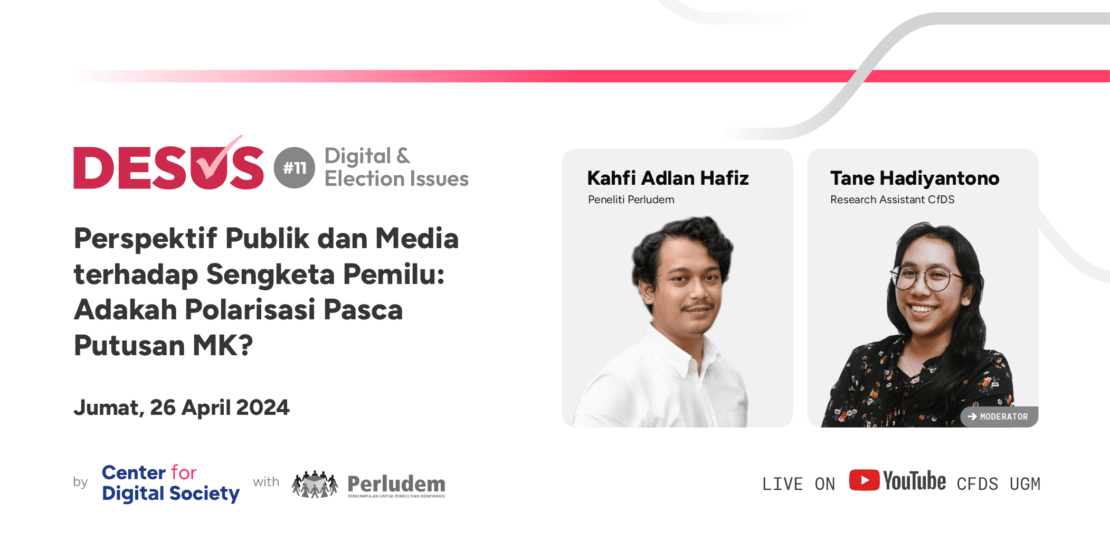
The decision of the Constitutional Court regarding the outcome of the 2024 General Elections has sparked various reactions from different parties. Many view this decision as a reflection of society’s resilience in politics and a step towards further consolidated democracy post the 1998 reformation. However, there are also many who remain dissatisfied with the decision. In light of this, through “Desus #11: “Public and Media Perspectives on Election Disputes: Is There Polarization Post-Constitutional Court Decision?”, the Center for Digital Society elaborates on the political dynamics shaping public opinion post the Constitutional Court ruling. Kahfi Adlan Hafiz (Researcher at Perludem) was the speaker at this event, moderated by Tane Hadiyantono (Research Assistant CfDS). This broadcast can be watched via https://www.youtube.com/watch?v=TE07OMd-tuc

Public Dissatisfaction Towards the Constitutional Court Decision
Kahfi opened the discussion by explaining that the hearings held by the Constitutional Court demonstrated the commitment of the judges to examine and focus on the issues raised by the applicants and respondents. Two aspects were focused on during the hearings: the performance of the Constitutional Court in discussing the arguments presented and the Election Organization Ethics Council’s decision regarding the General Election Commission’s ethical violations. This was reinforced by the presence of 14 amicus curiae as part of the legal considerations, indicating openness and inclusivity in the decision-making process, which was previously rare in cases of election disputes. However, there are still many parties who do not agree with the Constitutional Court’s decision, even rejecting it.
Debate and rejection regarding the Constitutional Court’s decision are common in the political realm, but procedural and substantive aspects must be considered to continue to progress. In the cases brought before the Constitutional Court, there is a tendency towards judicial restraint, where judges tend to behave conservatively and are fixated on the terminology and language that grants the judiciary the authority to handle election results disputes by focusing on the differences and margins, leading some to label the Constitutional Court as a “calculator” because it is perceived to engage in many calculations regarding vote discrepancies.
Building the Maturity of Indonesia’s Future Democracy
The Constitutional Court’s decision and the dynamics that follow do not necessarily indicate negativity. In fact, society is becoming more aware and critical of the political process involving the Constitutional Court and Bawaslu. Society perceives the roles of both state bodies in ensuring fair and just elections as lacking due to the criticism of the “waste bin” attributed to violations reported but not addressed by Bawaslu. This was also acknowledged by the Constitutional Court, stating that Bawaslu tends to prioritize procedural justice over substantive justice.
This phenomenon will shape Indonesia’s political culture in viewing the continuity between election malpractices and the existing constitutional regulations. Society and mass media play crucial roles in forming comprehensive perspectives through their opinions. “It’s actually the parties involved in the cases whose statements are quoted from social media. The role of political elites is not as significant because media coverage of the Constitutional Court’’s decision relies on experts rather than politicians. Thus, the opinion formation process and political decision-making will continue to reflect on building an integrity and credible democracy,” Kahfi concluded his discussion.
Writer: Muhammad Alfasya Syabil Sholatar
Editor: Allysa Rendry Putry
