- 23/04/2024
- Category: Press Release

Yogyakarta, (26/02/2023) – The role of AI in the 2024 general election has sparked discourses about its ethical use and potential for abuse. While AI presents various opportunities, it also requires appropriate regulations to prevent its risks and misuse in the future. Acknowledging this, CfDS tries to address the issue of AI and election in Indonesia through Difussion #107 entitled “AI at the Polls: Unpacking AI’s Utilisation and Regulation on Indonesian Election”. This event presented Ayom Mratita Purbandani (Research Assistant at CfDS) and Alifian Arrazi (Research Assistant at CfDS) as the main speakers, and was moderated by Martian Vinen Budi Roseanto (Community Outreach Assistant at CfDS).
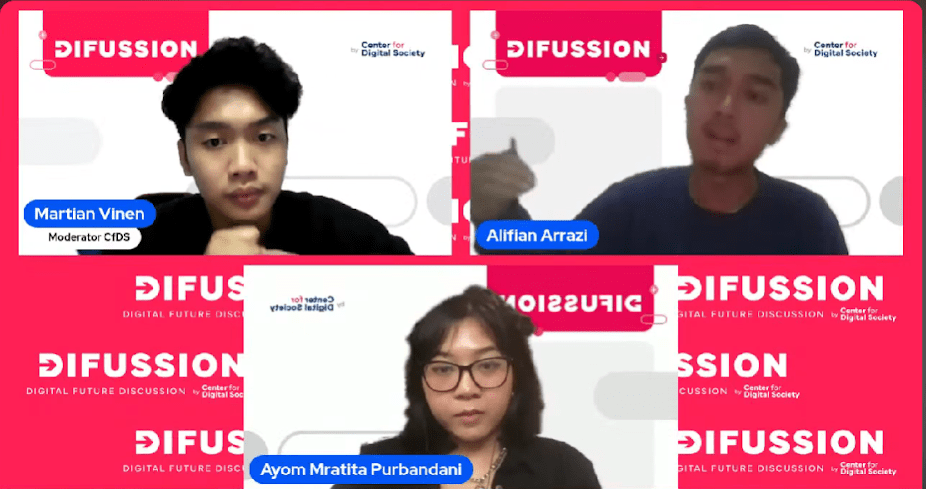
Discussing the role of AI in elections, Ayom highlights at least there are two perspectives that underscore the significance of this issue. Firstly, AI is perceived as a potential threat that could manipulate individuals’ electoral choices. For instance, the emergence of AI-generated buzzers or cyber troops produces fictitious and manipulative content, leading to the polarization of public opinion towards specific political actors on social media platforms.
On the contrary, the second perspective regards AI as an affirmative technology. Ayom explains, “AI has the potential to foster more open and inclusive elections by leveraging its capabilities to analyze voter sentiment and candidate campaign strategies.” Nevertheless, she added, there is still a need to form a regulatory framework to mitigate risks arising from AI developments and to strengthen democratic principles in the context of elections.

Alifian also contributed to the discussion by elaborating on various regulations governing the procedures for utilizing AI during the 2024 elections in Indonesia. For instance, Law No. 35 of 2014 on Electronic Information and Transactions (UU ITE) the ITE Law no. 35 of 2014 by Kemenkominfo regulates disinformation content and hate speech emerging from AI, PKPU No. 33 of 2018, Law issued by the KPU no. 7 of 2017, and so forth. Although they do not directly address the use of AI, these regulations can, at the very least, diminish the risk of AI adversely affecting democracy during elections in Indonesia.
At the end of the discussion session, Alifian emphasized the necessity for further regulation of AI usage in Indonesia. Additionally, he highlighted the importance of enhancing multi-stakeholder collaboration to formulate comprehensive and responsible AI governance. “It is hoped that these steps, including further policy formulation and collaboration initiation, can contribute to fostering accountability and preventing AI manipulation in Indonesia’ future elections,” concluded Alifian.
Diffusion #107 represents CfDS’s commitment to addressing the challenges of Indonesian democracy amidst the complex developments of AI. This also aims to positively influence political actors in creating policy, enhance public understanding, and support the sustainable development of AI through Indonesia’s democratic values.
