- 07/12/2023
- Category: Press Release
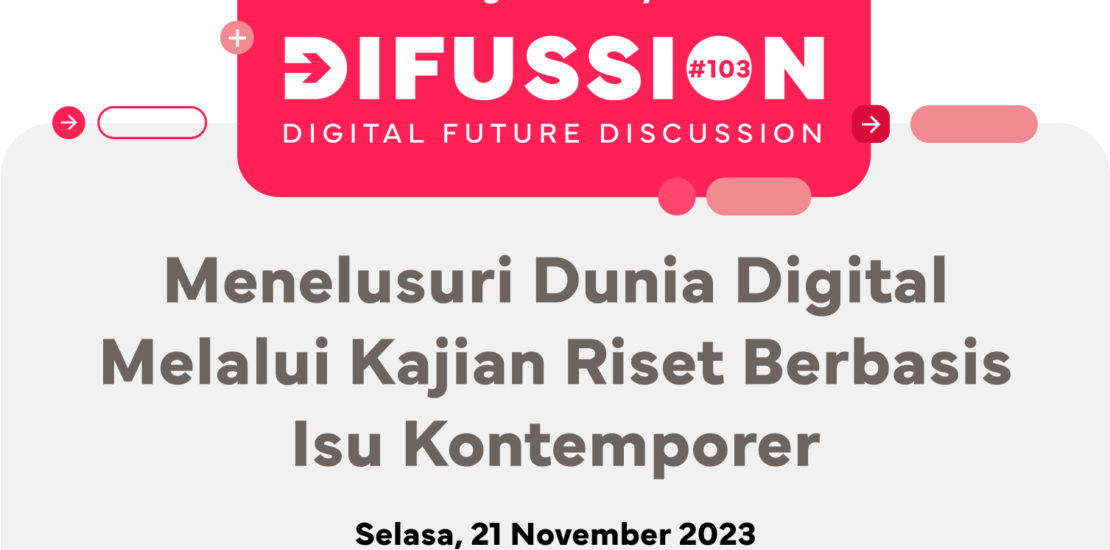
Yogyakarta, November 21, 2023 – Digitalization promises substantial benefits, including enhanced mobility, improved energy efficiency, and the thriving of companies. However, it also presents complex challenges, including new divides related to access and control of data, the evolving concept of humanity in a world shared with sophisticated artificial intelligence, and the task of discerning knowledge and truth amidst an overwhelming influx of information. These challenges bring forth multidisciplinary issues encompassing power, culture, governance, and social dynamics. In response to these, Center for Digital Society (CfDS) UGM presents Difussion #103: “Exploring the Digital World Through Contemporary Issue-Based Research Studies” divided into 2 sessions. The first session of Diffusion #103 was held on Tuesday (21/11/23) at BRI Works, Faculty of Social Political Science (FISIPOL) Universitas Gadjah Mada (UGM) addressed the topic “The Permeation of Artificial Intelligence in the Academic and Creative Field”. This event featured Ayom Mratita Purbandani, Valentino Yovenky Ardi, Emira Anjani, and Natasha Fortunata (Research Intern CfDS) as a speaker, moderated by B.R.A. Kusuma Maharani (Community Outreach Intern CfDS).

Mind Perception in the Appreciation of AI-generated Artworks
Creative artificial intelligence (AI) has garnered significant attention in recent years. Artworks that are introduced to be generated by AI, rather than created by a human artist, are often subject to negative evaluations. Through this discussion session, Emira and Natasha successfully ignited an engaging dialog regarding the dynamics of utilizing AI in artwork. According to them, one of the milestones that differentiates digital art from AI Art is the Generative Adversarial Networks (GANs). This encompasses the ability to create new and unique works of art that were previously unseen data that is similar to existing data. Emira mentioned that the evaluation or assessment of artwork is not limited solely to its quality but also extends to its creator.
In this discussion, Emira and Natasha presented brief research findings concerning students’ perceptions of AI art. The disagreement about the authenticity of AI-Art was the most common response among the study’s respondents. This includes opinions emphasizing human elements or aspects related to humans in artwork. “Without knowledge about the artist, assessments of agency and experience become limited, thus narrowing the space for the manifestation of tendencies to judge based on the artist,” concluded Natasha.
The Essay: Use of ChatGPT Amongst Humanities and Social Science University Students
AI-based tools such as ChatGPT and GPT-4 are presently reshaping the university landscape, prompting considerations in many areas about the potential consequences for future teaching methods and assessments. This discussion was started by Ayom, who explained speculations arising from the impact of ChatGPT’s ease in producing written content. To comprehend technological determinism and pre-existence responses toward technology adoption in education, she emphasized that ChatGPT appears as a ‘genie-in-a-bottle’, where humans can ask but cannot control the outcomes.
Valentino demonstrated the adoption patterns of ChatGPT in academic essay assignments examined through a brief research concerning students’ daily perspectives as subjects in the midst of this change. The research findings revealed at least three groups in responding to ChatGPT’s presence: adoptionists, pragmatists, and conventionalists. This typology reflects diversity in how social-humanities students respond to and adopt ChatGPT. It also indicates that not all respondents, or 100% of students, used ChatGPT to write academic essays. “Each student has their tensions in adopting and using ChatGPT,” added Ayom.
In conclusion, Ayom conveyed that perceptions regarding technology adoption in education are not solely negative as often accused in opinion pieces discussing ChatGPT disruption. Instead, it calls for a more careful and responsible approach.
Author: Putri Nara Mustika
Editor: Allysa Putri Rendry
