- 26/10/2023
- Category: Press Release


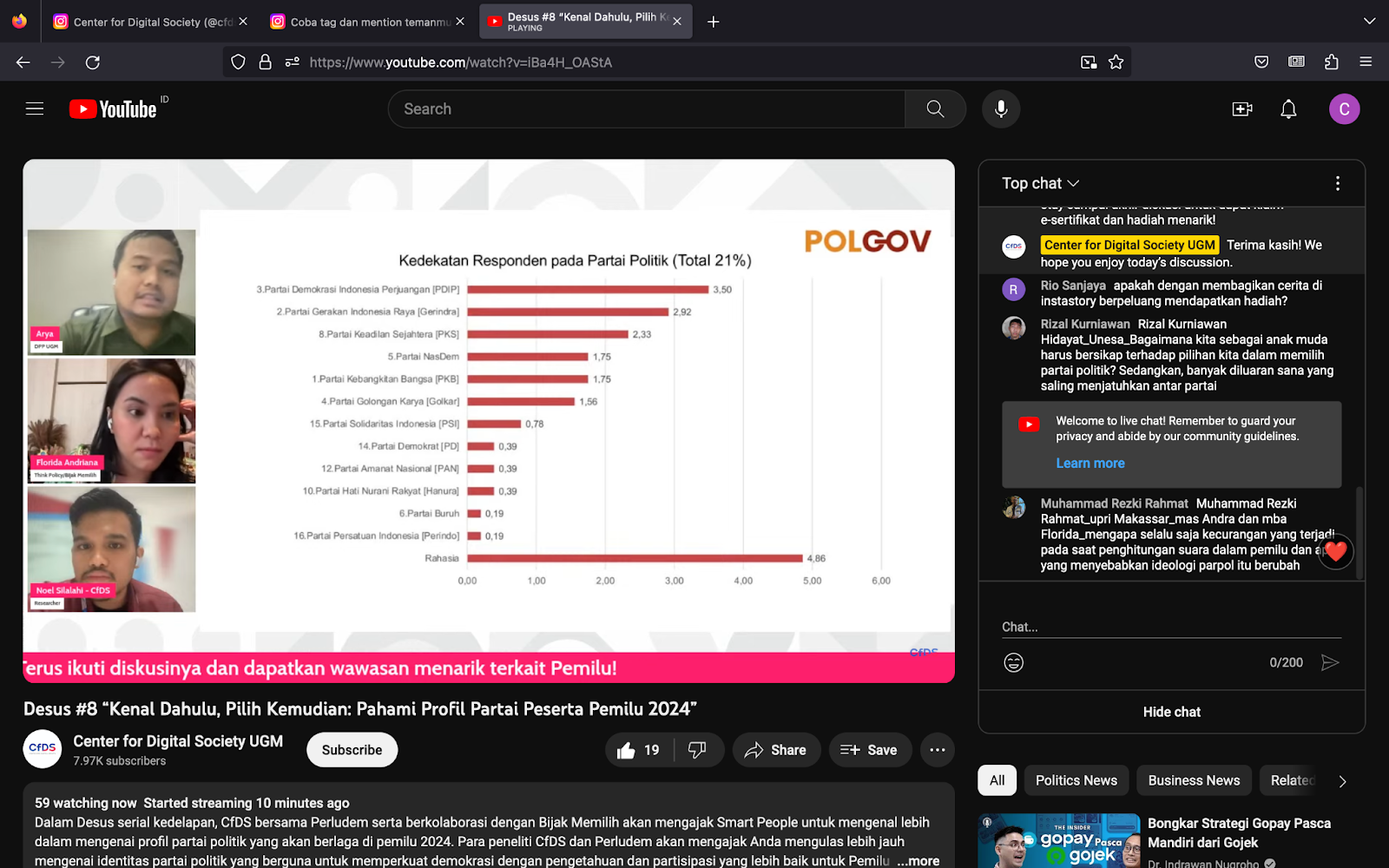
Yogyakarta (25/10/23) – Approaching the 2024 general election, currently, Indonesia’s political scene is increasingly dynamic. From the interesting actions of many political parties to the efforts of political figures to win the hearts of voters, everything is recorded in the mass media and discussed by various groups. However, there is an intriguing trend in Indonesia, where public trust in political parties is consistently low, and people tend to be apathetic towards political parties. In response to this phenomenon, the Center for Digital Society (CfDS) UGM, in collaboration with the Association for Election and Democracy (Perludem) and Bijak Memilih, held a Desus #8 discussion forum entitled “Know First, Choose Later: Understanding the Profile of Parties Participating in the 2024 General Election”. The event was held online on Wednesday (25/10) through the Youtube Live channel of CfDS UGM and Perludem, inviting speakers such as Arya Budi, a researcher at the Research Center for Politics and Government (PolGov) UGM and lecturer at the Department of Politics and Government (DPP) UGM, and Florida Andriana, as the co-initiator of Bijak Memilih.
The discussion began with Arya Budi’s presentation regarding the concept of “Party ID” and the phenomenon of the poor implementation of this concept in Indonesia. According to Budi, “Party ID” is the way people identify themselves with certain political parties, as well as the depiction of people’s affinity to certain political parties. Budi was involved in a survey that discovered that only 21 percent of college student respondents felt close to a political party, in comparison with 42 percent who felt close to a presidential candidate figure. This trend is due to the phenomenon of “personalization of politics” in Indonesia, which began in the era of TV broadcasting, the election system in Indonesia, as well as the development of the digital environment and new media, which enable direct interaction with political figures.
Subsequently, Florida Andriana discussed the issues faced by young voters, the group that makes up the majority of the electorate in the 2024 elections. Some of these problems include: (1) Lack of framework in political decision-making, (2) Unbalanced focus on individual figures instead of system reform, (3) Misinformation, disinformation, and bias, and (4) Pessimism and cynicism resulting in a self-fulfilling prophecy. In her presentation, Andriana discussed how Bijak Memilih helps young voters overcome these problems.
This discussion was followed by Budi’s discussion on the ideology offered by political parties in Indonesia nowadays. Back in the 1955 election, political parties in Indonesia were very ideological in character, with a loyal voter base. However, this trend has changed drastically since the New Order era. Subsequently, the trend of “politik aliran” and the practice of “consociational democracy” began to emerge in Indonesia, where the ideology of various parties moved to the center (de-ideologization of parties). Each party claims to be pro-people and nationalist-religious, and has a similar community base (such as the Islamic wing, the youth wing, and the “mothers” wing), thus, the indicators that distinguish political parties have become blurred.
Furthermore, Florida Andriana discussed several aspects that need to be considered in determining the choice of political parties during elections. She discussed that voters need to reflect on issues that are considered important and personally concerning to them. Then, voters need to consider the system within the political party and the individual political figures in formulating their choices. She analogized the election to a collective dynamic: “Remember, this is not an individual work, this is a group work”. Beyond what is being displayed by political figures, voters need to put other considerations that are crucial for the future of Indonesia over the next 5 years.
Finally, Indonesian voters need to put more effort into formulating their choices for the elections, beyond the outward appearance of political figures. Through consideration of the issues prominently addressed, the ecosystem of political parties, and the track record of political figures and political parties that endorse them, it is hoped that Indonesian voters will be able to vote in a more mindful and careful manner. Political participation is not only in the form of attendance at polling stations during the election, but also in the form of public control after the election. “There will be a possibility of a change in the party’s position after the election, but what we can do is to exercise public control over the policies they issue,” said the speaker.
Author: Carmelia Gaby Talia
Editor: Allysa Putri Rendry
