- 11/08/2023
- Category: Commentaries

Author: Raisa Rahima
Editor: Alfredo Putrawidjoyo
Jamet, Hyungers and Digital Identity
The phrase “internet meme” is commonly applied to describe the propagation of content such as jokes, rumours, videos, or pages from one person to another via the internet. Based on this popular notion, an internet meme is propagated in its original form and often spawns user-created derivatives.[i] This propagation is mediated by the definition of a meme that stands as a cultural unit or medium that carries cultural elements that are shared from person to person.[ii]
In defining memes as cultural items and propagation mediums, there are joking meme contents such as “jamet” and “hyungers” that often cross social media timelines. These cultural items, often intended as netizen “consumption material”, are produced solely as meaningless entertainment to fulfil the function of the meme medium as a carrier of cultural information or phenomena.
By consuming these memes as entertainment content and jokes, internet users will generally consume jamets and hyungers as particular groups of people who carry the humour of the culture they present. But this “humorous” element of jamet and hyungers presentation does not come intentionally.
Before the production of terms such as jamet or hyungers in cyberspace, there were people who lived with culture and habit x ( with x being a social phenomenon as meme information content). The meaning of these traits differs from what is replicated on social media: For example, the meaning and intention of jamet is often attributed to the traits/meaning of people with “bad” cultural preferences that evolved into a synonym of geeky. They are someone who wants to be cool by styling like metal heads but instead do not give a cool impression.[iii] In the case of hyungers, they also have a label as annoying netizens whose opinions are always biased and have stereotypes of hijab-wearing K-popers who like to consume mil coffee and seblak.[iv]
The meaning of jamet and hyungers has undergone a symbolic transformation where “jamet” and “hyungers” do not present themselves as real people but as symbols that are present in cyberspace for the sake of cultural propagation (in memes). Here, memes operate what Richard Dawkins (1941) calls a memetic process: The transmission of cultural units. Memes work as cultural transmission units, exactly like the idea of replicators. A replicator is an indivisible proportion of biological or chemical singularities. This molecule works like a template and has the capacity to create a mould of itself.[v]
In memes, the meanings of the original people behind the jamets, hyungers and other digital identities are replicated by carrying meanings that are completely different from the original meanings that denoted them.
By comprehending the formation of these digital identities, we can better grasp how memes contribute to the spread of a specific digital identity, culture, and mindset. This particular digital identity, represented by the variable ‘x’, encompasses the stereotypes ingrained in the digital society. Initially, when encountering such memes, individuals within the digital society perceive this digital identity as merely humorous content. However, a crucial aspect often overlooked in digital communication is why we tend to establish a sense of separation from them through laughter and amusement derived from digital identity x memes.
The consumption of this meme presupposes us to adapt y’s culture and way of thinking (where y is a reflection of social phenomenon x or an alternative way of thinking and culture to y): We refuse to behave like jamets and we refuse to think like hyungers. Thus, the consumption of memes will shape the personality of the user communicator in cyberspace.
Memes are not a Humor Medium, Memes are an Activity
According to Marshall McLuhan (1939-1980), it is impossible to understand cultural and social change without knowledge of how the media work.[vi] The cultural changes in society that now tend to be oriented towards the capitalistic spirit of “time is money” are the memetic and symbolic effects of Alva Edison’s invention of the light bulb. The light bulb is interpreted more as something that “causes productivity” than a “room lighting medium”. As a result, the “effect” of the medium contains more messages or meanings than the “medium” itself.[vii] In cyberspace, we recognize so many new meanings reproduced from social media. A medium can have an effect on the behaviour or nature of the media consumers themselves. Another example is Instagram User Interface design as a medium that can trigger society’s hedonistic nature and competitive culture.
Drawing from McLuhan’s thinking, we can see how memes as a medium are more meaningful in their effect: Society tends to dichotomize groups with x cultures and ways of thinking based on y parameters.
What is then interesting to explore further is what are these y parameters. What are the standards agreed upon by the cyberspace community to make these social classifications?
The Girls that get it… .get it… The Girls that don’t, don’t
The process of cultivating a culture and way of thinking for the digital society can be explained by how they access transparent social media. This transparent nature allows social media users from different backgrounds to conduct digital communication where there is exposure and exchange of information on a massive amount and scale.[viii] Among the many exposures and exchanges of information is the exposure to memes x, which will then change their personalities in culture and ways of thinking y.
The cultivation of culture and way of thinking is exactly what Thomas Kuhn (1922-1996) calledParadigm Shift in The Structure of Scientific Revolution (1996). Kuhn said that the paradigm of science is always changing when anomalies appear in a scientific activity that cannot be resolved in science paradigm A inevitably, the paradigm will change to science paradigm B accumulatively. We used to recognize the geocentric theory, now, we recognize the heliocentric theory. By the same mechanism, cultures and ways of thinking transform paradigmatically. Trends usually mark such paradigm shifts.
This paradigm shift from A to B can be demonstrated by how in the middle of the 2010s, digital society was so close to liberal culture and popular-science-oriented thinking. Many digital citizens base their personalities on Western culture as well as rational-scientific thinking. Popular science books such as Yuval Harari’s Homo Sapiens (2011) greatly impacted the populist promotion of rational-scientific thinking. However, with the emergence of anti-popular book memes (such as Yuval Harari’s Homo Sapiens ), society excludes the populist personality because it is the personality of Jakarta’s liberal university student (so the stereotype goes).
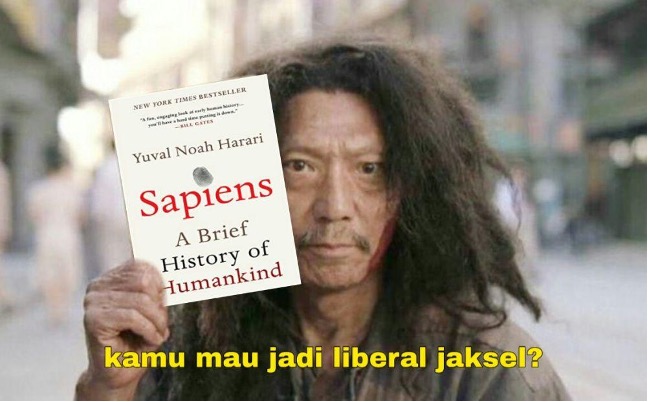
But of course, the effect of the meme medium is not to denote a specific cultural paradigm or academic climate (in the sense of a structural cultural paradigm shift). This medium effect is specific to the digital society. When they encounter the consumption of memes containing symbolic identities with the propagation of x culture and way of thinking, they tend to adapt y culture and way of thinking to better blend in with other digital communities. This process initiates a new trend of y culture and way of thinking. Gradually, a paradigm shift from A to B occurs: the digital society begins to adapt its personality to the culture and way of thinking y of its fellow netizens in an effort to fitting-in in the digital communication space. That way, internet personalities adapted to the mere activity of consuming memes.
To demonstrate the latest case, one can look at digital identities that have recently crossed Twitter’s homepage since the beginning of April 2023. The digital identity is “nuruls”, which is reserved for heterosexual women, the majority of whom are Muslim, and still adhere to traditional beliefs because they grew up in a religious environment.[ix]
After consuming memes of nuruls, hyungers, jamet, and Homo Sapiens students who stand as digital identities, we will tend to use alternative cultures and ways of thinking y that become the antithesis of all these digital identity stereotypes. Thus, memes also shape the personality of digital society and implicitly also contribute to cultivating cultures and ways of thinking y (for example, thoughts that tend to be anti-heterosexual narratives in the case of nuruls) to then, in the future, become memes again, and continue to rotate in a paradigmatic cycle.
Conclusion
Memes as joke items provide artificial and stereotypical identities for x groups of people. Netizens’ behaviour towards these symbolically created identities from memes is that they tend to dichotomize the artificial groups produced by memes. This tendency is based on the assumption that social media creates certain intellectual and cultural paradigms for fellow users to follow: memes are memetic tools to replicate information based on these paradigms (memes have a symbolic role).
[i] “In the vernacular discourse of netizens, the phrase “Internet meme” is commonly applied to describe the propagation of content items such as jokes, rumors, videos, or websites from one person to others via the Internet. According to this popular notion, an Internet meme may spread in its original form, but it often also spawns user-created derivatives“, cf. Limor Shifman, Memes in a Digital World: Reconciling with a Conceptual Troublemaker, Jerusalem: Journal of Computer-Mediated Communication (18), 2013. p. 1
[ii] “Webster’s New World College Dictionary defines a meme as “a concept, belief, or practice conceived as a unit of cultural information that may be passed on from person to person, subject to influences in a manner analogous to natural selection“, cf. Alexis Benveniste, The Meaning and History of Memes, Accessed April 14, 2023, from https://www.nytimes.com/2022/01/26/crosswords/what-is-a-meme.html
[iii] “The meaning of the word jamet is someone who wants to be cool by looking like a metal kid. The term jamet is given to those who look physically like metal band members, using accessories, clothes, and makeup typical of metal kids, but this appearance does not give a cool impression. On the contrary, the impression that arises when seeing someone is far from cool, so that the community considers it necessary to give its own nickname“, cf. Nandy, Definition of Jamet and other terms, Accessed April 14, 2023, from https://www.gramedia.com/best-seller/pengertian-jamet/
[iv] “Through this viral meme (hyungers), we can see that hyungers are stereotyped as hijab-wearing K-popers who like to consume milk coffee and seblak. This stereotype illustrates the relationship between gender (in this case women) and certain types of food“, cf, Cxomedia.id, Food Gender, Is It Really a Stereotype?, https://www.gramedia.com/best-seller/pengertian-jamet/
[v] “The new soup is the soup of human culture. We need a name for the new replicator, a noun that conveys the idea of a unit of cultural transmission, or a unit of imitation….I hope my classicist friends will forgive me if I abbreviate mimeme to meme“. Cf. Richard Dawkins, The Selfish Gene, USA: Oxford University Press, 1989. p 171
The context of the description of replicators working as templates is explained by Dawkins on page 20:
“Actually a molecule that makes copies of itself is not as difficult to imagine as it seems at first, and it only had to arise once. Think of the replicator as a mold or template. Imagine it as a large molecule consisting of a complex chain of various kinds of building block molecules“
Dawkins’ context then explains how memes work exactly as genes are further explained in the memes chapter on pages 171-173.
“Fundamentally, the reason why it is good policy for us to try to explain biological phenomena in terms of gene advantage is that genes are replicators. For more than three thousand million years, DNA has been the only replicator worth talking about in the world.” ….Imitation, in the broad sense, is how memes can replicate. But just as not all genes that can replicate do so successfully, so some memes are more successful in the meme-pool than others. This is the analogue of natural selection“
[vi] “Societies have always been shaped more by the nature of the media by which men communicate than by the content of the communication. The alphabet, for example, is a technology that is absorbed by the very young child in a completely unconscious manner, by osmosis so to speak. Words and the meaning of words predispose the child to think and act automatically in certain ways. The alphabet and print technology fostered and encouraged a fragmenting process, a process of specialization and of detachment. Electric technology fosters and encourages unification and involvement. It is impossible to understand social and cultural changes without a knowledge of the workings of the media“, cf. Marshal Mcluhan & Quentin Fiore, The Medium is the Message: an Inventory of Effects, CA: Gingko Press, 2001. p. 4
[vii] “The medium, or process, of our time-electric technology-is reshaping and restructuring patterns of social interdependence and every aspect of our personal lives. It is forcing us to reconsider and re-evaluate practically every thought, every action, and every institution formerly taken for granted. Everything is changing-you, your family, your neighborhood, your education, your job, your government, your relationship to “the others.”. And they’re changing dramatically”
Mcluhan explains in the chapter “amateur” on page 92 how Michael Faraday’s discovery of electric induction has more effect on the distinction between an “expert” and an “amateur“. In writing, the trend of “expertise” is analogous to the trend of “productive” in the medium of lamp invention (in the original example of the invention of electric induction).
“Faraday’s ignorance of mathematics contributed to his inspiration, that it compelled him to develop a simple, nonmathematical concept when he looked for an explanation of his electrical and magnetic phenomena. Faraday had two qualities that more than made up for his lack of education: fantastic intuition and independence and originality of mind.”
“Professionalism is environmental. Amateurism is anti-environmental. Professionalism merges the individual into patterns of the total environment. Amateurism seeks the development of the total awareness of the individual and the critical awareness of the rules of society. The amateur can afford to lose. The professional tends to classify and to specialize, to accept uncritically the groundrules of the environment. The groundrules provided by the mass response of his colleagues serve as a pervasive environment of which he is contentedly and unaware. The “expert” is the man who stays put.”
[viii] Byung Chul-Han in The Transparency Society (2015) says that digital society has been living in a transparent digital world that allows exposure and exchange of information on a large scale.
“Today the growing, indeed the rampant, mass of information is crippling all higher judgment“, cf. Byung Chul-Han, The Transparency Society, California: Stanford University Press, 2015. Page 4
[ix] “In other words, the Nuruls are lower-middle class heterosexual women who still adhere to traditional beliefs because they were raised in a religious environment. They are exposed to conservative teachings on a daily basis, so they think that their understanding of the world is the correct one.”, cf. The History of the Nuruls, According to VICE. (n.d.). Www.vice.com. Accessed April 14, 2023, from https://www.vice.com/id/article/pkad78/sejarah-munculnya-sebutan-the-nuruls-menurut-penelusuran-vice
