
- 02/03/2021
- Category: Press Release
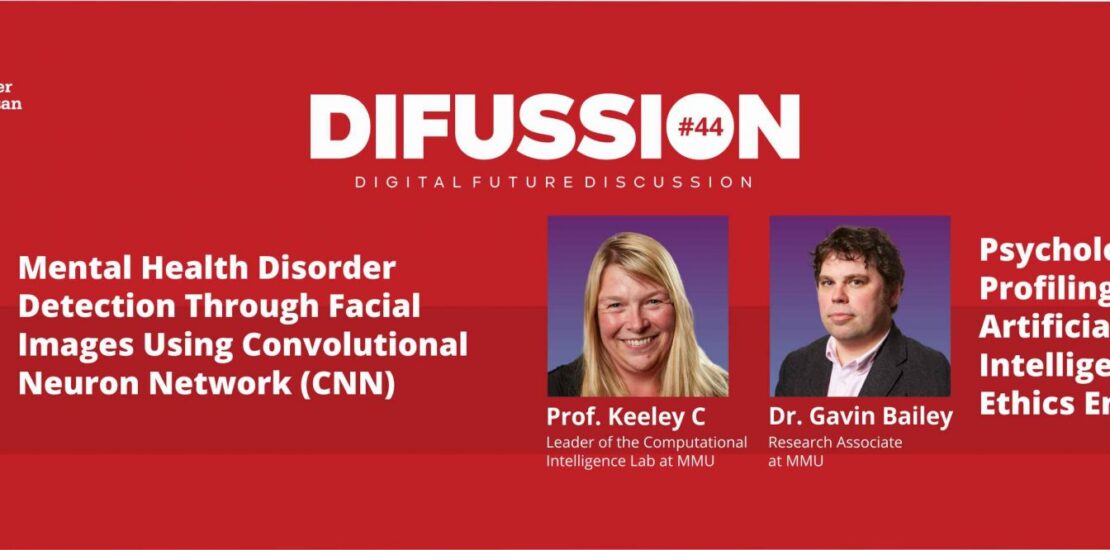
Yogyakarta, February 26th, 2020 – Center for Digital Society (CfDS) UGM, in collaboration with the Policy Evaluation and Research Unit (PERU) Manchester Metropolitan University, held a discussion about AI technology used in the scope of psychology. This discussion is part of Difussion titled Psychology with AI: Between Developmental or Ethical Issues and invited two representatives from CfDS and PERU to discuss their research regarding artificial intelligence. PERU representatives Keeley Crockett (Computational Intelligence Lab. Leader) and Gavin Bailey (Research Associate) are elucidating their psychological profiling research using artificial intelligence. On the other hand, Vidiskiu Kurniawan (Researcher at Digital Intelligence Lab CfDS UGM) and Moh. Edi Wibowo (Lecturer at Computer Science UGM) explain the use of AI to detect mental health disorder and also analyze the debate surrounding the ethics of AI adaptation. This discussion is moderated by Kevin Wong, the Assistant Director of PERU, and broadcasted live through the CfDS UGM YouTube channel.
Detecting Deception through The Use of AI
Keeley started her presentations by explaining the definition of psychological profiling. “Psychological profiling is an instrument commonly used in crime investigation to analyze someone’s non-verbal behavior as an effort to determine their mental state.”, Keeley stated. In correlation with crime investigation, psychological profiling can be used to determine whether someone is lying or not. Before AI, deception detection is done through tools such as polygraph, voice stress analysis, or even human-based detection. Keeley and her team developed what is known as automated deception detection, named Silent Talker, which can analyze someone’s non-verbal behavior through an interview and then determine whether they are lying or not. This machine also considers several factors at play that can influence someone’s non-verbal behavior during the interview.
In its application, this tool has experimented on Intelligent Border Control in the European Union scheme, which aims to speed land-border crossing and also enhance security with technological assistance. A border guard avatar is placed at checkpoints to interview travelers coming to the Schengen area. This experiment shows that Silent Talker has approximately 75% level of accuracy in detecting truthful behavior and 73% level of accuracy in determining deception. Besides, the AI technology in profiling can also be used to measure comprehension. The trials for the tools’ adaptation are used in the research context of clinical trials to tackle the AIDS epidemic in Africa by teaching the machine to differentiate between medical-related topics that need low or high comprehension.
In the debate regarding the ethical issue, Keeley explained that in the framework of European Union General Data Protection (GDPR), someone has the right not to be subject to the decision based solely on automated processing. They also have the right to ask for human intervention and to inquire about machine-based decisions, especially to those who became the subject of the utilization of artificial intelligence. Keeley also emphasized that AI should not have a bias in doing psychological profiling on humans. Therefore, the development concept should be based on the principle of diversity and inclusivity so that the compiled data for the machine learning process is more representative. “Sometimes, the system of AI also needs to be adjusted to ensure fairness,” Gavin added.
Mental Health Disorder Detection through Facial Images
Vidiskiu’s research is based on the stigmatization of society on mental health disorders. “By employing AI, mental health disorder can be detected only by reading non-expressive facial images through the utilization of convolution neural network (CNN).” His research is based on patterns that can be detected from someone who’s experiencing mental health disorder. Facial expression can sometimes be abstract, which led CNN to rely on the principle of correlation to predict mental health disorder symptoms. Vidiskiu gave an example, “someone who is experiencing depression with the symptom of insomnia will likely develop eye bags or black circles around the eye. Through this correlation method, it can be inferred that this person has depression.” However, this detection is highly dependent on the machine’s data so that when more data is acquired, the detection result will be more accurate.
Moh. Edi Wibowo as the lecturer from the computer science department mentioned that there are already several types of research that integrate AI to understand someone’s psychological condition. Some examples are facial expression recognition, micro-expression classification, and mood detection concerning music taste. Nevertheless, Edi emphasized that “Someone’s psychological profile is a part of their privacy, so things like that cannot be freely exposed.” With the advance of AI to detect someone’s psychological condition, this can generate the risk that AI may reveal sensitive information of their user. Therefore, in the data collection process for machine learning, consent from the participant is needed, and the participants should fully understand the process they undergo. Moreover, education for users about their data privacy is a necessity.
Writer: Aldo Rafi
Editor: Ruth T. Simanjuntak
