- 09/02/2021
- Category: Press Release
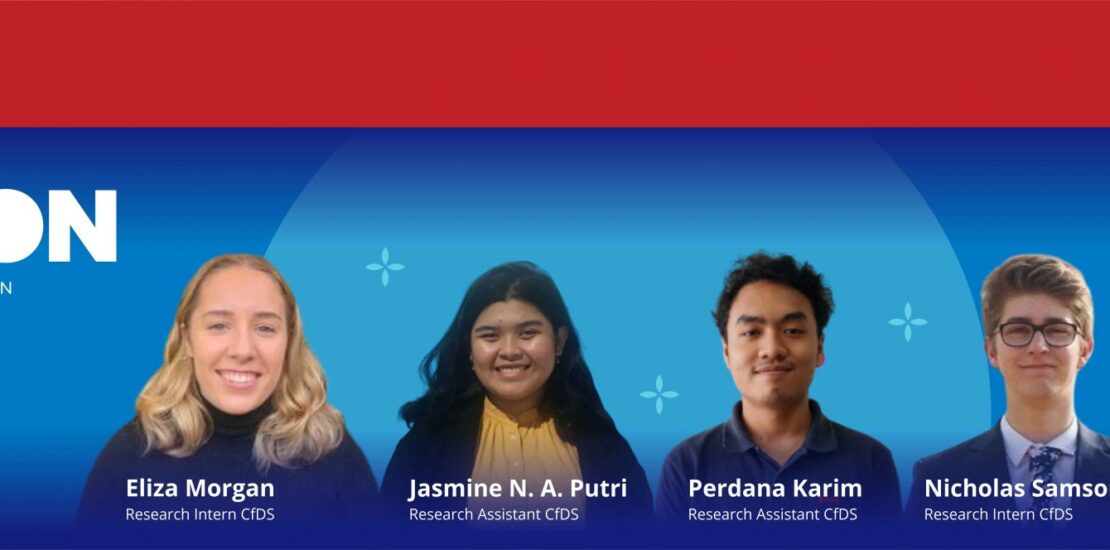
Yogyakarta, Friday 5th , 2021 Although it has been almost a year since the arrival of the Covid-19 case in Indonesia, the curve of viral infections in Indonesia is still increasing and showing no signs of decreasing. It is partly due to misinformation/disinformation issues and low digital literacy. Therefore, in the 42nd edition of Difussion, the Center for Digital Society (CfDS) invited Jasmine Putri and Perdana Karim as Research Assistants (CfDS) to exchange information with Eliza Morgan and Nicholas Samson from Australia, who currently are serving as Research Interns (CfDS) regarding differences in Indonesia’s and Australia’s responses to this issue. This event was held on Google Meet and broadcasted on YouTube.
Digital Culture and Covid-19 in Indonesia and Australia
Opening up the first session, Karim presented the Covid-19 case, which is still growing in Indonesia. The government’s inadequate response and corruption exacerbated the situation, while people are forced to adapt to an all-digital lifestyle without supporting digital infrastructure. By only implementing large-scale social restrictions in some areas, working from home and self-isolation are luxuries that most Indonesians cannot do, especially in informal sector jobs. This situation is in stark contrast to Australia, where the government imposed a lockdown in May 2020 and was reinstated in June 2020 in Victoria, known as the longest and tightest lockdown in the world. “Although the Australian government has implemented strict preventive measures with fines as penalties, they also provide incentive measures to support people who have been laid off as well as those who have no income, so that they are (still able to meet their daily needs,” Nicholas concluded.
Besides, Indonesia is still experiencing an increased curve in cases of infected people while Australia, on the other hand, has experienced a decrease in cases. Although there are no high hopes for the Indonesian government with its current track record, society has now
adapted to an all-digital lifestyle. As more and more people get used to working from home, this will become a new culture that can be sustained after the pandemic ends. Karim and Nicholas wish Indonesia and Australia all the best and urge to remain cautious about a second wave’s dangers, which is imminent this year.
Social Media and Covid-19 Misinformation: insight from Indonesia and Australia
Jasmine opened the session by comparing the various social media used to spread various types of fake news. According to Jasmine, the pandemic has led to an increase in the use of social media globally. However, fake news also increases rapidly and leads to infodemics that carry danger when it is misinterpreted. Misinformation/disinformation spreads six times faster than real news. In her presentation, Jasmine found that Facebook is the most popular platform for spreading fake news, followed by Twitter and messaging applications such as WhatsApp and Facebook Messenger. The topic is quite similar regarding the distribution of vaccines, prevention of Covid-19, and its treatment. Eliza explains that social media also contributes to the spread of fake news because the algorithm focuses on increasing usage statistics and user engagement in the ecosystem, regardless of how factual the news is.
As more people rely on social media to get the daily news, there have been efforts from the social media platforms to mitigate the issue and halting the spread of the news. Global institutions and member states also take part in taking action, such as the Indonesian and Australian governments’ efforts to create myth-busting pages through their websites to debunk misinformation from social media. Government collaboration with social media platforms to tackle the issue is seen as essential, especially with more fake news targeting the vaccine that is starting to be distributed internationally.
Because more and more people rely on social media to get the latest news, social media platforms present an effort to reduce and stop the spread of such misinformation/disinformation news. Eliza added that global institutions and member countries had played a part in taking action, such as the Indonesian and Australian governments’ efforts to create myth-busting pages through their websites to debunk misinformation from social media. “Collaboration between the government and social media platforms to solve this problem is seen as important, especially with the increasing number of fake news targeting vaccines that are starting to be distributed internationally,” said Eliza.
Author: Christophorus Ariobumi
Editor: Ruth T. SImanjuntak
