
- 14/01/2021
- Category: Commentaries

Having done preliminary research to prove that people essentially still seek or are involved with social relationships in mobile gaming through my previous article titled “Mobile Gaming in Indonesia: Relationships through New Media,” this survey result will prove further that it is indeed the phenomenon happening in Indonesia.[i] This survey is made from Google Survey and is distributed through various social media and gaming platforms such as Instagram, Facebook, LINE, WhatsApp, and Discord. It is also available for mass distribution, and it does not target any specific age. The only requirement needed to fill in this survey is for the respondent to have played or is currently playing any mobile games type. The purpose of this survey is to map out relationships in the context of mobile gaming to prove that people essentially still seek social interaction, even in mobile gaming, thus blurring the lines between “real life” interaction and those that happen within digital platforms. The survey targeted a minimum of 100 respondents to provide a sufficient numerical depiction of the data result.
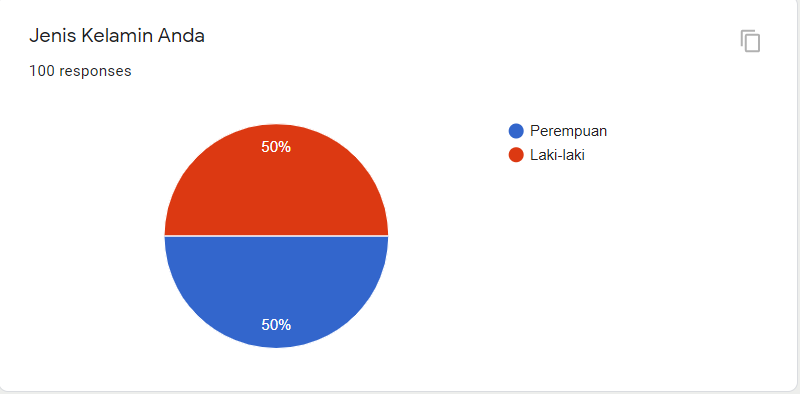
Figure 1 shows the percentage number of females (blue) and males (red) mobile gamers in the survey, out of 100 respondents.
Firstly, similar to the data provided by statista on mobile games in Indonesia, the percentage number of players in terms of gender is around equal. In this survey the result is shared evenly between males and females’ respondents (50% each) (See Figure 1).[ii] However, it is interesting to see how most players prefer to play as male characters than other genders (See Figure 2). Such result shows that male characters are the most preferred persona created in-game; this is interesting considering many game advertisements usually depict the availability of female characters more than males. However, despite the number of female characters available and chosen, players in this case still choose to depict themselves as a male character (53% of respondents) (See Figure 2).

Figure 2 shows the percentage number of respondents choosing to be any specific gender in the play’s games, red being males, dark blue being females, yellow, dark green, purple, light blue, and pink being any genders equally, and light green being omitting their gender.
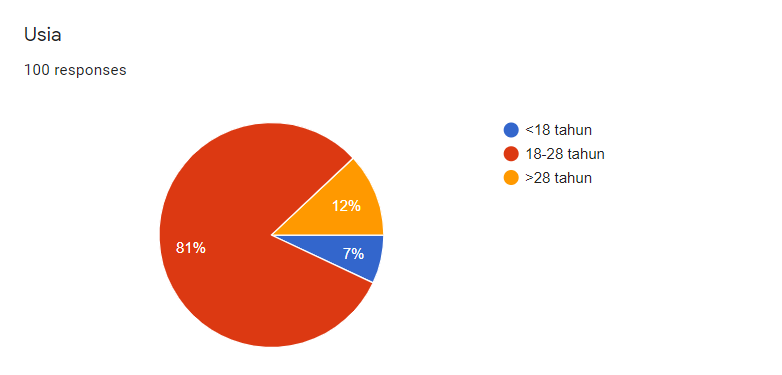
Figure 3 demonstrates the respondents’ age percentage, red being 18-28 years old, yellow being more than 28 years old, and blue being less than 18 years old.
Secondly, similar to Statista survey result mentioned previously, most mobile gamers in Indonesia are young adults to adults (See Figure 3).[iii] 81% of respondents are from the age of 18 to 28 years old, 12% from the age above 28 years old, and 7% under 18 (See Figure 3). What makes this result different from Statista’s survey data is that it also considers respondents under the age of 18 in the pie chart (See Figure 3). However, essentially the emphasis is similar, that most mobile gamers are young adults to adults. This proves further the previous article’s main argument that mobile gaming is more relatable to adults’ condition rather than that of children, perhaps to escape from real-life responsibilities or to simply take a breather from their “real life.”
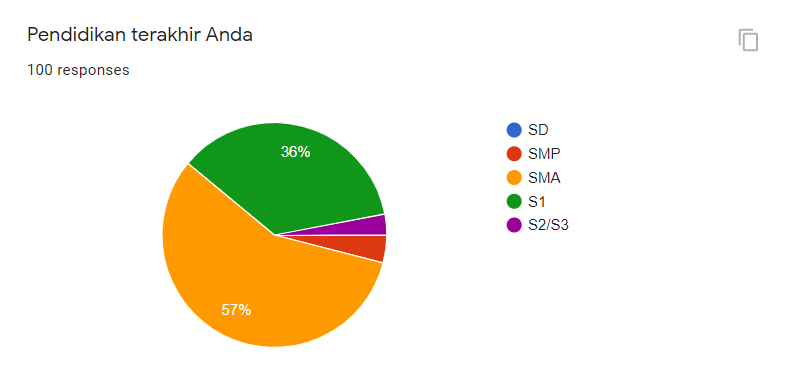
Figure 4 shows respondents’ education level, yellow being high school, green being bachelor, red being middle school, purple being masters or PhD, and blue being primary school.
Thirdly, most respondents do not go to university, as 57% obtained high school diplomas as their highest education level (See Figure 4). This data could relate to the concern over digital penetration and digital literacy rate in Indonesia. Widely, this article argues that digital society is very much visible in mobile gaming. Still, with increased digital penetration, interaction, relationship, and communication, another problem is seen, which is related to online interactions’ negativity. Concerningly, Indonesia’s gaming community is widely famous for their “toxic” players. This data could serve as one of the evidence to prove the hypothesis that the reasoning may be related to the players’ education level. Schools in Indonesia do not teach much about digital literacy, and such topics are more familiarly touched upon in university. Thus, without much knowledge on digital literacy, gaming toxicity may be created and fostered. To add, while many workplaces now emphasize and teach their full-time workers more on the importance of digital literacy through workshops or training, most of these respondents do not work in a full-time manner (See Figure 5). Most of them, in fact, do not work or do not have a job (40%), while 39% are part-timers and freelancers (See Figure 5).
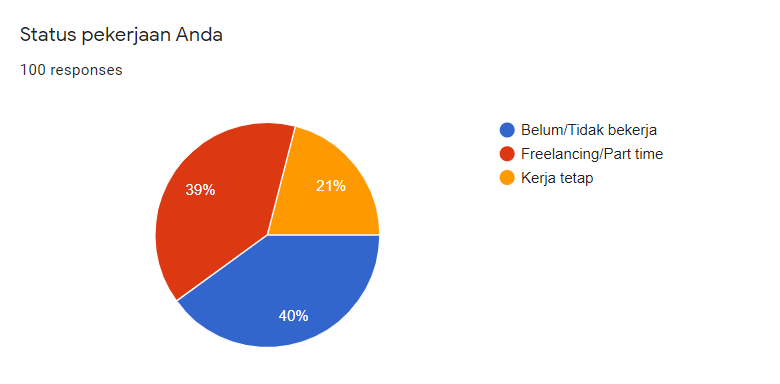
Figure 5 shows respondents’ employment status, blue being unemployed/have yet been employed, red being freelancing/part timing, and yellow being employed in a full-time job.
Fourth, most mobile gamers played Mobile Legends, around 69% of respondents, and PUBG Mobile, around 52% (See Figure 6). In this section, respondents are free to choose more than one game and they are welcomed to write the name of the game they played if it is not available. Most respondents have also spent more than two years playing their game; this is based on the game they played the longest (See Figure 7). This data shows how in general, games with multiplayer features are the most popular among Indonesian mobile gamers. These data also show how Indonesian tend to be loyal to the games they played (See Figure 7).
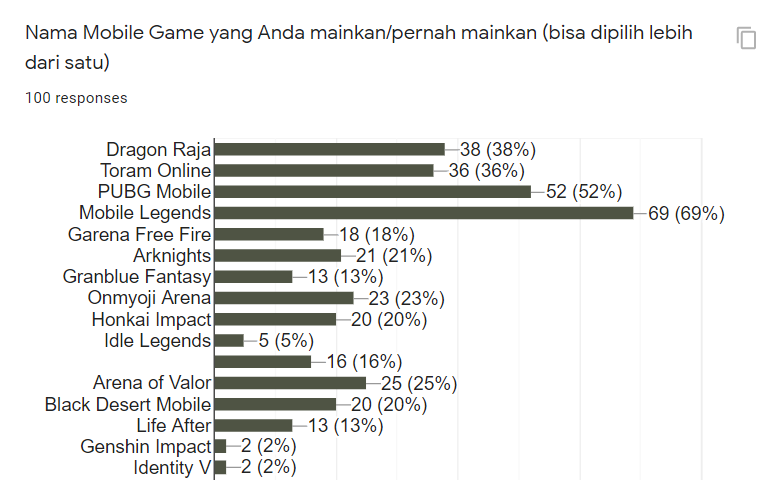
Figure 6 shows the type of games respondents played; this figure only shows games with 5% respondents results and more.
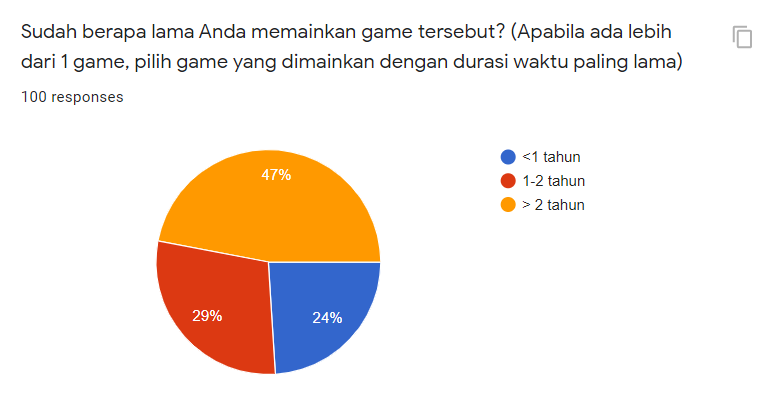
Figure 7 shows the number of years spent by respondents on their longest played game, yellow being more than 2 years, red being around 1 to 2 years, and blue being less than a year.
Fifth, the most popular reason why the respondents play mobile games is that they wanted to find a place to escape from reality (75%). This finding proves the previous argument that most mobile gamers, which are adults, play mobile games because they wanted to escape from “reality” (See Figure 8). Other reasonings that amount to more than 20% also highlight how most respondents play due to social-related reasonings or pressures (See Figure 8). This is further supported through the next figure, which shows how most respondents prefer to play their game in a “multiplayer” manner compared to solo (See Figure 9).
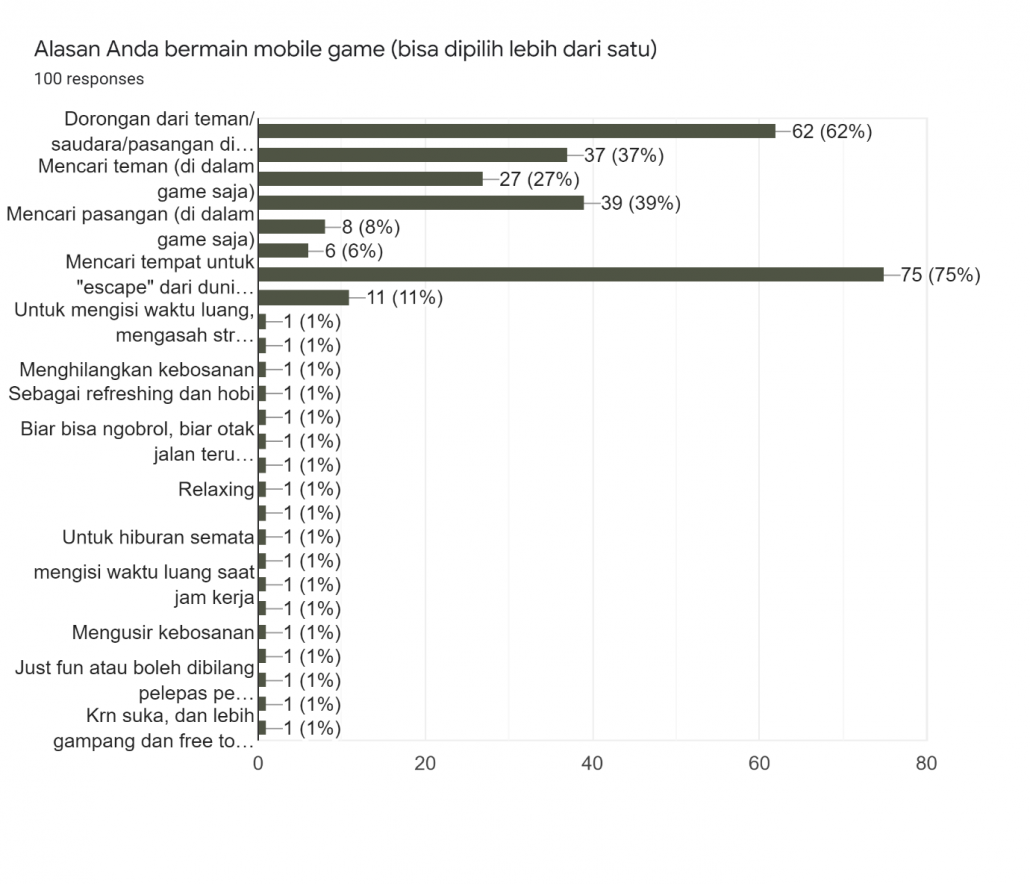
Figure 8 indicates the reason why respondents play mobile games. From top to bottom: 1. Encouragement from friends/relatives/romantic partners, 2. Finding friends in-game, 3. Finding romantic partners in-game, 4. Finding a place to escape from reality, 5. To spend free time, 6. To improve gaming/strategy skills, 7. To get rid of boredom, 8. To refresh and as a hobby, 9. To chat, to improve brain performance, 10. To relax, 11. For entertainment only, 12. To spend free time in-between work hours, 13. To get rid of boredom, 14. For fun, to release stress, 15. Because it is more fun and convenient
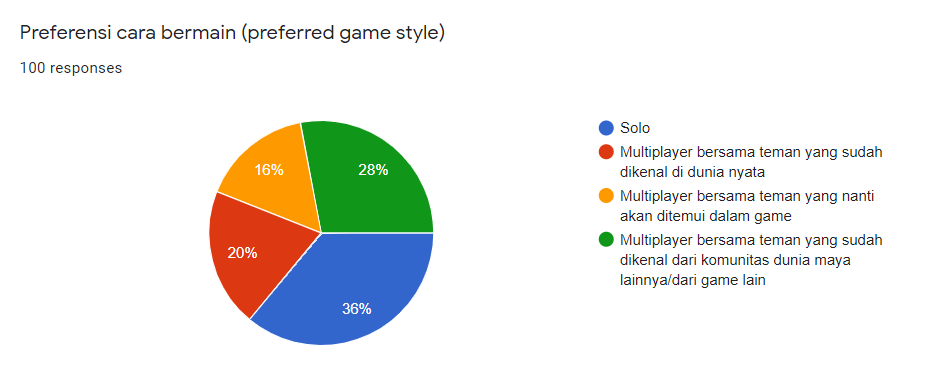
Figure 9 reveals respondents’ preferred game style, blue being solo, while other colors are multiplayer with different specifications. Red being multiplayer with people they already know in real life, yellow being multiplayer with people they will meet in the game, and green being multiplayer with people they know from other online or gaming communities.
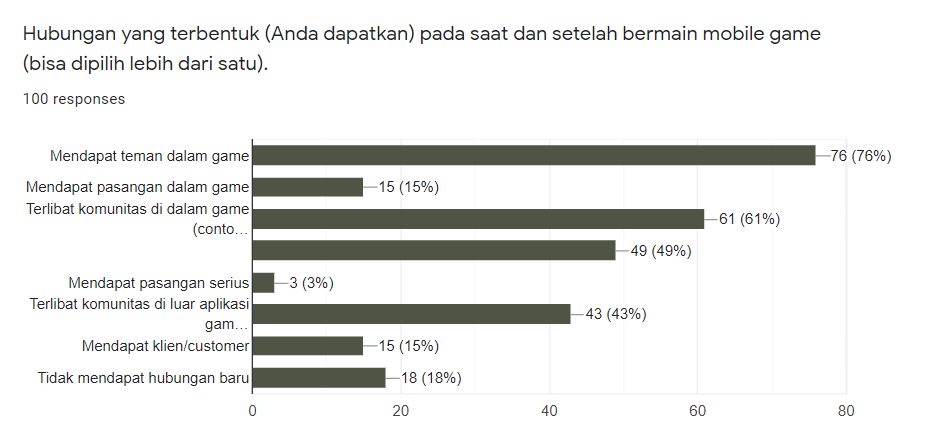
Figure 10 shows the kind of relationships made by players through mobile games, which are (from top to bottom): 1. Getting friends in-game, 2. Pursuing romantic partners in-game, 3. Participating in the in-game communities, 4. Having players that could be contacted outside game, 5. Courting serious romantic partners, 6. Engaging in gaming communities outside the gaming platform, 7. Establishing business/partnership network, and lastly, 8. Not getting any new kind of relationships through the game they play
Lastly, to further prove this article argues that relationship and socializing are now an integral part of the mobile gaming experience, only 82% of respondents have developed new relations with other players through the game they play (See Figure 10). The finding supports the main argument that people are essentially seeking or involving social relationships while playing mobile games. Such behavior blurring the lines between what is used to be exclusively deemed as fictional relation (those through digital platforms) and relations that came from the players “real life.”
References
[i] (Add link for the previous article, I can’t provide link as it is not published yet)
[ii] Statista. (2020). Mobile Games. Statista (online). Available at: https://www.statista.com/outlook/211/120/mobile-games/indonesia
[iii] Ibid.
