- 23/09/2020
- Category: Commentaries
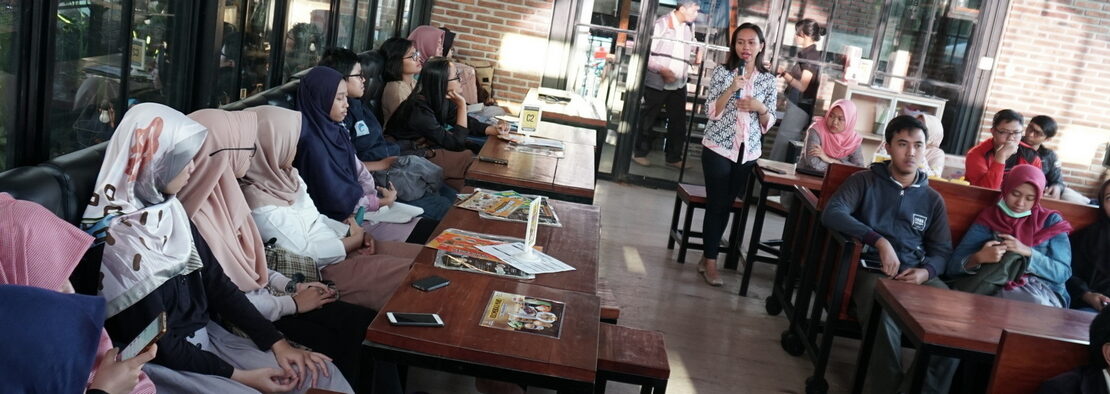
Yogyakarta, 9th May 2019 – Technological advancements have brought various types of innovations that are impacting on our demography. In the aspects of demography, there are several issues that are interesting to be studied, such as population and gender. Both of these issues have been directly affected by the existence of technology, and it was discussed in the 12th edition of Digital Future Discussion (Difussion), which was held by CfDS on 9th May 2019 at Warung Upnormal Yogyakarta.
Online Dating Apps & Its Effect to The Society’s Structure
Online dating application was firstly appeared in 1980. Since then, more and more people have found their romantic partners through the platform. It’s a unique phenomenom when before the existence of this application, most people found their romantic partners through their social relations in the real world. Uniquely, an American research revealed that along with the increase in people who find their romantic partners through online dating apps, the more frequent inter-racial marriages occur. Online dating apps make individuals pay less attention to the prejudices that exist in races, and if this phenomenom continues to occur, social inclusion figures will eventually increase. Great, a CfDS’ research assistant revealed, ‘In Asia Pacific, the number of ‘single’ people who use online dating apps reached 64%, while in Indonesia alone it reaches 46%. The ‘openness of opportunity’ aspect that is included in the online dating apps increases the likelihood of someone meeting a partner who has a difference, for example racial or ethnic differences’.
Deepfake & Violence Against Women
Deepfake is a video manipulation technology, which uses the ability of Artificial Intelligence to imitate someone’s shape and movement, without needing the presence of subjects to be imitated. Various types of concerns have arisen, considering that the technology has the potential to bring new types of cybercrime. In the next session, Bolby as CfDS research assistant explained the abuse of deepfake technology to create videos that involved identity forgery. For example, there was a manipulated pornographic video, so that the video seems to be “starred” by Scarlett Johansson, even though Scarlett Johansson never did that. Then what is the connection with violence against women? Bolby explained, the ‘fake’ porn video case confirmed that for most of the time, woman’s body had become an objectification of male fantasies. Especially in the realm of sexual issues, the majority of women are still often blamed, for example when there is a pornographic video being disseminated, the woman is usually the one to be blamed for. The presence of victim-blaming stigma that emerged from the society eventually triggered feelings of discomfort on the woman’s part.
Sex Education in Digital Era
When we talk about sex education, some views assume that the term ‘sex’ is being affiliated with personal matters that are taboo to be discussed. In fact, it is in sex education that we get scientific knowledge about how sexual relations work. For example, things like the aspect of cleanliness in sex, or even the role of ‘consent factor’ in preventing violence in a relationship are important things to be understood by the society. While other countries such as India and Malaysia have compiled sexual education curriculum for their young generation, there is still an ‘age gap’ between parents and children in addressing sexual education. Nevertheless, the presence of internet technology is able to provide very broad information resources regarding sex education. The breadth of information about sex education provided by the internet certainly must be filtered by parents, before the information is conveyed to the children. ‘Parents can choose sex education that is suitable for their children, as long as the parents do not feel that it is taboo to give the information to their child. The role of parents is important considering that there are various information on sex education in the internet that does not necessarily correspond to the age level of information access,” said Iko while closing the discussion session.
CfDS (Center for Digital Society) UGM is a multi-disciplinary research center that is established under the Faculty of Social & Political Sciences University of Gadjah Mada. This research center is built upon the concern over the contemporary dynamics of socio-political condition of the world that is accentuated by the impeccable influence of information technology. The phenomenon triggers the new patterns and complexities in the society, and thus requires new approaches in managing such complexities. Our research and other activities are based on spirits that is aligned with our motto, productive, innovative, & influential.
