- 27/11/2017
- Categories: Commentaries, Press Release
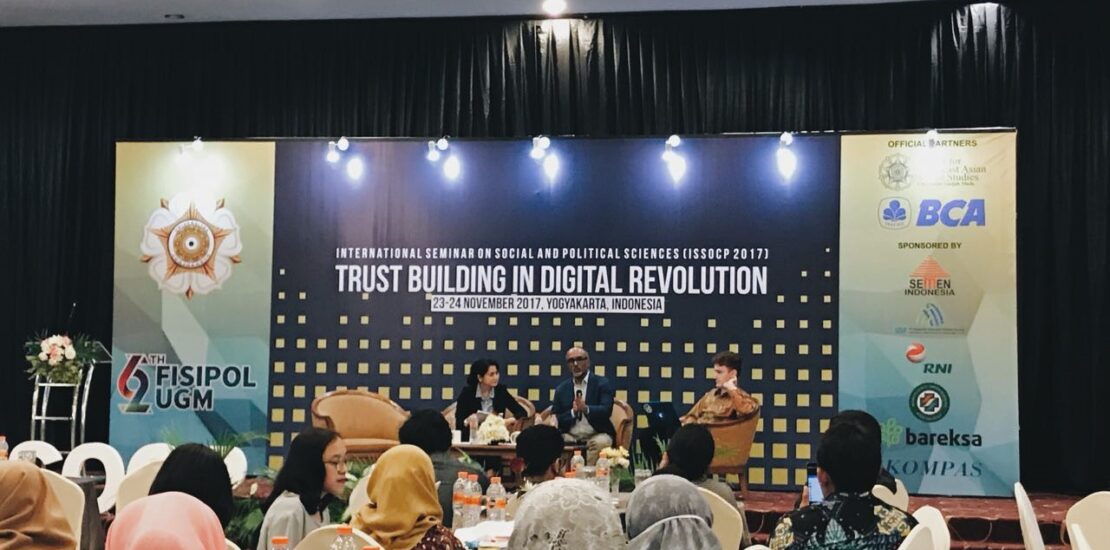
Yogyakarta, 24 November 2017 – On 23 – 24 November 2017, Center for Digital Society participates in the International Seminar of social and Political Sciences (ISSOCP 2017) with main topic on Trust Building in Digital Revolution. The seminar was attended by public and invitees from a variety of backgrounds, such as academia, the media, journalists, employees, and others. The event was formally opened with a welcome speech by the Minister of the Secretariat of State of the Republic of Indonesia, Prof. Dr. Pratikno who discuss the importance of digital democracy in fostering democratic principals that built the supportive environment of digital democracy.
In the first main plenary sessions, the event started with the leading statements of the panel moderator, Dr. Poppy Winanti, Vice-Dean of FISIPOL, Universitas Gadjah Mada and continued with a lecture by Prof. Dr. George Cherian from Hong Kong Baptist University. He talks about the manipulation of religious based information or identity based that occurred in both India and Indonesia. Later, Cherian argues if limiting the principle of freedom of speech is not the right solution to solve this problem. According to him, a more appropriate approach to do is by creating strong nationalism in a country with a multicultural society. The process towards the ideal stage is indeed difficult and we must be ready to deal with any friction that occurs. However, in the end we can create a solid nation when all elements of society have a high sense of nationalism for the reduction of ego tribal and each of these groups.
Afterward, the second speaker was Dr. Stephen Leigh Miller who is a visiting lecturer at the Faculty of social and Political Sciences of the Universitas Gadjah Mada. In his explanation, Dr. Stephen mentions plenty information about the phenomenon of ‘media spin’ and ‘ post-truth ‘ that is widely used by politicians (for example; Donald Trump and the phenomenon of Brexit) as a tool for winning elections by the popularity and gaining power from the society. Though, many use the manipulated information, Dr. Stephen argues if the power of the media spin also grows in line with the reality of social, political and economic development that occurred in the community. In the end, ‘misleading news ‘ thus gives great impact to society and still continues to this day.
The discussion was continued after lunch, filled by speakers from a variety of fields. Mr. Armand Hartono as Deputy President Director of PT Bank Central Asia Tbk., Ms. Karaniya Dharmasaputra, MPP as the co-founder of the Bareksa.com, and Mr. Dr. Kuskridho Ambardi as the head of the Department of Communication Studies, together discuss the influence of the digital revolution in the progress of many sectors. All three speakers represent the business sector, finance and economy, as well as the media. On the business side, Armand Hartono confirms that more innovations presented by today’s generation has bridged creativity and opportunity that ultimately sparks changes to the environment. For example, the phenomenon of seeking income by utilizing social media.
On the other hand, according to Kuskridho Ambardi, digital media also play a role in forming the opinion that finally affect the public reaction against particular case. For example, in the case of General Election, there are two television media that extensively spread the news related the competing candidates before the election started until the post-election, “…..it definitely raises a huge polarization in society of Indonesia,” said Kuskridho.
The second day of the ISSOCP 2017 focuses on the presentation of research carried out by the participants of the seminar. Presentation session is divided into four panel sessions with judges and moderators. Participants are chosen based on the selection of research proposal that has been carried out before the starting day of the seminar. Themes of research vary from issue of hoax news, hate speech, political literacy, citizen journalism, online representation, digital trust, and digital media. (Media Team of CfDS)
