
- 13/09/2017
- Category: Commentaries
In this day and age, social media has allowed us to be present online in order to experience our social life holistically. We are now able to share our lives on social media much more explicitly with features such as ‘checking in’ (geo-tagging), ‘automated tags’ (tags through facial recognition) and ‘stories’ (images and videos which last for 24 hours)—making sharing easier, enjoyable and intimate. What many users don’t seem to realize is how these features come at a price. In exchange for being able to use them for free, we pay with the newest digital currency: privacy.[1] Our private lives are much more exposed not only when we choose to use these features, but also when those around us casually upload images of us on their social media.
According to Pew Research Center, the percentage for Americans who use the Internet is 91% for parents, in comparison to 77% for non-parent adults. Within that 91%, 75% of the parents use social media.[2] With high numbers of social media users being parents, social media has affected parenting and the portrayal of children in the digital age.
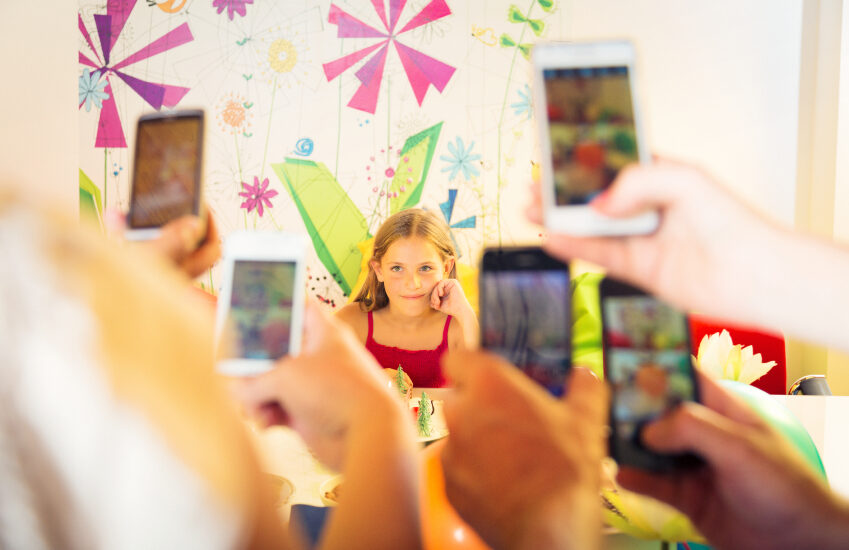
One phenomenon many parents in social media participate in is posting images of their children online, coined as ‘sharenting’. The average parent will upload 1,500 images of their child on social media by the time their child is five.[3] Many parents thoughtlessly upload images of their child enjoying a bubble bath or having a tantrum for not getting attention. Whilst this may seem harmless, it’s not without repercussion.
Though we may think not participating in ‘sharenting’ is paranoid and privacy settings keep our children safe, think again. Some known risks involved with sharing our children’s private moments on social media are embarrassment, cyber bullying, identity theft and digital kidnapping. According to a survey by eSafety, an Australian government official, images on child pornography sites were initially shared by parents on social media platforms like Facebook and Instagram. eSafety estimated about half of the 45 million images appeared to be sourced directly from social media.[4] One American mother discovered an Instagram account with images of her daughter, claiming to be an 11-year-old bisexual cheerleader. Though the image wasn’t rendered in any way, it was accompanied with sexually explicit content and at least eleven porn sites were tagged to the image.[5][AZ4]
Aside from the issue that parents themselves can contribute to their children being digitally violated, the main issue with ‘sharenting’ is that many parents are overlooking the children’s voice in the matter. Children do not give consent to their private moments being spectacled by an audience that averagely consists of 50% casual bystanders (colleagues, friends-of-friends, people we find aesthetically pleasing and the occasional stranger we had a conversation with once[6]).
However, even if parents decide to remove all the images they uploaded in the past, it is unclear whether the metadata will be removed on cyber space. There is also the issue that even if parents control how much or how little they expose their children digitally, they can’t always stop other people from uploading images of their children.[7] No parenting styles are the same, and not all parents want to completely stop themselves from ‘sharenting’. Asking your age-appropriate children, “Do you want other people to see this?” could be one way to start.[8]
Children may not know the implications of social media like adults do, but they have agencies of their own and they have a right to create their own digital footprint. Whilst social media has many benefits, including enabling many people to remain in communication in this once dispersed world, this new phenomenon is one with boundaries that still need to be clearly defined. How much of our private lives should we really expose. To what extent are parents willing to compromise their children’s security for the sake of social validation?
Picture: http://www.womenofgrace.com/blog/wp-content/uploads/sites/1423/2015/03/iStock_000027415006_Small.jpg
[1] CollegeHumor 2016, The Terrifying Cost of “Free” Websites, video, YouTube, 7 December, viewed 31 August 2017,
[2] Pew Research Center 2015, Parents and Social Media, Pew Research Center,
[3] Mangan, L 2016, ‘I don’t put pictures of my children on Facebook – and you shouldn’t either’, The Telegraph, 17 September, viewed 30 August 2017,
[4] Haelle, T 2016, ‘Do Parents Invade Children’s Privacy When They Post Photos Online?’, National Public Radio, 28 October, viewed 30 August 2017,
[5] Woodruff, D 2015, ‘Riverton mom finds kids’ pictures on porn sites’, KUTV, viewed 7 September 2017,
[6] Mangan, L 2016.
[7] Geddes, L 2014, ‘Does sharing photos of your children on Facebook put them at risk?’, The Guardian, 21 September, viewed 30 August 2017,
[8] Haelle, T 2016.
