- 17/04/2017
- Category: Commentaries
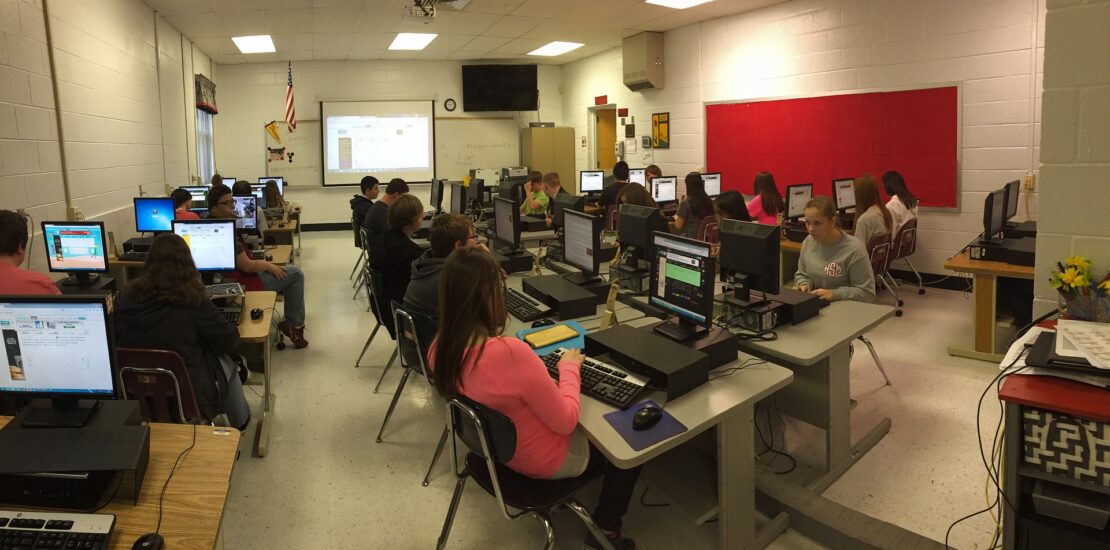
The way of transfer of knowledge that is under the spotlight this couple decade, e-learning, has undergone a drastic improvement ever since. It spans from ‘techy’ subject that involves technology, to a friendly and close-to-community kind of subject. We are highly aware of the shift from classroom learning, to learning that you could do in the very corner of your room, even everywhere, and that is great. Every online course on the web, the free or the paid ones, has never required you to be seated in a room physically along with the instructors and the other learners. There are unique attributes attached to e-Learning, which distinguish it from classroom learning.[i] Several distinctive characteristics of e-Learning are, among others, modality, personalization, and interaction.[ii]
Modality
The main difference between classroom teaching and e-Learning is the interactions between the instructor and the other learner. We can directly talk to a person in a classroom teaching, and there will always (or sometimes) be a controlled agent and a force to follow the learning program with the defined schedule. As for the e-Learning, the learners have their motivation not to be trailed behind a subject, in other words, they are on their own. They are not obliged to follow certain expectations on their educational activities.
Personalization
One of the deficiencies in classroom teaching is that sometimes, giving too much information in a relatively short time, it makes the learners having a hard time to focus and digest the information. e-Learning comes to tackle that away.”because learners could define their pace and duration. Additionally, e-Learning course is often set to smaller segments which .” it easier for people to grasp, especially for those who find their days crammed in other business. People with minimum free time could easily re-watch the course and learning material as if there is no problem at all.[iii]
Interaction
Social interaction between learners, colleague and instructor is the most interesting part in classroom teaching. Asking a question, doing a presentation, and other types of interaction certainly happen. But, that doesn’t mean that this kind of interaction is not embedded in e-Learning. It is, only in different ways. Studies of Karayan & Crowe[iv] and Smith & Hardaker[v] showed that online interaction triggers more participation along with more real discussion. This interaction happens via board discussion, chat, forum and video conference. The key is, the instructor has to act as administrator and also participant that has to join the discussion when needed.
The future of e-Learning?
Does the future of e-Learning develop as most people expected? Or is it just a trend in an era and would fade away as time goes on? The demand of e-Learning course would increase in the not-so-distant future, but not in a quick pace.[vi] The generation that is in charge of leading today is the generation that was born when there was no advance computing technology. We would see higher demands of e-Learning when Generation X and the millennial are the workforce generation in the future. They are used to the technology of such.
As the conclusion, the most important part to develop in e-Learning is interactions. A lot of people think that e-Learning is a bit ‘isolated.’ However, one thing can be developed for e-Learning in the future is an online facility of question and answer that lets the learners talk directly to a person via a network, which could very much maintain the social element in a learning progress that needs no meeting. This means that e-Learning only moves the learners and educators to a virtual space without diminishing the very essence of education and interaction. Learners can then be more integrated and engaged with both the facilitators and fellow students.
Picture: Pixabay
[i] Buckley, Fiona. (2011). “Teaching and Training”. Department of Government, O’Rahilly Building, University College Cork, Cork, Ireland. [online]. Available at: http://search.proquest.com.ezproxy.ugm.ac.id/docview/882570348?pq-origsite=summon. [Accessed 12 April 2017]
[ii] Davies, Jo, and Martin Graff. (2005). “Performance in E-Learning: Online Participation and Student Grades”. British Journal of Educational Technology 36.4: 657-663. [online]. Available at: http://yp3mz3xt4m.search.serialssolutions.com/?ctx_ver=Z39.88-2004&ctx_enc=info%3Aofi%2Fenc%3AUTF-8&rfr_id=info%3Asid%2Fsummon.serialssolutions.com&rft_val_fmt=info%3Aofi%2Ffmt%3Akev%3Amtx%3Ajournal&rft.genre=article&rft.atitle=Performance+in+e-learning%3A+online+participation+and+student+grades&rft.jtitle=British+Journal+of+Educational+Technology&rft.au=Jo+Davies&rft.au=Martin+Graff&rft.date=2005-07-01&rft.pub=Blackwell+Publishing+Ltd&rft.issn=0007-1013&rft.eissn=1467-8535&rft.volume=36&rft.issue=4&rft.spage=657&rft_id=info:doi/10.1111%2Fj.1467-8535.2005.00542.x&rft.externalDocID=893321841¶mdict=en-US. [Accessed 13 April 2017]
[iii] Ni, Anna Ya. (2013). “Comparing the Effectiveness of Classroom and Online Learning: Teaching Research Methods”. Journal of Public Affairs Education, Vol. 19, No. 2 (SPRING 2013), pp. 199-215. National Association of Schools of Public Affairs and Administration (NASPAA). [online]. Available at: http://www.jstor.org/stable/23608947. [Accessed 12 April 2017]
[iv] Karayan, S. and Crowe, J. (1997). Student perspectives on electronic discussion groups. THE Journal: Technological horizon in education, 24(9), pp. 64-71
[v] Smith, D. and Hardaker, G. (2000). E-Learning innovation through the implementation of an integrated supported learning environment. Educational Technology and Society, 3, pp. 1-16
[vi] Ettinger, Andrew, Viki Holton, and Eddie Blass. (2006). “E‐learner experiences: what is the future for e‐learning?”. Industrial and Commercial Training, Vol. 38 Iss: 4, pp.208 – 212. [online]. Available at: http://search.proquest.com.ezproxy.ugm.ac.id/docview/214105128?pq-origsite=summon. [Accessed 11 April 2017]
