- 13/10/2021
- Category: Digital Intelligence Lab ID
Introduction
The surging number of COVID-19 cases due to the spread of the new Delta variant since the end of June 2021 has forced the Indonesian government to adopt new policy approaches to contain the pandemic. Pemberlakuan Pembatasan Kegiatan Masyarakat Darurat (Emergency Implementation of Public Activity Restriction or PPKM Darurat) was introduced on July 1 in replacement of the previous existing measures. In contrast to the previous policies, PPKM Darurat is considered to be much more restrictive due to the threats posed by the Delta variant. This is particularly reflected in the number of deaths which surpassed 500 deaths by July 4 and reached a new peak of 2,000 deaths on July 27 (Nugraheny, 2021). The implementation of PPKM Darurat was centered around the Java and Bali islands due to the concentrated number of cases in these regions and took place from July 8-20. Several crucial policy clauses of PPKM Darurat included 100% work-from-home policy for non-essential and non-critical sectors, closure of all recreational, arts, and religious spaces, restriction on dine-in options, limited operational hours for businesses, as well as tightened testing requirements for travel (Arnani, 2021).
Due to the constant rise in the number of cases, the Indonesian government announced an extension on PPKM from July 21 to August 3 and later on from August 3 to August 9. During these extensions, new terms and conditions were introduced, such as the division of levels on restrictions depending on the assessed pandemic risks in municipalities. This decision has drawn a lot of debate between those who are for and against the extension. Epidemiologists have evaluated the extension as the right step to take in order to further suppress the spread of the virus. Epidemiologist Dicky Budiman considers the extension of PPKM as a must (Putri, 2021). However, several aspects should be considered and improved during the extension, such as the provision of economic support for communities most affected by the pandemic and an increase in testing and tracing facilitated by the government. Several governmental figures also announced that PPKM was able to suppress the fast growth of infection rates and lowered bed occupancy rates that were overloaded during mid-July (Mutia, 2021).
On the other hand, it is inevitable that the restriction on activities has caused a hard hit on economic growth and businesses. Small to medium enterprises (SMEs) as well as low-wage and informal workers who constitute the poor working class are most affected by the policy. Such economic conditions have become the pretense for those who object to the extension of PPKM, as the decision would see more economic struggles. Other parties have pointed out the lack of arrangement and distribution of socioeconomic support from the government, mainly from the Bantuan Sosial (Social Subsidy or Bansos) scheme (CNN Indonesia, 2021). As the social restrictions continue to cripple down the economy, many are demanding the government to end the policy and change its approach towards curbing the pandemic. At the same time, opposition religious groups in Indonesia have consistently criticized government policy ever since the beginning of Joko Widodo’s second presidency in 2019. Such criticisms have extended towards the government’s handling of the pandemic, including the decision to implement and extend social restrictions.
This research aims to investigate how media reports on the extension of PPKM by employing sentiment analysis on news headlines reporting on the issue. Data of news headlines will be collected from selected online media sites, after which sentiment analysis will be conducted. The results will be further discussed in a qualitative manner to understand the variety of framings in the news headlines.
Research Background and Design
A growing body of research has studied how media can influence public perception, including how the public evaluates public policy. Framing theory in journalism suggests that the way the media frames governmental decisions can affect the public’s opinion. Additionally, online journalism particularly plays a key role as an information source during the pandemic as mobility becomes limited and the online presence of individuals increases. In this process, news headlines are the center of online journalism as they provide a one-sentence simplified information an article is about to deliver. News headlines also contribute to shaping impressions and opinions on a particular article’s subject (Liu et al., 2019). This research holds importance in understanding whether media framing of government policy, in this case, the extension of social restrictions, is shaped in a particular way. More specifically, this research analyzes the sentiments of media framing of the Indonesian government’s policy through news headlines.
Sentiment analysis is a computational linguistics study that identifies people’s opinions, emotions, and sentiments towards a particular issue or stimulus (Liu, 2015). Although news headlines are a part of journalism that weighs itself on reporting facts, the use of sentiment analysis is relevant to identify whether online media use sentiment-based words in their headlines. News headlines reporting on the extension of PPKM from July 20 to August 3 from 78 online media sites were collected based on a query list.
The following query list was built to obtain the dataset:
(Per* OR Level OR Skala OR Peng* OR Evaluasi OR Dampak OR Di* OR Aturan OR Pemerintah OR Efek) AND PPKM
A total of 5863 media headlines were obtained, after which sentiment analysis was run. Sentiment analysis is conducted using a self-developed metric adjusted to various factors in the context of Indonesian as the primary language of the dataset.
Results and Discussion
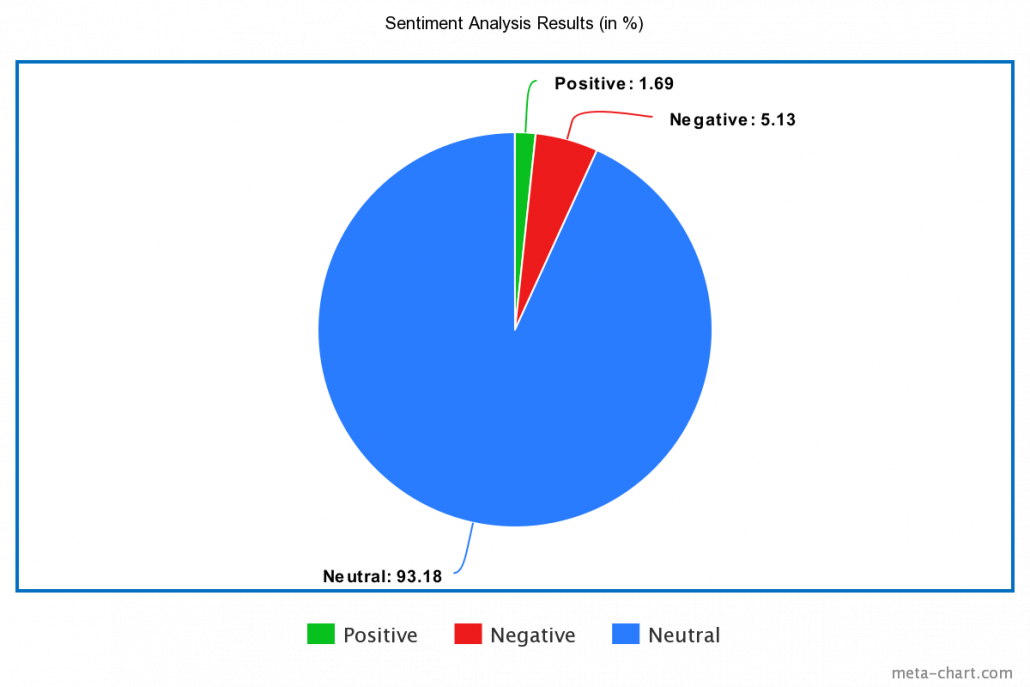
Sentiment analysis results as displayed above show the ratio of negative, positive, and neutral headlines from 78 online media. As can be observed, neutral sentiments dominate the majority of identified news headlines with 93.18 percent. This is given as objectivity is one of the core aspects of journalism and news reporting. As one of the main goals of journalism is to deliver factual information, crafting news headlines that are able to deliver news in a compact and simplified manner is the priority. Thus, neutral framing is an expected sentiment result of news headlines regardless of topic or issue.
On the other hand, negative sentiment comprises 5.13 percent of the identified headlines. This is approximately three times more than the positive sentiment of the identified headlines with 1.69 percent. Such results display a higher ratio of negative sentiment compared to positive sentiment of news headlines reporting on the government’s decision to extend social restrictions. This research will proceed to identify and map out various themes and topics mentioned by sentiment-ridden (positive or negative) news headlines.

Positive headlines referring to the extension of social restrictions can be classified into the following themes:
1. Evaluation on the effects of strengthened social restrictions
Several important stakeholders, such as government heads and epidemiologists, have reviewed the social restrictions policy in a positive light. This decision was seen to be appropriate and needed during a time when the number of cases increased rapidly. News headlines on this topic report the positive responses from these stakeholders in relation to the social restrictions policy.
2. Changed policies in the extension of social restrictions
While the first round of PPKM has seen a strict limitation on outdoor activities which inevitably impacted the economy negatively, the extension of it is followed by changed policies. This includes changed operation hours for SMEs as well as the number of individuals allowed to gather in a place based on their vaccination status. Some news headlines frame this theme in a positive way by relating it to the perspectives of street vendors, SME owners, and other business practitioners who see this change as important to keep their businesses running.
3. Assessment on the prices of basic necessities
As the economy is positioned in a vulnerable situation during the social restrictions, many are concerned about whether prices would rise. News headlines highlighting this issue suggest that prices of basic necessities have remained stagnant and unaffected by the economic contraction caused by the social restrictions. Such information is framed in a positive light as it reassures the public of the controlled situation during the pandemic.

Meanwhile, negative headlines referring to the extension of social restrictions from general online media can be classified into the following themes:
1.Highlight on worsening economic conditions due to the extension
A number of identified headlines highlight the impacts of the social restriction extension on the economy. Other than further aiding the economic struggles of SMEs and informal workers, the headlines also detail the extension’s effects on economic investment in Indonesia. As social restriction extension further reduces consumption, it also will significantly affect Indonesia’s economy on a larger scale.
2. Complaints and dissatisfaction from parties disadvantaged by the extension
Several parties have protested the extension of social restriction, mainly due to economic reasons. SMEs particularly have voiced out their frustration with the extension and shared their economic loss, even to the extent of bankruptcy. Workers in the tourism sector also expressed their disappointment in the government due to the policy.
3. Criticisms on the government’s inconsistency and ineffectiveness in extending the policy
A few headlines referred to the questions and debate within the society on whether PPKM as a social restriction policy was effective and should be extended. Negative headlines include articles discussing those who consider the government’s policy as ineffective and thus should no longer be extended. The headlines include news and information on those who have publicly criticized the government
4. Demand on the government to provide social benefits and support for the economically disadvantaged
During the COVID-19 pandemic, the government has promised to distribute social benefits for the poor and the lower class whose income becomes significantly reduced due to the pandemic. The news headlines in this theme cluster refer to the comments made by various parties demanding a proper distribution of the benefits. Negative headlines particularly highlight the government’s lack of concrete action and speed in distributing the benefits, causing provisional beneficiaries to struggle in fulfilling basic necessities.
5.Personal attacks on the incumbent government
Several media outlets directly target the incumbent, President Joko Widodo, and frame the decision as a government failure in protecting the citizens. Such headlines explicitly mention the President and refer to the extension of PPKM as a strategic maneuver by the incumbent to extend his power and control during the pandemic. Some headlines also considered the extension of PPKM as an opportunity to impeach the president due to the negative impacts of the decision. However, only a limited number of news sites took this approach of framings, such as Repelita and Gelora.
The following graph summarizes the ratio of neutral, negative, and positive headlines from each media site.
Conclusion
Framing in news headlines plays an important role in influencing the perception of public policy and in the delivery of particular information. In the case of the extension of PPKM, most of the news headlines reporting on the issue bear a neutral sentiment. However, as analyzed, a number of news headlines also frame the policy in positive or negative sentiment. The analysis shows that the number of negative headlines is three times more than the number of positive headlines. Additionally, various themes are embedded within the sentiment-ridden headlines, mostly related to the aspect of the economy in the midst of the pandemic. Further research may probe into the political aspects that may give rise to the negative framing of the decision. Additionally, qualitative research into the contents of the news may also reveal more extensive results and an understanding of the particular characteristics of each media site in reporting this policy.
Author: Safira Tafani Cholisi
Editor: Josia Paska Darmawan
Data collecting: Nadia Elaesiana
REFERENCES
Arnani, M., 2021. Aturan Lengkap PPKM Darurat Jawa-Bali, Berlaku 3-20 Juli 2021. [online] KOMPAS.com. Available at: <https://www.kompas.com/tren/read/2021/07/01/114000665/aturan-lengkap-ppkm-darurat-jawa-bali-berlaku-3-20-juli-2021?page=all> [Accessed 6 September 2021].
CNN Indonesia, 2021. Netizen Ramai-ramai Tagih Bansos PPKM Darurat. [online] CNN Indonesia. Available at: <https://www.cnnindonesia.com/ekonomi/20210713104126-92-666906/netizen-ramai-ramai-tagih-bansos-ppkm-darurat> [Accessed 6 September 2021].
Liu, B., 2015. Sentiment Analysis: Mining Opinions, Sentiments, and Emotions. Cambridge: Cambridge University Press.
Liu, S., Guo, L., Mays, K., Betke, M. and Wijaya, D., 2019. Detecting Frames in News Headlines and Its Application to Analyzing News Framing Trends Surrounding U.S. Gun Violence. In: 23rd Conference on Computational Natural Language Learning. [online] Hong Kong, China: Association for Computational Linguistics, pp.504-514. Available at: <https://aclanthology.org/K19-1047.pdf> [Accessed 6 September 2021].
Mutia, A., 2021. Rapor Dampak PPKM di Berbagai Wilayah di Indonesia. [online] Katadata. Available at: <https://katadata.co.id/ariayudhistira/analisisdata/6119f1ff096b9/rapor-dampak-ppkm-di-berbagai-wilayah-di-indonesia> [Accessed 6 September 2021].
Nugraheny, D., 2021. Angka Kematian Covid-19 Lewati 2.000 Orang dalam Sehari, Ini Kata Istana. [online] KOMPAS.com. Available at: <https://nasional.kompas.com/read/2021/07/28/12533861/angka-kematian-covid-19-lewati-2000-orang-dalam-sehari-ini-kata-istana?page=all> [Accessed 6 September 2021].
Putri, G., 2021. Epidemiolog: PPKM Sudah Seharusnya Diperpanjang, tapi Ada Catatan Penting. [online] KOMPAS.com. Available at: <https://www.kompas.com/sains/read/2021/08/03/103852023/epidemiolog-ppkm-sudah-seharusnya-diperpanjang-tapi-ada-catatan-penting?page=all> [Accessed 6 September 2021].
