- 17/12/2025
- Category: Commentaries

Author: Hilman Nurjaman
Editor: Achmed Faiz Yudha Siregar
Indonesia currently stands at a crossroads, both opportunities and challenges in its education ecosystem among the rapid expansion of artificial intelligence (AI). This moment is closely linked to the rapid growth of digital technology, especially internet access and everyday digital devices, over the past few year. Data from We Are Social show that around 66.5% of Indonesia’s population are active internet users, and more than 95% of people aged 16 to 64 have access to mobile devices such as smartphones.[1] This trend is more confirmed by a survey from APJII, which reports that national internet penetration reached 79.5% in 2024, with the highest usage found among younger generations, particularly Generation Z (born 1997–2012) and Millennials (born 1981–1996).[2] However, these positive numbers tell only part of the story. International assessments like PISA reveal a worrying picture of Indonesia’s education quality, especially in terms of basic literacy. The 2022 PISA (Programme for International Student Assessment) results place Indonesia near the bottom, with scores of 359 in reading, 366 in mathematics, and 383 in science. These figures fall far below the OECD average, which stands at 476 for reading and science, and 472 for mathematics.[3] This gap makes one thing clear, even though technology is now widely available, many students still lack the fundamental skills needed to make good use of it in learning. Thus, it is essential for Indonesia to develop more focused and context-based policies to ensure that technology can be utilized in a truly effective and meaningful way.
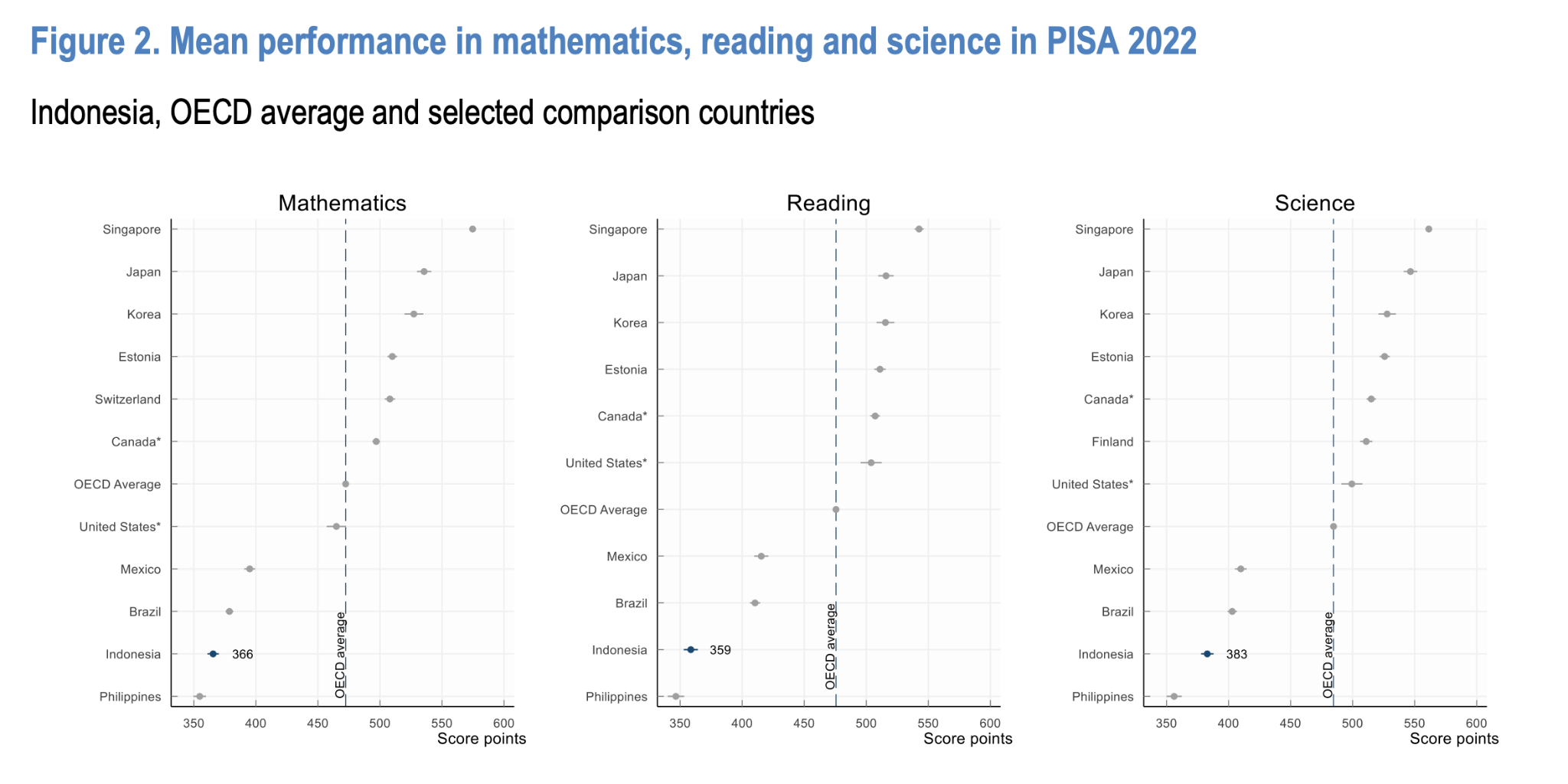
Source: PISA 2022 Results.
Why should literacy start in primary education?
One of the big challenges in developing AI literacy lies in the risk of cognitive debt among students, a condition in which individuals rely too heavily on technology without enough critical thinking, evaluation, or verification of the information generated by AI systems.[4] When students are not prepared with the skills to critically engage with technology-produced information, they risk becoming dependent on it, accepting outputs uncritically rather than questioning or assessing their validity. A 2025 study by MIT underscores this concern, showing that excessive use of AI in academic tasks has the potential to reduce independent thinking and argumentative capacity.[5] The study found that students who relied on AI to complete assignments demonstrated lower concept retention and more tendency to accept AI-generated results without analytical processing, a pattern that may foster cognitive dependence in the long run.
This issue is further reinforced by studies conducted between 2018–2019 by the Stanford History Education Group, which revealed that many students struggle to evaluate the credibility of online information sources and to identify between valid facts and misleading content.[6] Despite having greater access to technology and information, students often lack the ability to verify or filter what they consume, making them particularly vulnerable to misinformation. More recent studies from 2025 point to similar concerns. Digital literacy interventions, such as fast-checking practices introduced at the senior high school level, do not consistently correlate with students’ ability to identify between true and false news.[7] This suggests that media literacy remains a persistent challenge, highlighting the need for literacy skills to be encouraged much earlier.
These conditions contribute to an even greater accumulation of cognitive debt, as students increasingly depend on technology to supply information without developing a deep understanding of how evaluation or verification processes work. For this reason, effective literacy development should begin at the level of basic education, where strong cognitive foundations are first formed. At this stage, digital literacy learning must be tailored to students’ age and cultural context.[8] This means introducing fundamental concepts early on, before gradually moving toward more complex topics as students’ cognitive maturity and understanding develop. Such an approach ensures that students are not only users of technology, but are also capable of evaluating and critically engaging with the information produced by it.
The urgency of enhancing AI literacy in Indonesia becomes even more visible when examining current practices in the field. In recent years, many schools and higher education institutions have begun to encounter common use of generative AI, for finishing assignments, writing essays, and other academic activities, often without clear ethical rules. At the same moment, a significant number of educators in Indonesia remain poorly prepared to guide students in using AI critically.[9] This situation unfolds against the backdrop of relatively low levels of basic literacy among Indonesian students, as reflected in the 2022 PISA results, which show reading, mathematics, and science competencies below the OECD average.[10] n It means, advanced technologies are entering a learning ecosystem whose fundamental literacy skills are still fragile. Without well-designed interventions, the adoption of AI risks deepening gaps in learning quality and further deepening cognitive dependence, particularly among students.
Integrating AI into the national curriculum
Integrating artificial intelligence (AI) into the national education curriculum has become increasingly important in line with Indonesia’s Indonesia Emas mission and its response to technological change. A curriculum that incorporates AI must be accessible to all students without placing too much burden on them, which makes a contextual and carefully designed approach key. One model that can be adopted is a staged approach to AI literacy. For example, the AI for All program implemented in India offers a useful illustration of how AI literacy can begin with basic, accessible concepts for students from diverse backgrounds, before gradually introducing more technical skills at higher levels of education.[11] This program emphasizes fundamental technological understanding, such as basic programming and digital literacy, which then expands into topics like machine learning and data science at the secondary level, and the application of AI across sectors at the higher education level. This approach not only helps students catch on increasingly complex technologies, but also ensures that they are not overwhelmed by overly technical material too early.[12]
In the Indonesian context, a similar approach could be applied by introducing AI literacy through core subjects such as mathematics. Through this pathway, students can develop a more comprehensive understanding of AI without feeling burdened by content that is too technical or difficult to understand. As students grow older and their levels of understanding mature, learning can gradually shift toward more complex topics, including the use of AI in education, industry, and everyday life. However, despite the existence of policies in Indonesia that point toward the development of AI talent, their implementation continues to face significant limitations, particularly the lack of systematic integration of AI into the national curriculum. Referring to the 2020 National AI Strategy (Strategi Nasional Kecerdasan Artificial), while policy directions for AI talent development are defined, there remains no clear guidance on relevant competencies at each educational level or on how AI should be integrated coherently into curriculum.[13] This underscores the urgent need for policy refinement and stronger integration of AI within Indonesia’s formal education system.
Policy recommendations for the development of AI talent in Indonesia
Based on the findings discussed above, several policy recommendations can help accelerate the development of AI talent in Indonesia: (1) the AI curriculum should be designed in a holistic manner, covering not only technical skills but also social and ethical competencies. Education must be aligned with technological developments and real-world needs, while ensuring that ethical literacy is embedded in the learning process so that students are equipped to anticipate and avoid the risks of technology misuse. (2) for AI literacy to be implemented properly, it is crucial to provide systematic training programs for teachers. These programs should cover the use of AI as a learning tool, as well as pedagogical approaches that enable educators to teach in practice in an environment shaped by quickly evolving technologies. (3) the development of AI talent in Indonesia cannot be conducted by the government or educational institutions alone. Strong collaboration between the public sector, educational institutions, and industry is a key to building an inclusive and sustainable education ecosystem. The technology industry, in particular, needs to be actively involved in providing training for teachers and students, as well as offering access to up-to-date technologies that can be meaningfully integrated into learning processes.
Conclusion
Indonesia now stands at a critical moment, facing both significant opportunities and serious challenges in an increasingly fast-paced digital era. While access to technology continues to expand, PISA results indicate that the overall quality of education in Indonesia remains far from ideal, especially in terms of basic literacy. This presents a serious concern, as greater technological connectivity does not automatically translate into readiness to use technology effectively. Many students remain falling short prepared to fully leverage technological tools for learning and problem-solving. For this reason, Indonesia must place stronger emphasis on integrating artificial intelligence (AI) literacy into the national education curriculum, from basic education through higher education, using a gradual approach that is responsive to students’ developmental stages and learning needs.
However, this transformation cannot rest only on the shoulders of government or educational institutions. Improving AI literacy requires cross-sector collaboration within a pentahelix framework that brings together government, educational institutions, industry, media, and civil society organizations (CSOs) and communities. The government plays a central role in setting policy directions and regulatory frameworks, educational institutions are responsible for embedding AI literacy into curricula and teaching practices, and industry contributes through expertise, technology, and the sharing of best practices. At the same time, the media plays a key role in raising public awareness and framing the use of AI in a critical and balanced manner, while CSOs and community groups serve as vital bridges between policy and on-the-ground practice, particularly in ensuring that AI literacy initiatives are inclusive and attentive to vulnerable groups. Through a synergistic pentahelix collaboration, Indonesia has a strong opportunity to promote a younger generation that is not only technologically literate, but also capable of using artificial intelligence in a wise, critical, and responsible way.
- We Are Social & Hootsuite. (2024). Digital 2024: Indonesia. ↑
- APJII. (2024). Laporan Survei Penetrasi dan Perilaku Internet Indonesia 2023–2024. ↑
- OECD. (2023). PISA Results: Factsheets Indonesia. ↑
- Kosmyna, N., Hauptmann, E., Yuan, Y. T., Situ, J., Liao, X.-H., Beresnitzky, A. V., Braunstein, I., & Maes, P., (2021). Your Brain on ChatGPT: Accumulation of Cognitive Debt when Using an AI Assistant for Essay Writing Task. In MIT Media Lab. ↑
- Ibid. ↑
- SHEG. (2019). Students’ Civic Online Reasoning. ↑
- Nygren, T., & Efimova, E. (2025). Investigating the long-term impact of misinformation interventions in upper secondary education. Plos One. ↑
- UNICEF. (2019). Digital literacy for children: 10 things you need to know. ↑
- UNICEF. (2021). Situational Analysis on Digital Learning Landscape in Indonesia. ↑
- OECD. (2023). PISA Results: Factsheets Indonesia. ↑
- Elias, J. (2020). AI for All: India’s AI Strategy for Empowering the Next Billion. ↑
- NITI Aayog. (2018). National Strategy for Artificial Intelligence #AIFORALL. ↑
- Badan Pengkajian dan Penerapan Teknologi (BPPT). (2020). Strategi Nasional Kecerdasan Artifisial Indonesia 2020–2045. ↑
