- 17/02/2025
- Category: Press Release
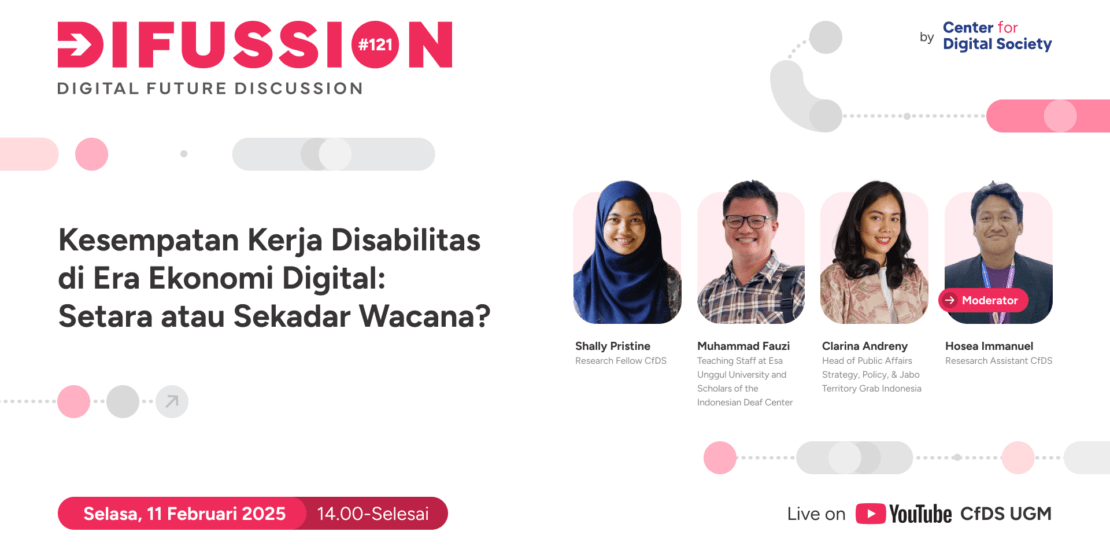
There are more than 23 million people with disabilities in Indonesia, yet less than 10% of them of working age are recorded as having jobs. However, the digital economy era seems to offer a new perspective on social inclusion, particularly for those with disabilities. Many ride-hailing platforms have begun offering equal opportunities for people with disabilities to earn a decent living through flexible job opportunities and access to income. Highlighting this issue, the Center for Digital Society presents Difussion #121, “Employment Opportunities for People with Disabilities in the Digital Economy: Equality or Mere Rhetoric?” to discuss this phenomenon. The discussion features Shally Pristine (Research Fellow at CfDS), Muhammad Fauzi (Deaf Lecturer at Esa Unggul University), and Clarina Andreny (Head of Public Affairs Strategy, Policy & Jabo Territory at Grab Indonesia), moderated by Hosea Immanuel (Research Associate at CfDS). The event can be watched on the CfDS YouTube channel through the following link: [https://www.youtube.com/watch?v=LNCEmBuc-wc&t=1s]

The discussion was opened by Shally Pristine, a Research Fellow at CfDS, who explained that Indonesia has around 28 million people with disabilities, making it one of the highest in Southeast Asia. However, their participation in the workforce remains low, with an employment rate of less than 10% and an unemployment rate of 90%. This is despite Law No. 8 of 2016, which mandates that private companies employ at least 2% of their workforce from people with disabilities, while the public sector must allocate at least 1%. Various internal and external factors contribute to this low participation rate. However, with Indonesia’s rapidly growing digital economy, valued at 82 billion USD in 2023 and growing 8% above the national average, new opportunities are opening up for people with disabilities. The ride-hailing and delivery sectors, along with alternative work models in digital platforms, are some examples.
Provision of Inclusive Space for People with Disabilities
To better understand this issue, Shally Pristine conducted a study involving six deaf ride-hailing drivers across different platforms, transportation modes, and working hours in the Greater Jakarta area. The study found that before joining these platforms, deaf individuals struggled to find formal employment, which negatively impacted their self-confidence. “Those with higher education have better opportunities at disability-friendly companies, but they are often more vulnerable to layoffs. Many expressed that joining these platforms is easy due to text- and image-based features that help them navigate the work,” explained Shally.

One of the ride-hailing platforms enhancing inclusivity in the digital ecosystem by offering more job opportunities for people with disabilities is Grab. Clarina Andreny, Head of Public Affairs Strategy, Policy & Jabo Territory at Grab Indonesia, shared that Grab Indonesia has implemented various inclusive initiatives, such as Grab Access and Grab Gerak. Grab Indonesia ensures that its digital social innovations continue to benefit all communities, including those with disabilities. According to a study by LAPI ITB, one in four Indonesians relies heavily on the online transportation and delivery industry, which further highlights the importance of economic opportunities for people with disabilities across different sectors, including GrabCar, GrabBike, GrabExpress, GrabMart, GrabKios, and GrabFood.
Grab Indonesia continues to push for inclusiveness through Grab Access, a program designed to expand digital economic access for people with disabilities, offering them opportunities as driver-partners or merchants with specialized orientation support, including sign language interpreters. Additionally, driver-partners with disabilities receive operational support, training, and loyalty programs. Grab Indonesia has also established an internal community, Accessibility Inc., to help employees better interact with colleagues with special needs. Furthermore, the Ruang Setara facility at the Grab Excellence Center serves as a multifunctional space for training and as a platform for voicing the aspirations of disabled partners, accessible to various disability communities. Grab Indonesia currently provides a dedicated registration pathway for prospective driver-partners with disabilities through [bit.ly/Grabaccessform]

Tantangan Pemerataan Inklusivitas di Indonesia
Despite these positive developments, challenges remain, particularly in providing access for people with disabilities who want to become partners in digital platforms. According to Muhammad Fauzi, a Teaching Staff at Esa Unggul University and Scholar of the Indonesian Deaf Center, organizations such as the Indonesian Association of Women with Disabilities (HWDI) and the Indonesian Association of Persons with Disabilities (PPDI) play a crucial role in collaborating to offer orientation and assistance for individuals with special needs who wish to join the digital workforce. One of the most important steps is changing public perceptions of disabled workers. Raising social awareness can help build a better understanding of their diversity and capabilities.

The media also plays a significant role in shaping public opinion about workers with disabilities. Unfortunately, this topic is rarely discussed unless in the context of campaigns, which is why media involvement in highlighting their success stories is essential to inspire individuals and shift societal perspectives. “Changing this perspective requires a collective effort from various stakeholders, including the government, the private sector, the media, and local communities. With a more inclusive approach, workers with disabilities can be valued as valuable assets. As Emma Thompson once said, ‘Being disabled should not mean being disqualified from having access to every aspect of life,'” Fauzi stated.
Writer: Muhammad Alfasya Syabil Sholatar
Editor: Eka Nur Raharja
