- 06/12/2024
- Category: Press Release
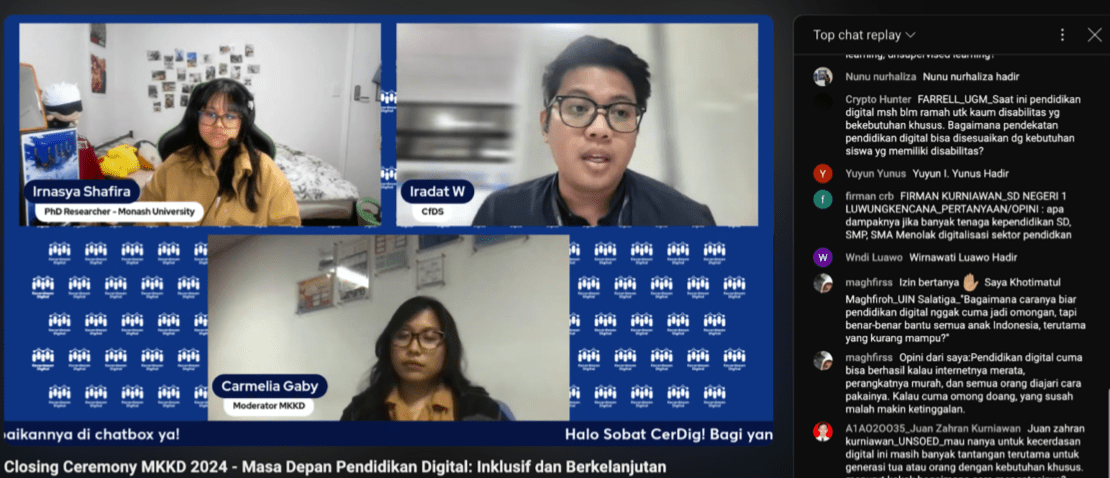
Yogyakarta (18/11/2024) – Digital education is growing rapidly, enabling more flexible learning methods and increasing opportunities for people to obtain various types of education. However, the implementation of digital education still faces various challenges, especially in its efforts to achieve inclusion and sustainability. In response to this situation, last Monday (18/11), Center for Digital Society (CfDS) UGM held the Closing Ceremony of the Digital Intelligence Course (MKKD) 2024 themed “The Future of Digital Education: Inclusive and Sustainable”. Featuring Iradat Wirid, Manager of MKKD and Deputy Executive Secretary of CfDS, and Irnasya Shafira, PhD Candidate of Monash University and Lecturer of MKKD 2024, this discussion was broadcast live through the official YouTube account of Kecerdasan Digital and CfDS UGM.
Iradat Wirid explained that MKKD was initiated to bridge the gap between society’s digital skills and the demand for digital talent in Indonesia, which includes the shortage of social researchers who comprehend the digital context of social issues. MKKD invites participants to understand the social and digital context thoroughly before learning advanced methods. He also appreciated government programs such as the Digital Talent Scholarship that are effective in improving digital skills, hoping that similar programs will continue in the future.
Reflecting on the program highlighted by CfDS, Iradat also shared his experience in trying to improve the digital intelligence and digital literacy of the society. Among the challenges is the high demand for instant results. He emphasized the importance of following the right process without shortcuts and bypasses. He also appreciates the success of multi-sector collaboration in Indonesia in developing a digitally proficient workforce during the five years of MKKD implementation. In the future, he hopes the collaboration will involve MKKD alumni to create a sustainable regeneration cycle. “If we talk about inclusivity, of course we can not ignore the representation of those who are minorities. For example, now, in one of the National Digital Literacy Movements, our friends with disabilities are not only seen as people who will be given policies but also invited to formulate policies, because they are the ones who experience it,” said Iradat.
An inclusive, collaborative approach such as that presented by Iradat not only impacts the success of the program, but also provides direct benefits to the individuals involved. One example is the experience of Irnasya Shafira, who has seen her professional competencies improve through digital intelligence classes. “Thanks to the digital intelligence classes, I am able to explain complex topics to the general public in a concise and easy-to-understand manner, and apply digital research methods,” she boasts.
However, at the same time, Irnasya also noted a number of challenges in improving people’s digital literacy, such as unequal infrastructure, lack of attention to cybercrime, impatience with results, and the perspective that separates social reality and the digital world. She emphasized the importance of digital ethics as a guideline for responsible use of technology, and underlined that infrastructure and digital skills of educators are the main challenges in integrating digital education into traditional education systems. Irnasya added, “It is difficult to teach digital skills when teachers do not have a digital mindset and digital intelligence for themselves. When explaining digital skills as something ‘other’ or very different, the learning process becomes unsteady”
Irnasya emphasized the importance of multi-stakeholder collaboration in improving digital skills and talents in Indonesia, considering that the internet is a shared space. To accelerate the transformation of digital education, the government needs to develop a roadmap with clear incremental steps and conduct effective pilot studies as a basis for policy making.
As the 2024 MKKD comes to an end, CfDS reaffirms its commitment to encourage the creation of an increasingly capable and literate Indonesian society in the digital world. Going forward, the MKKD program will continue to be held as one of CfDS’s strategic initiatives in fulfilling the vision of building a society that is responsive and adaptive to the development of digital technology.
Author : Carmelia Gaby
Editor : Allysa Putri Rendry
