
- 25/09/2024
- Category: Commentaries

Author: Ayom Mratita Purbandani
Editor: Achmed Faiz Yudha Siregar
The digitization of the gig economy has opened up more diverse job opportunities. This new type of work is seen as a means to provide marginalized groups with easy access to income, especially women. Having the combination of flexibility, diversity, and autonomy makes such work arrangements unique since they cannot be accommodated within standard employment relationships. Gig economies provide women with a variety of employment opportunities in traditional gendered divisions of labor, where women are not viewed as breadwinners. Gig economy services range from crowdwork (outsourcing tasks to online platforms like Freelancer, UpWork, and Fiverr) to in-situ services (such as ride-hailing, food delivery, courier services, and cleaning).
Platform-mediated work schemes are often hailed as a panacea to address poverty and inequality faced by women in the workforce by increasing their participation in the labor market. Despite their apparent accommodation of women, these non-standard forms of work often fail to resolve the double burden of women’s reproductive and productive labor. As a result, economic achievement is measured only by individual labor value, ignoring significant barriers related to gender. In this article, I argue that the gig economy exacerbates inequality through its technology-mediated work processes as well as its fundamental social, political, and cultural characteristics.
The illusion of flexibility, diversity, and freedom
In the gig economy, non-standard work relationships complicate discussions about workers’ rights. Work arrangements such as these are rife with uncertainty and contingency regarding working hours, job boundaries, worker status, and social security benefits. This leaves gig workers at risk of sudden dismissal, unfair wages, and insufficient job protection because they lack bargaining power with platforms. Both male and female gig workers face this precariousness, but female gig workers face it to a much greater extent.
This disparity is reflected in often unnoticed dynamics within the gig economy employment structure, particularly through the distinction between productive and reproductive labor (Kwan, 2022). Separating economically valuable labor from unpaid reproductive labor, including domestic and emotional tasks, is a means of separating economically important from unimportant work. Gig-economy promises of flexibility, diversity, and freedom are often seen as ways to overcome the barriers women face in formal employment, such as gender-based discrimination and workplace violence. For women workers, these promises become an illusion behind the rhetoric of “empowerment.”
For women, flexible and free work is often a necessity in order to accommodate their reproductive responsibilities (Doorn, 2017). While platform-based work combines unpaid productive work with paid reproductive work and creates the impression of being one’s own boss, female gig workers end up working even harder (Rani et al., 2022). The gig economy is popular among women seeking additional income, but many also work full-time. Due to domestic duties still assigned solely to women, gig workers are generally expected to work longer hours.
Wage gaps, discrimination, and lack of social security
Female gig workers face higher costs. Anwar (2022) introduces a heuristic framework that illustrates the cyclical relationship between gendered socio-cultural and political norms, algorithmic management, and job quality outcomes.
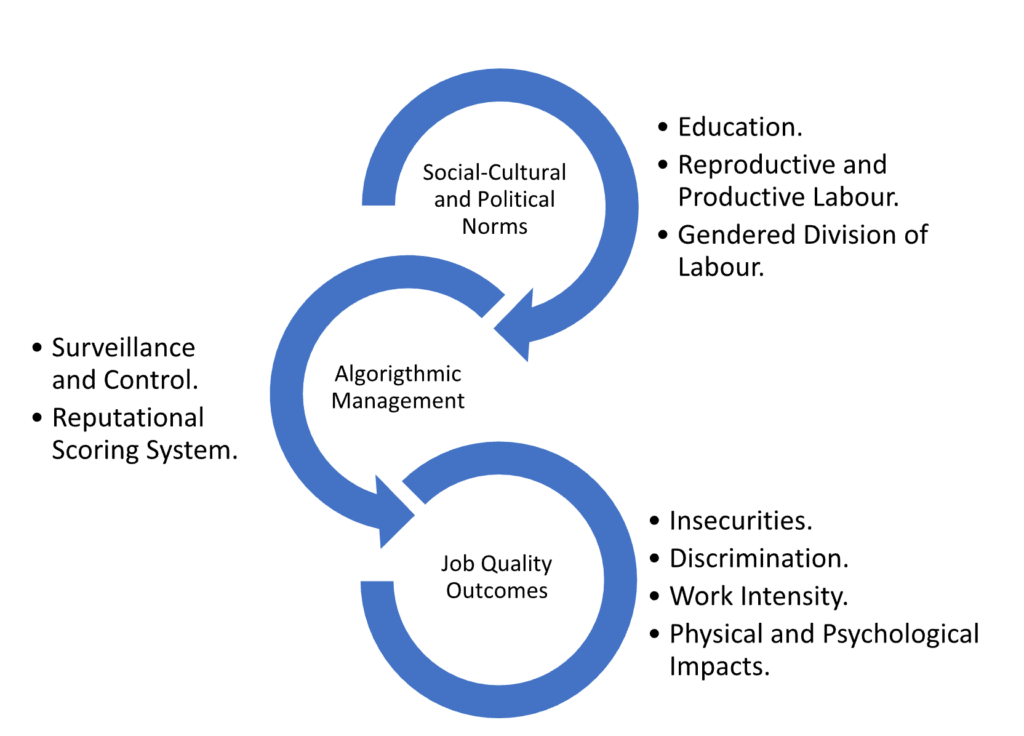
Source: Anwar (2022)
Inequalities and unsafe working conditions are exacerbated by four consequences resulting from the intersection of gender-based socio-cultural and political norms and algorithmic management–economic insecurity, discrimination, work intensity, and physical and psychological effects. It highlights a significant difference between how men and women interact with the digital labor platform.
First, Economic Insecurity: For many women, the gig economy offers an opportunity for financial independence. In contrast to their male counterparts, female gig workers remain economically insecure. The ZenBusiness (2022) study found that male crowdworkers charge 48% more than female crowdworkers in the gig economy, making the pay gap even wider than in formal employment. Software development roles show the largest gap.
Location-based work (in-situ) is similarly affected. The reproductive labor demands of female gig workers affect productivity, as measured by income ratios. Moreover, male workers are more willing to work late hours or in riskier areas, leading to a productivity gap in underserved regions (Cook et al., 2021). In Indonesia, a study by Damayanti (2023) shows that the gender wage gap in the gig economy stands at 45.95%. According to the World Economic Forum (2022), this growing wage gap is expected to take 132 years to close.
Second, discrimination: While many women enter gig work to avoid gender-based discrimination, it persists within gig work. According to Leung and Koppman (2018), both crowdwork and in-situ jobs harbor strong gender biases that limit women’s access to paid work. When it comes to crowdwork, clients often prefer to hire men for tasks like web design, software development, UI/UX, and data management. Female drivers in in-situ jobs such as ride-hailing and delivery services tend to experience higher cancellation rates based on gender-related stereotypes about driving abilities (Setyowati, 2018).
Third, Work Intensity: The lack of social protections such as healthcare, menstrual leave, and maternity leave significantly affects women’s work intensity (Rumengan, 2023). Furthermore, in-situ work is point-based, while crowdwork is short-term, incentivizing unit credits to be used for evaluation. In the absence of social protections and compensation, women earn lower credit scores, resulting in lower incomes.
Fourth, Physical and Psychological Impact: High-intensity work, long hours, and economic insecurity take a toll on female gig workers’ physical and mental well-being. In-situ cleaners and freelancers engaged in crowdwork are more likely to feel isolated due to the distance between them and their communities. As for in-situ workers, like ride-hail drivers, they might have worker solidarity networks, but their high-risk nature, combined with the double burden of productive and reproductive work, negatively affect their psychological well-being.
Paving the way for decent work
Gig work cannot merely accommodate women’s reproductive labor, but must also address its critical challenges-namely the enhancement of gender-based labor divisions that gig work creates. Addressing these challenges involves removing obstacles and biases, such as:
- Privacy, Safety, and Security: The absence of comprehensive regulations leaves female gig workers vulnerable to gender-based harassment and exploitation. Regulatory frameworks for platforms, supported by legislative efforts, must be established to monitor platforms and ensure worker safety through measures such as mandatory recording of service-related communications and emergency buttons for women in unsafe situations (Prewett, 2023).
- Dispute Resolution Systems: Gig platforms lack appropriate mechanisms for resolving disputes, which disproportionately affects female workers who fear negative feedback and high cancellation rates. The ILO’s Examination of Grievances Recommendation, 1967 (No. 130) calls for fair grievance resolution systems to foster more equitable participation for women.
- Social Security and Employment Benefits: Independent partners or freelancers are not eligible for Social Security benefits. The key to solving this problem lies in clearly defining employment relationships. Especially for workers who commit their full time to one aggregator, platforms should offer contracts with fair benefits. It is necessary to mainstream collective action as a means of creating accessible contribution schemes, such as the Gojek Swadaya program for partners, which provides savings, insurance, and loans (Gojek, 2022). Governments also need to be proactive in collecting better data on gig workers to inform gender-sensitive policies and compensation schemes that protect women’s rights.
In order for platforms to comply with local labor regulations and be held accountable, governments must do everything in their power. The goal is not just to increase the number of women participating, but also to improve the quality of jobs, which will be crucial in addressing women gig workers’ problems. Unless decisive action is taken, insecure and “indecent” work risks becoming the new norm for a growing number of workers. This concern will be highlighted in the 113th Session of the International Labour Conference (2025), where the shifting landscape of labor conditions was a key focus. Additionally, the first comprehensive analysis of digital labor platforms and platform workers in ASEAN Member States underscores the urgency of addressing this issue (ASEAN, 2023). The report reveals how digital labor platforms, which often lack adequate protections for workers, are becoming more prevalent, further entrenching precarious employment conditions across the region. This situation disproportionately affects women, who already face significant barriers in the labor market. To fully understand how new digital technologies can contribute to women’s economic empowerment, it is crucial to not only focus on technological advancements but also to examine the socio-cultural norms that continue to shape labor dynamics and restrict women’s opportunities in various ways.
