- 06/06/2024
- Category: Commentaries

Author: Falah Muhammad
Editor: Arifatus Sholekhah
Artificial Intelligence (AI) technology development demonstrates exponential advancements. The fact that AI has become a necessity for humans today, such as helping and simplifying daily activities, supports this argument.1 For instance, using AI technology as a reliable personal assistant, like ChatGPT, shows how humans are beginning to rely on this technology. ChatGPT is a technology based on Generative AI (Gen AI) introduced by OpenAI in November 2022.2 The sophistication offered by Gen AI can bring revolutionary changes in human-computer interactions across various fields.
Gen AI is a machine learning (ML) algorithm capable of creating new data samples similar to the examples it was trained on.3 Gen AI is already used to create various works, including text, images, music, and video.45 Its ability to understand complex commands and generate outputs that resemble human creations has made Gen AI algorithms one of consumers’ most widely used technologies. For example, OpenAI’s ChatGPT has reportedly surpassed 100 million users within 5 months of its release.6
The sophistication of Gen AI has prompted several researchers to conduct studies to see how reliable Gen AI can be. Professor Christian Terwiesch, a researcher from the University of Pennsylvania’s Wharton School, tested the ability of an AI chatbot (ChatGPT) to complete final assignments for an MBA (Master of Business Administration) program. The results of this study showed that ChatGPT managed to pass the course with grades ranging from B- to B.7 These findings have significant implications for the field of education, such as the potential of Gen AI to create a dependency effect among students on Gen AI for completing their assignments.
Therefore, it is crucial for academics to be aware of the Gen AI influence on students and to reevaluate exam policies and curricula to be more adaptive to AI developments. So, how does the use of Gen AI affect students? In addition, what mitigation strategies are appropriate to ensure that the use of Gen AI in education can help improve the quality of education?
Gen AI Impacts on Student Laziness and Decision-Making
In a competitive world, a lack of self-confidence causes individuals to avoid tasks they perceive as beyond their abilities.8 This lack of self-confidence drives them to seek alternative solutions, such as using ChatGPT. In the educational realm, using ChatGPT allows students to quickly get answers and improve academic performance in the short term.9 However, it can potentially cause dependence on AI as a quick solution, particularly for students with low academic self-efficacy who tend to overuse AI in the long term.10 The impact of increased use and reliance on Gen AI generally includes limiting the human brain’s thinking capacity, leading to a loss of intelligence and making humans more artificial.11 High dependence on Gen AI can result in humans losing their cognitive abilities, causing stress when their brains are needed to assess and consider a problem. This can happen because Gen AI can replace the autonomous role of humans by providing choices based on processed data.12
A study conducted on students from various universities in Pakistan and China regarding the impact of AI on decision-making, laziness, and security in the education sector shows how Gen AI plays a role in these three issues.13 First, Gen AI negatively affects human decision-making. The ability of Gen AI to process large amounts of data and make accurate predictions based on trained data causes humans to rely on this technology. This dependency triggers a decline in human innovation and critical thinking skills.
Second, AI can lead to laziness in humans. AI performs repetitive tasks automatically and does not require humans to memorize, use analytical skills, or engage in cognitive processes.14 This leads to a dependency behavior that prevents humans from using their abilities, making them lazy. In education, reliance on Gen AI results in a loss of interest among teachers and students in engaging in academic activities and learning specific skills or methodologies. This happens because Gen AI can complete tasks automatically, so humans do not need to memorize, use reasoning, or employ cognitive skills. Teachers and students who depend on AI will gradually lose interest in working independently, ultimately making them lazy. This can result in a decline in the quality of education and personal development within the academic community.
Leveraging Gen AI to Improve Critical Thinking in The Academic Context
Excessive dependence on Gen AI will have a negative impact on critical thinking and problem-solving abilities. However, this can be different if the Gen AI use involves cognitive skills, such as analysis and evaluation, which will enhance critical thinking skills.15 To understand how Gen AI plays role in improving human critical thinking abilities, Bloom’s taxonomy framework becomes a relevant framework in evaluating educational learning objectives.16 This framework attempts to categorize cognitive abilities into two levels. First, the lower-order level, which includes cognitive skills such as remembering, understanding, and applying skills. Second, the higher-order level, which encompasses abilities such as analyzing, evaluating, and creating skills.17 Elaborating the use of Gen AI and Bloom’s taxonomy framework in learning strategies can enhance critical thinking skills, for example, by providing complex case studies for students to analyze, evaluate, and generate solutions.
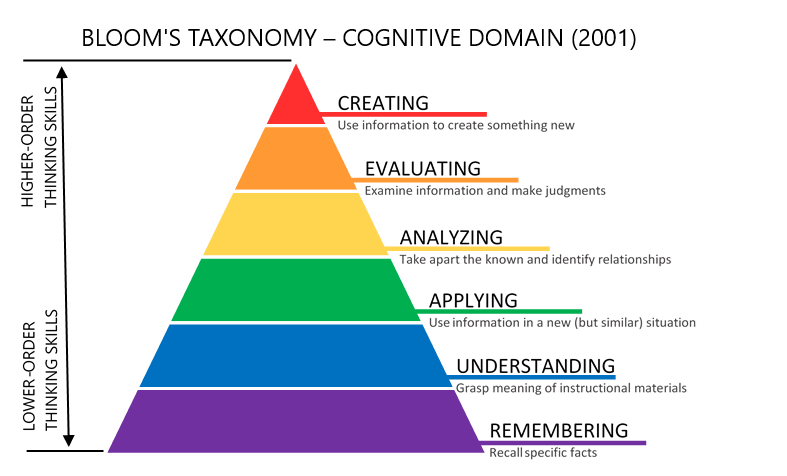
A study conducted on business graduates in the UK showed that the use of ChatGPT, aligned with Bloom’s taxonomy framework, successfully enhanced critical thinking skills.18 In the study, the findings were divided into two themes based on Bloom’s taxonomy framework: the impact of Gen AI on critical thinking at the lower-order and higher-order levels.
The findings at the lower-order level suggested significant improvements in the ability to recall information, understand complex concepts, practical application, and task efficiency. At this basic cognitive level, ChatGPT is very useful for simplifying research processes, proofreading, and structuring academic tasks. This efficiency helps reduce thinking time, allowing the remaining cognitive capacity to be allocated to more complex tasks.
On the other hand, there was a moderate increase in critical thinking aspects at the higher-order level. ChatGPT can assist in the processes of analysis and evaluation. This is because ChatGPT can provide new perspectives, aid in brainstorming ideas, and increase users’ attention to fact-checking due to the potential for “AI hallucination”, which is a condition where the AI considers incorrect information as factual.
From the explanation above, we can understand that cognitive activities based on Bloom’s Taxonomy framework operate hierarchically. This implies that to master complex critical thinking skills such as analyzing, evaluating, and creating (higher-order thinking), one must first master basic skills such as remembering, understanding, and applying (lower-order thinking). In the fast-paced environment of the technology era, time is a scarce resource. Therefore, using AI technology to perform lower-oder tasks gives students more time to practice cognitive skills, providing them with the opportunity to develop higher-order thinking skills. The use of AI technology in conjunction with Bloom’s Taxonomy framework can help enhance students’ critical thinking abilities.
Conclusion
Educational institutions must embrace technology in their teaching and learning methods as a response to the increased use of AI technology in academic environments. Given that technological capabilities offer various conveniences, their utilization in education will support the quality of both educators and learners. Educators need to design learning systems that incorporate AI technology into the teaching and learning process. This can be done by creating learning scenarios that target higher-order cognitive levels in students. A learning approach that allows for human-AI collaboration needs to be implemented with the aim of enhancing the quality of education.
- Spector, J.M., Ma, S. Inquiry and critical thinking skills for the next generation: from artificial intelligence back to human intelligence. Smart Learn. Environ. 6, 8 (2019). ↩︎
- Kurian, N., Cherian, J., Sudharson, N. et al. AI is now everywhere. Br Dent J 234, 72 (2023) ↩︎
- Ali, S., Ravi, P., Williams, R., DiPaola, D., & Breazeal, C. (2024, March). Constructing dreams using generative AI. In Proceedings of the AAAI Conference on Artificial Intelligence (Vol. 38, No. 21, pp. 23268-23275). ↩︎
- Alpaydin, E. (2021). Machine learning. MIT press. ↩︎
- Chan, C.K.Y., Hu, W. Students’ voices on generative AI: perceptions, benefits, and challenges in higher education. Int J Educ Technol High Educ 20, 43 (2023). ↩︎
- Milmo, D. 2023. ChatGPT reaches 100 million users two months after launch. The Guardian. ↩︎
- Christian Terwiesch, “Would Chat GPT3 Get a Wharton MBA? A Prediction Based on Its Performance in the Operations Management Course”, Mack Institute for Innovation Management at the Wharton School, University of Pennsylvania, 2023. ↩︎
- Hassan, M. S., Al Halbusi, H., Razali, A., Ariffin, R. N. R., & Williams, K. A. (2022). The Swedish gamble: trust in the government and self-efficacy in the battle to combat COVID-19. Current Psychology, 1-16. ↩︎
- Rahman, M. M., & Watanobe, Y. (2023). ChatGPT for education and research: Opportunities, threats, and strategies. Applied Sciences, 13(9), 5783. ↩︎
- Zhang, S., Zhao, X., Zhou, T. et al. Do you have AI dependency? The roles of academic self-efficacy, academic stress, and performance expectations on problematic AI usage behavior. Int J Educ Technol High Educ 21, 34 (2024) ↩︎
- Ahmad, S.F., Han, H., Alam, M.M. et al. Impact of artificial intelligence on human loss in decision making, laziness and safety in education. Humanit Soc Sci Commun 10, 311 (2023). ↩︎
- Chiodo, S. Human autonomy, technological automation (and reverse). AI & Soc 37, 39–48 (2022). https://doi.org/10.1007/s00146-021-01149-5 ↩︎
- Ahmad, S.F., Han, H., Alam, M.M. et al. Impact of artificial intelligence on human loss in decision making, laziness and safety in education. Humanit Soc Sci Commun 10, 311 (2023). ↩︎
- Nikita Duggal. 2023. “Advantages and Disadvantages of Artificial Intelligence”. Simplilearn. ↩︎
- van den Berg G, du Plessis E. ChatGPT and Generative AI: Possibilities for Its Contribution to Lesson Planning, Critical Thinking and Openness in Teacher Education. Education Sciences. 2023; 13(10):998. ↩︎
- Calma, A., and M. Davies. 2021. “Critical Thinking in Business Education: Current Outlook and Future Prospects.” Studies in Higher Education 46 (11): 2279–95. ↩︎
- Krathwohl, D. R. 2002. “A Revision of Bloom’s Taxonomy: An Overview.” Theory Into Practice 41 (4): 212–8 ↩︎
- Aniekan Essien, Oyegoke Teslim Bukoye, Xianghan O’Dea & Marios Kremantzis (17 Feb 2024): The influence of AI text generators on critical thinking skills in UK business schools, Studies in Higher Education. ↩︎
