- 01/11/2023
- Category: Press Release
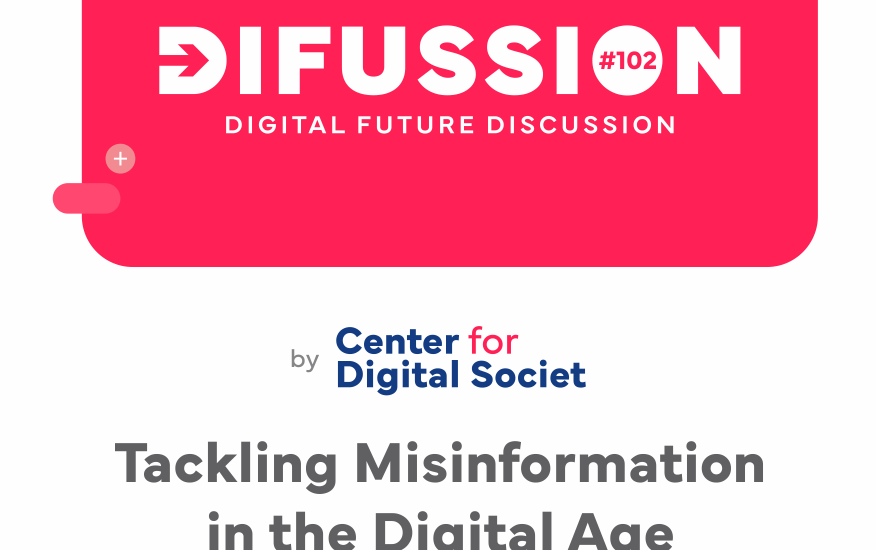
CfDS Official YouTube Channel (23/10/19) – In today’s digital age, the impact of fake news and misinformation on society is a significant concern. With the rise of online news sources and social media platforms, it has become easier for false information to spread easily and quickly, which can harm people’s behaviors, attitudes, beliefs, civic engagement, and decision-making processes. Center for Digital Society (CfDS) UGM tries to address this issue through Difussion #102: “Tackling Misinformation in the Digital Age”. The discussion featured Sasmita-Jati Karim (Research Officer CfDS) dan M. Irfan Dwi Putra (Research Officer CfDS), moderated Carmelia Gaby Talia (Partnership Intern CfDS). Difussion #102 can be rewatched through this link https://www.youtube.com/watch?v=xUKwNaxTUw0.

In this discussion, Perdana highlighted the serious issues arising from disinformation, misinformation, and malinformation in our digital society. “Misinformation is the spread of inaccurate and misleading information in an unintentional way,” as emphasized by Perdana. According to Perdana, misinformation has several negative impacts, including misleading the public, damaging the reputation of those affected, fueling divisions, and creating negative opinions on various topics.
There are several underlying reasons for the spread of misinformation in society. “Unintentional human errors, cognitive biases, incomplete information, inaccurate statistics, miscommunication, the influence of social media and the internet, and lack of media literacy, are some of the factors that cause misinformation,” Perdana stressed.
Recognizing the importance of avoiding misinformation, Perdana encouraged the public to seek reliable sources of information, use tools to identify misinformation, and not easily fall for hoaxes. Media literacy is essential for developing critical thinking skills in evaluating news for individuals.
Irfan enriched the discourse by providing his critical analysis of misinformation and disinformation about climate change within society. “Some examples of misinformation about climate change include claims that global warming is normal, that the existence of winter proves the absence of global warming, and that climate change has always existed, so there is no significant climate change,” Irfan Added.
Misinformation about climate change can create polarization in society, hinder climate change mitigation efforts, and obstruct policymakers from taking necessary actions. In response to these, Irfan suggested various measures to counteract misinformation about climate change. These efforts included big technology companies tightening regulations regarding misinformation dissemination and internet users filtering news and reporting content that contains misinformation. “With collaborative efforts, we can address this serious issue and take steps to protect our planet,” Irfan stressed.
In conclusion, Perdana firmly highlighted that climate change is real. Misinformation and disinformation about climate change must be continuously challenged. We must continue to make efforts in information validation and filtering to protect the Earth from the threat of climate change.
Writer: Putri Nara Mustika
Editor: Allysa Putri Rendry
