- 11/10/2023
- Category: Press Release
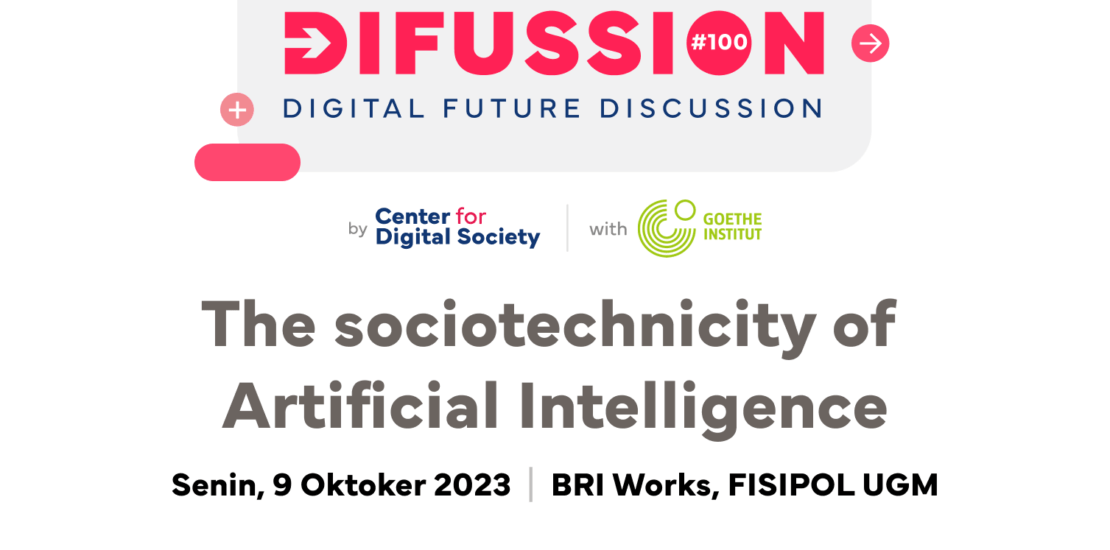
Yogyakarta, October 9, 2023 – Artificial Intelligence (AI), crafted by human ingenuity, has undergone a remarkable transformation in recent years. AI has evolved to possess the capability to conduct intricate data analysis, make intelligent decisions, and tackle challenges that were once considered the exclusive domain of human cognition. This evolution has ignited debates surrounding the ethics, policies, and business practices associated with AI. In response to these, Center for Digital Society (CfDS) UGM, in collaboration with Goethe Institut Indonesien, presents a collaborative effort in the form of Difussion #101: “The Sociotechnicity of AI” which was held on Monday (09/10/23) at BRI Works, Fakultas Ilmu Sosial dan Ilmu Politik (FISIPOL) Universitas Gadjah Mada (UGM). This event featured Dr. Anna Jobin (Senior Researcher at the Humboldt Institute & Society Berlin) as a speaker, moderated by M. Perdana Sasmita-Jati Karim (Research Officer CfDS).

Through this event, Anna successfully ignited an engaging discussion about the dynamics of AI utilization, both globally and within Indonesia itself. According to her, the governance of digital technology, particularly artificial intelligence (AI), plays a critical role in our modern world. This encompasses both how we influence and control AI systems and how these systems in-turn impact our society. According to Anna, AI is a complex and evolving field that includes establishing global ethical guidelines for AI development and addressing the controversies and opportunities AI presents in media, policy, and research. These areas of study are pivotal in shaping a responsible and beneficial AI-driven future.
Anna distinguished between two prominent paradigms within Artificial Intelligence (AI): connectionist AI and symbolic AI, while also tracing the evolution of academic influence surrounding these approaches. She emphasized that machine learning, a cornerstone of AI, is not confined by rigid structures. Anna highlighted the importance of considering AI as an algorithmic system, where understanding can be attained by establishing fixed inputs and outputs to unveil underlying processes. In her statement, “There’s no one fixed definition of AI,” she underscored the multifaceted and evolving nature of this field.
To comprehend Artificial Intelligence in the 21st century, Anna emphasized focusing on three pivotal dimensions: media and public discourse, research and technological development, and policy governance. She highlighted the inherent interdependence of technology and society, emphasizing that technology is never purely technical but carries profound social implications. Anna examined into the process of shaping AI and how AI in-turn shapes society. “Technology is neither inherently good nor bad, nor is it neutral,” she said.
Due to the controversies surrounding AI and the AI-hype phenomenon as a social issue involving attention, resource allocation, and framing, Anna affirmed that society can shape technology.
In conclusion, Anna highlighted the importance of collective awareness, emphasizing that it’s not solely about being concerned with strong AI, but about recognizing that AI (as a whole) is a new and evolving frontier for all of us. She encouraged everyone to take a closer look and not take it for granted, as understanding and vigilance are key in this ever-changing landscape.
Author: Putri Nara Mustika
Editor: Allysa Putri Rendry
