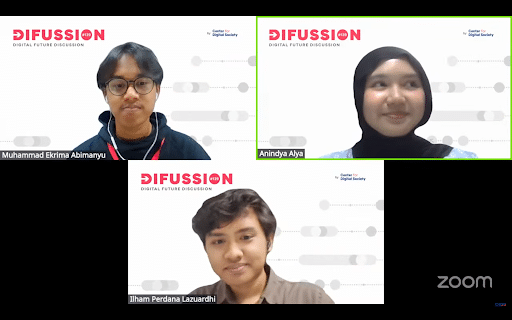
Yogyakarta, November 19, 2026 – The growth of AI has increased the demand for data centers around the world, including Indonesia. However, its benefits remain contested, as data centres are argued to put pressure on the earth’s already scarce water and electricity supply. In navigating this development, the Center for Digital Society (CfDS), Faculty of Social and Political Sciences (FISIPOL), Universitas Gadjah Mada (UGM) came back with Diffusion #139 entitled “The Political Economy of Resources Behind AI Data Centers” online on Thursday (19/11). The speakers were two CfDS Research Assistants, Ilham Perdana Lazuardhi and Muhammad Ekrima Abimanyu, and the discussion was moderated by Anindya Alya Nurmaitsa (CfDS Research Assistant).
In the first segment, Ilham focused on the relations between technology, the environment, and public welfare. He emphasized that “AI data centers are inherently political because they determine optimization priorities, the distribution of prosperity, the resilience of environmental ecosystems, and they position water within the AI data center cycle as a resource that has been, and may continue to be, extracted to optimize AI data centers.” For example, allocating water to data centers can compromise public access to essential water supplies, a concern that has already sparked protests in Indonesia.
Citing IEA estimates, Ilham said data centers used 560 billion liters of water in 2023, a figure expected to reach 1,200 billion liters by 2030, noting that the world has entered a stage of water bankruptcy. Responding to this, in Ilham’s view, each party has different responsibilities. The tech industry should use cooling systems that reuse water and should restore damaged environments. The government should decide which areas are suitable and oversee how data centers use water, while the public can advocate for its interests and document the harm it suffers.
In the second segment, Abimanyu discussed the issue of the energy paradox in Indonesia, highlighting how AI, while contributing to energy efficiency, for example through PLN’s predictive Virtual Command Center (VCC), is also a new source of electricity demand. According to the data Abimanyu compiled, the 159 data centers that are PLN customers used 2,378 GWh in 2025, about 0.75% of national electricity consumption. This is projected to grow roughly tenfold by 2030, and most data centers sit on the Java-Madura-Bali grid. He also noted that restrictions on data centers in Singapore and Malaysia have made Indonesia the next destination for investment. Using the 4A framework (availability, accessibility, affordability, acceptability) and a case study in Cikarang, he concluded that “Indonesia appears to be experiencing a paradox in which the risks and burdens outweigh the benefits.”
In the Q&A session, both speakers said AI development tends to widen the gap between advanced and developing countries. Indonesia provides land, cheap electricity and water, but does not yet control the technology. Abimanyu pointed to cooperation among Global South countries, including within ASEAN, as a way to strengthen bargaining power. Meanwhile, Ilham stressed that digital sovereignty is not enough unless the benefits are shared fairly at home. The challenge, therefore, concluded by the webinar, is not simply how to attract more AI investment, but how to ensure that the resources powering it serve the public interest rather than deepen existing inequalities.
The recording of the webinar can be watched at the following link: https://www.youtube.com/live/X8gVZMCIc6o
Author: Palupi Esfandiany Widihartanto
Editors: Masgustian and Eka Nur Raharja