- 05/06/2024
- Category: Commentaries

Author: Luthfi Baihaqi Riziq
Editor: Achmed Faiz Yudha Siregar
Introduction
Up until mid-2024, the Nusantara smart city development project has been dynamic. It became a more popular theme preceding the 2024 presidential election.1 Beyond that, in not-so-political terms, the city itself has witnessed infrastructural progress while also constantly receiving dissidents from occupying indigenous peoples and from skeptical citizens all over Indonesia.2 This “not-so-political” side of things has been termed “infra-politics”, concerning how asymmetrical power relations lead the disadvantaged groups to exercise nonpolitical resistance.3 This commentary intends to highlight the problems of the Nusantara digitalization vision, illustrate the politics of infrastructure, and how citizen resistance could be exercised.
Idea of Digitalization for IKN
The first phase of the new Indonesian capital city Nusantara (Ibu Kota Nusantara/IKN) is about to end. The government has constructed basic infrastructures to facilitate government affairs, such as offices and residences for government officials.4 This part of the development is expected to continue until September 2024, when thousands of civil servants are relocated to Nusantara.5 This first phase is just a foundational step in the overall development plan of Nusantara. According to the city blueprint, its development consists of five phases. In the first phase, the focus is on the main government and other urgent infrastructures such as roads and hospitals, enough for government relocation. The second phase will see the development of supporting infrastructures, namely transportation. The third phase, expected in 2030-2034, will witness the installation of digital amenities in the city’s core area.6 This will show more openly the realization of the “Nusantara smart city”, with digital technologies pervasive in daily urban processes and citizens’ normal life, even involved in the fourth phase of education and fifth phase of research and development to ideally set the course of Nusantara to become a “world-class city”.
The vision is to create an interconnected city using systems that are integrated into infrastructures, like buildings, public transportation, and power grids. Specifically, the main infrastructure in the blueprint is a data center and an “Integrated Command and Control Center” (ICCC). These infrastructures are to process collected data through urban activities and later influence city decision-making. The “smart city main technology”, however, only directly involves city administrators, not a common citizen. Common citizens play the role of consumers and users of public digital infrastructure. Walking down the street, citizens are expected to meet with “smart poles”, light poles with all sorts of features embedded in them. They can use it to call authorities in case of emergency, search for information, or charge their electric vehicles.
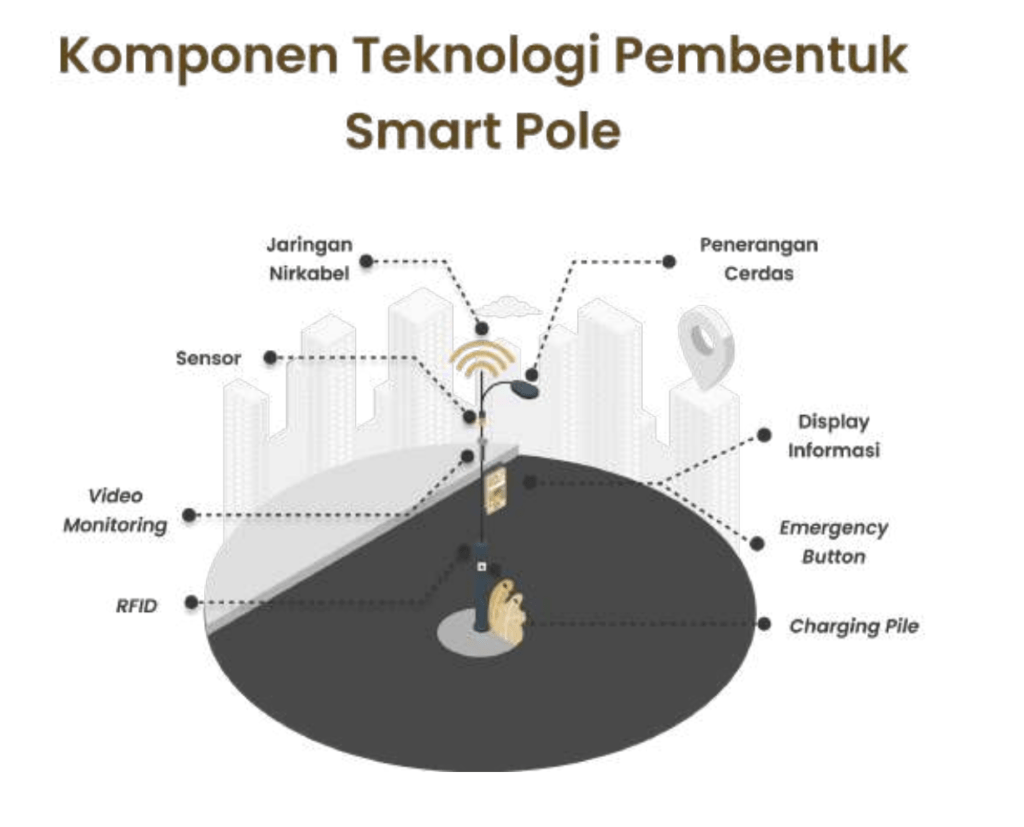
Picture 1. Smart poles (Source: OIKN).
Of course, along with smart cities, came the idea of “smart people”. Hetifah Sjaifudian, vice chairwoman of the Tenth Commission of the House of Representatives, wrote in Tribun Kaltara that “smart people” would also be needed in the new smart city Nusantara. She defines “smart people” as a smart, modern, and cultured society. Education in Nusantara, Hetifah fantasizes, is taught by smart people to future ones.7 However, as we will see, this image leaves off a larger picture and discriminatorily assumes what it means to be “smart”. The Nusantara digitalization vision—along with ideals of the people living in it—is problematic because it is based on a top-down and technocratic nature.8 It leaves off the voices of local indigenous groups, abandoning the opportunity to make the whole project a democratic and deliberative one.
“Smart People”: Who?
In an interview with Tempo, LIPI researcher Henny Warsilah said that Nusantara has to implement a smart city based on smart people to prevent it from being a dead city in the future.9 The question that remains here is whether marginalized indigenous peoples who were already occupying the spaces of Nusantara would be included in this predefined sense of smartness.Two BRIN researchers Moh. Muttaqin and Vita Pusvita framed the required skills for smart people in Nusantara as ICT competencies. The ability of citizens to use and innovate digital technologies that will be present in Nusantara is what they describe as smart people to have.10 Concerns regarding this are not that indigenous peoples are technologically illiterate or anti-digital technology. It is that they will not be included in the production of the technology or even the education to use it. This concern is likely to be reproduced after the fact that indigenous citizens are not optimally being engaged in the spatial production and governance of the city.11
| Competencies | Primary actor |
| Accessing database (e.g. from the city’s data center) | Government (employees, political leaders) |
| Private | |
| Citizen | |
| Utilise database content | Practitioner |
| Innovate new solutions/technology | Innovator |
| Apply knowledge and learn new insight | User |
| Tester | |
| Share insight and create new knowledge | Group of user/tester |
| Formulate and standardize knowledge | Group of user/tester |
| Systemise the knowledge management | Knowledge management team (knowledge management experts) |
As advocated by AMAN, the Capital City Authority (Otorita Ibu Kota Nusantara/OIKN) needs to have productive dialogues with common indigenous community members—those who are not the tribal elite nor those who pose as one. This is because it is not uncommon for said tribal representatives to support the government’s policy without promoting local concerns.12 In developing digital infrastructure for the smart city, OIKN has to involve indigenous citizens in the planning process. This will make local concerns more visible in the development results while simultaneously preparing common indigenous people to become “smart people”: that is, enabling the diffusion of ICT knowledge and competencies relevant to the smart city for the common Indigenous communities.
Conclusion If local concerns are not addressed in the upcoming phases, there are three forms of infra-political resistance that indigenous citizens might hold. The first is the most generally known, that is to learn to adapt to the situation by preparing technological literacy independent of government policies and programs. The second is to have internal connections to government officials that can work so that indigenous communities can get a hold of some key infrastructure in Nusantara, such as water or electrical grids.13 The third is to live by constantly reproducing and sharing indigenous narratives inside the city. In this way, indigenous citizens may continue to voice their concerns against the development of the smart city.
- A theme in the 2024 presidential election is the debate on capital relocation. It is also thought to be a significant factor in the result of the election. See Wilson, I. D. (2023) Nusantara and the spatial implications for the practice of Indonesian democracy. In J. M. Lau, A. N. Alami, S. D. Negara, & Y. Nugroho (Eds.), Road to Nusantara: Process, challenges, and opportunities (pp. 52-74). ISEAS. ↩︎
- See, for example, Widadio, N. A., & Budhi, O. (2024, March 27). Masyarakat lokal ‘merasa terusir’ dari tanah mereka saat IKN digadang jadi ‘magnet ekonomi baru’ – ‘Kami tidak akan melihat kota itu’. BBC. [online]. Available at: https://www.bbc.com/indonesia/articles/cljl4lzw2dxo [Accessed 6 May 2024]. ↩︎
- Scott, J. (2009). Domination and the arts of resistance: Hidden transcripts. Yale University Press. ↩︎
- See, for example, Aditya, R. (2024, April 20). Potret rusun ASN di IKN jelang pemindahan September 2024, ketahui fasilitas hingga tunjangannya. Suara.com. [online]. Available at: https://www.suara.com/bisnis/2024/04/20/071500/potret-rusun-asn-di-ikn-jelang-pemindahan-september-2024-ketahui-fasilitas-hingga-tunjangannya [Accessed 5 May 2024]. ↩︎
- Kementerian Pendayagunaan Aparatur Negara dan Reformasi Birokrasi. (2023, December 16). 3.246 ASN pindah IKN pada Juli-November 2024. [online]. Available at: https://www.menpan.go.id/site/berita-terkini/3-246-asn-pindah-ikn-pada-juli-november-2024 [Accessed 6 May 2024]. ↩︎
- Otorita Ibu Kota Nusantara. (2023). Cetak biru kota cerdas Nusantara. ↩︎
- Sjaifudian, H. (2023, November 27). Menyambut IKN Nusantara, guru-guru di Kaltim pencetak “smart people”. Tribun [online]. Available at: https://kaltara.tribunnews.com/2023/11/27/menyambut-ikn-nusantara-guru-guru-di-kaltim-harus-smart-people [Accessed 5 May 2024]. ↩︎
- See Fainstein, S. S. (2010). The just city. Cornell University Press. ↩︎
- Tempo. (2022, March 7). Ibu kota cerdas untuk pemerataan ekonomi. [online]. Available at: https://koran.tempo.co/read/info-tempo/472328/ibu-kota-cerdas-untuk-pemerataan-ekonomi [Accessed 6 May 2024]. ↩︎
- Muttaqin, M., & Pusvita, V. (2023). Knowledge management for Nusantara’s three visions: Model, system, and contents. In H. Warsilah, L. Mulyani, & I. K. Nasution (Eds.), Assembling Nusantara: Mimicry, friction, and resonance in the new capital development (pp. 231-248). Springer. ↩︎
- Ayunda, I. (2022, April 13). Ancaman punahnya masyarakat adat akibat pembangunan IKN. AMAN. [online]. Available at: https://aman.or.id/news/read/ancaman-punahnya-masyarakat-adat-akibat-pembangunan-ikn [Accessed 6 May 2024]. ↩︎
- Simandjuntak, D., Meschede, D., & Haug, M. (2023). Identifying potential social challenges in IKN: Perspectives of civil society and villagers in East Kalimantan. In J. M. Lau, A. N. Alami, S. D. Negara, & Y. Nugroho (Eds.), Road to Nusantara: Process, challenges, and opportunities (pp. 150-172). ISEAS. ↩︎
- For one notable example, see Anand, N. (2017). Hydraulic City: Water and the infrastructures of citizenship in Mumbai. Duke University Press. ↩︎
