- 29/05/2024
- Category: Press Release
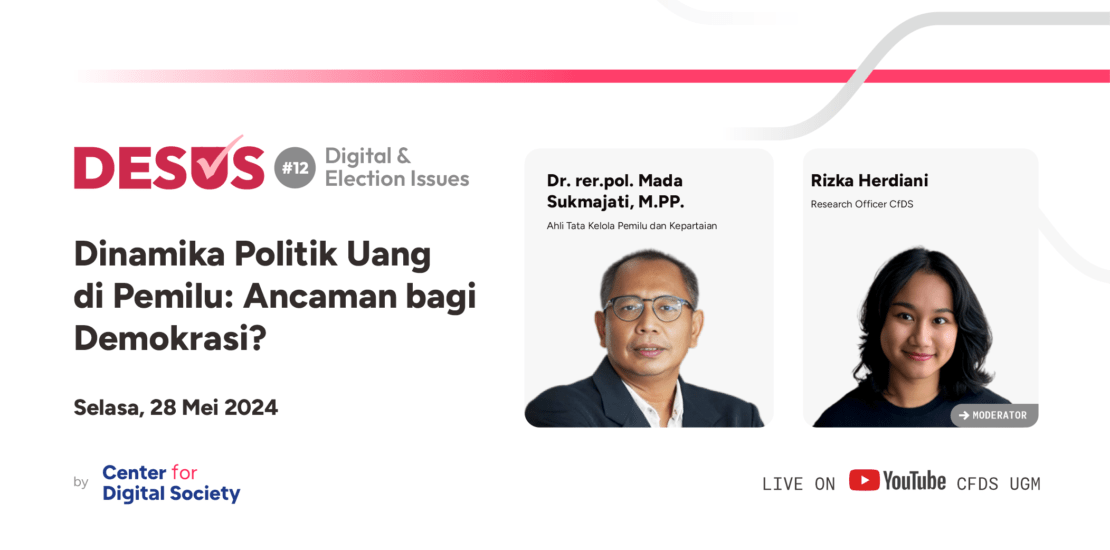
Yogyakarta, (May 28, 2024) – The practice of money politics during elections appears to have evolved in this era, as evidenced by the growing use of digital money through e-wallets. This trend has worsened as the 2024 Regional Elections approach – several national political figures have been reported to distribute ‘illegal’ money digitally in efforts to gain sympathy and votes from the public. In response to this, the Center for Digital Society hosted an Electoral Governance and Party Systems expert, Dr. rer. pol. Mada Sukmajati, M.PP, at the 12th Digital and Election Issues (Desus) event titled “The Dynamics of Money Politics in Elections: A Threat to Democracy?”. The discussion, moderated by Rizka Herdiani (Research Assistant at CfDS), can be rewatched on the CfDS UGM YouTube channel through the link https://www.youtube.com/live/rynCapLHomw?si=FrffuvFQpQHsvbuK]
Money Politics in the Era of Technological Globalization

Mada began his discussion by explaining findings from Prajna Research Indonesia, revealing that the campaign costs to become a member of the House of Representatives (DPR RI) range from Rp 1 billion to 2 billion. For the Regional House of Representatives (DPRD), the costs range from Rp 500 million to 1 billion. These figures are significantly higher compared to campaign costs in 2014 and 2019. This phenomenon is further exacerbated by 47% of voters who are still tolerant of money politics and consider it a norm. This indicates that the culture of money politics is deeply rooted in Indonesian society.
Another alarming finding is the transition of distributing political funds to digital payment platforms, accompanied by campaign materials and social assistance favored by candidates using various modes of operation. Mada presented data from Bawaslu, identifying five provinces with the highest acceptance rates of money politics. These provinces are North Maluku, Lampung, Banten, West Java, and North Sulawesi. This situation is driven by several factors, including structural, economic, and legal aspects. Structural and economic factors, in particular, attract attention. “In essence, regions with lower economic levels are more vulnerable to ‘falling for’ money politics,” Mada stated.
Youth Participation in Stopping Money Politics
Money politics undoubtedly threatens the democracy that has been established in Indonesia. This phenomenon leads to increased corruption, as the rising operational costs of elections make it more difficult for political figures to recover their expenses. Therefore, society, especially the younger generation, is expected to actively participate in eradicating money politics. Nevertheless, the challenge of combating money politics in the digital world still needs further development. This is because, since the first regional elections in 2004, the practice of money politics has become common and has even reached the national level.
This practice is not only present before the elections but also targets election officials after voting, specifically during the vote counting process. “Therefore, in addition to the younger generation helping to tackle money politics, conventional media must also play a role in exposing political cases through their reporting. This needs to be accompanied by further actions to be effective,” Mada concluded his discussion.
Author: Muhammad Alfasya Syabil Sholatar
Editor: Allysa Putri Rendry
