- 20/05/2024
- Category: Press Release
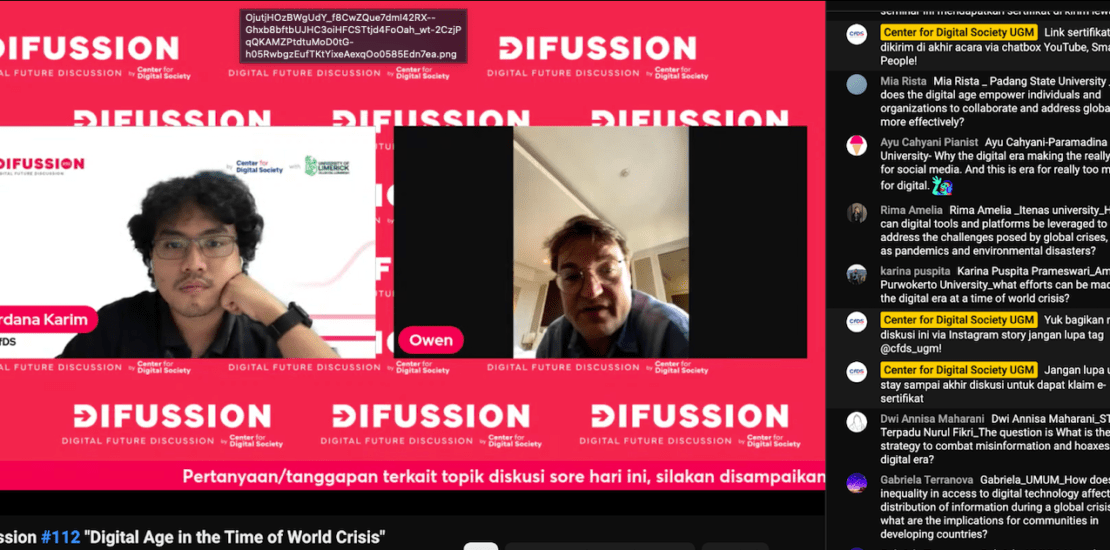
Yogyakarta (16/5/2024) – In the 21st century, the world is confronted with various crises. From economic crisis, health crisis, to political crisis, social problems alternately occur and are clearly exposed in the eyes of the digital society. Responding to this phenomenon, Center for Digital Society (CfDS) UGM held the 112th Digital Future Discussion (Difussion) entitled “Digital Age in the Time of World Crisis” on Thursday (16/5). This event presented Professor Owen Worth, Head of Politics and Public Administration Department at the University of Limerick, as the guest speaker, and Perdana Karim, Research Coordinator of CfDS, as the moderator. The discussion was broadcasted through the official YouTube account of CfDS UGM at https://www.youtube.com/live/Csu6aW9X1U8?si=gqvuplgYhJNar7Ya.
Worth explained that we can view crisis in different ways. Crisis eras are generally characterized by things like economic collapse, political changes, consequences of globalization, environmental conditions, and geopolitical situations. These matters, on certain levels, have a digital element. Communication also plays an important role. He mentioned that one of the perspectives, as mentioned in Adam Tooze’s research, refers to the current era as a ‘polycrisis’ era. A polycrisis is a collection of crises or a type of super-crisis, which refers to a period where society has a collection of crises that occur simultaneously or collide with each other, creating a super-crisis that does not simply disappear. The term is also borrowed from a French philosopher named Edgar Morin, who wrote on related subjects in the 1990s and discussed the societal crisis, with the aim of understanding contemporary phenomena. Worth points out that Adam Tooze has particularly highlighted the post-Cold War neoliberal system as a system undergoing crises.
Worth addressed perspectives from other studies that have argued that the world experiences a state of interregnum and the unraveling of the current global system is taking place. He cites Antonio Gramsci’s famous quote, “The old is dying and the new cannot yet be born”. This kind of argument believes that the current era is dying and coming to an end, which explains why we are experiencing crises. However, people don’t really know what to replace it with. Worth emphasized that communication plays a big role in the digital age because it creates new forms of narrative, new forms of instability, and new forms of opportunity. These new things add to the unusual symptoms of the current era. Some researchers suggest that we are returning to the conditions of the early 20th century when societies experienced various crises and wars. In this thread of crises, the internet continues to play a major role.
The speaker explained about another perspective in understanding the crisis in this digital era, namely through the concept of “the age of catastrophe” coined by Alex Callinicos. He stated that the current crisis can actually be seen more substantially as a kind of catastrophe, as if the world is literally exploding in various ways. We are able to this through extreme poverty rising for the first time in a long time and absolute poverty continuing to decline, which is particularly affecting the Global South. It is also possible to see this through the instigations of war and environmental degradation. The phenomenon is characterized by peculiar events taking place in countries labeled as developed, such as the United States and the United Kingdom, which have experienced political collapse in recent years. The digital age plays a big role in the so-called “culture wars”, where everything tends to appear in the form of stories. We live in a post-truth society that encourages any form of truth to be contested. The digital age also contributes to many associated problems, allowing digital societies to be divided by different views.
Worth elaborated on the crises of global society, from the economic crisis, such as the 2008 financial crisis, the political crisis, such as the rise of right-wing populism and the British Exit (Brexit) phenomenon, the crisis caused by the COVID-19 pandemic, to the crisis caused by climate change and the many disaster occurrences. He added that digital advancements potentially perpetuate crises by enabling the spread of misinformation and disinformation. In experiencing today’s social crises, he suggested the global community to encourage rational debates rather than perpetuating the kind of culture wars that favors post-truth arguments to flourish.
He agrees that the digital age empowers individuals and organizations to collaborate and address global crises more effectively because of the potential to produce progressive movements. He invited us to reflect on this issue through the ongoing global debate on Palestine and Israel. “You’ll see quite a lot of significant campaigning which are pointing out genocide and significant inequalities, and that’s been empowered through information and forged through information. So the culture wars are important because if the right group win or mobilize themselves, then they can empower individuals, and as the result, organization, in order to change things. So, it does provide a catalyst in order to do that,” Worth said.
Author: Carmelia Gaby Talia
Editor: Allysa Putri Rendry
