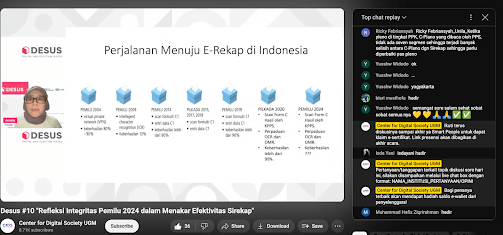
Yogyakarta (8/3/2024) – Nearly a month has passed since the General Election was held in Indonesia. While waiting for the recapitulation process of the vote count results to be completed, various issues and public questions have emerged in regards to the implementation procedures. One of them is the organizer’s decision to use the Recapitulation Information System (Sirekap) technology as a recapitulation and publication tool. Participating in this discussion, the Center for Digital Society (CfDS) UGM held a Desus #10 event entitled “Reflection on the Integrity of the 2024 Election in Measuring the Effectiveness of Sirekap”. This event invited Nurul Amalia Salabi, a Program Officer from the Association for Elections and Democracy (Perludem), as a speaker. This activity was held through live broadcast through the official Youtube account of CfDS UGM at the following link https://www.youtube.com/live/leWAudHGx2g?si=AlPM6F21DkI0pdzI.
At the beginning of the presentation, Nurul explained the global definitions of the use of information technology in elections. In general, the use of technology in elections can create various benefits such as speed, transparency, accuracy, voter convenience, and preventing fraud. However, the use of technology in elections also has various risks such as difficulty in understanding, loss of transparency, system malfunctions, higher costs, and cyber security threats. E-recap as one of the types of voting and counting technology implementation also has several types. E-recap in the context of scanning technology, can use Optical Mark Recognition (OMR), Optical Character Recognition (OCR), Intelligent Character Recognition (ICR), or Seven Segment technology. In addition, e-recap technology can also be used in data entry activities, as well as the use of mobile devices and faxes.
Meanwhile, there are several main principles in using e-rekap. Some of them include: At the planning stage, the decision to use a particular technology needs to be based on the need and urgency of solving election-related problems. Then, this decision should be agreed upon by all interested parties and supported by the public. On the other hand, at the procurement stage, an institution that is credible and has the capacity to develop election technology is needed. Furthermore, at the implementation stage, technology needs to be inclusive, which means that it can be used by everyone easily. Then, Nurul explained the chronology of the use of various types of technology in elections in Indonesia since 2004, and compared the most recent technology used, which is Situng in 2019, with Sirekap in 2024. In the end, the event was closed with a conversation on the problems of Sirekap usage that were found in this year’s election, along with responses and recommendations from Perludem.
At the end of the discussion, waiting for the recapitulation process of the vote count results which is still ongoing until March 20, Nurul responded, “It takes super high endurance [and] resilience from the public now, Mas, to be able to distinguish which information is correct, which information is really disinformation. Because, the challenge now is that our information ecosystem is crammed with as much information as possible, which eventually makes us confused. So, Mas Adat and friends, we need to remain capable in overseeing our elections and we continue to encourage the commitment of data disclosure from the KPU and access to oversee our elections.”
Author: Carmelia Gaby Talia
Editor: Ayu Pratiwi