- 21/09/2023
- Category: Press Release
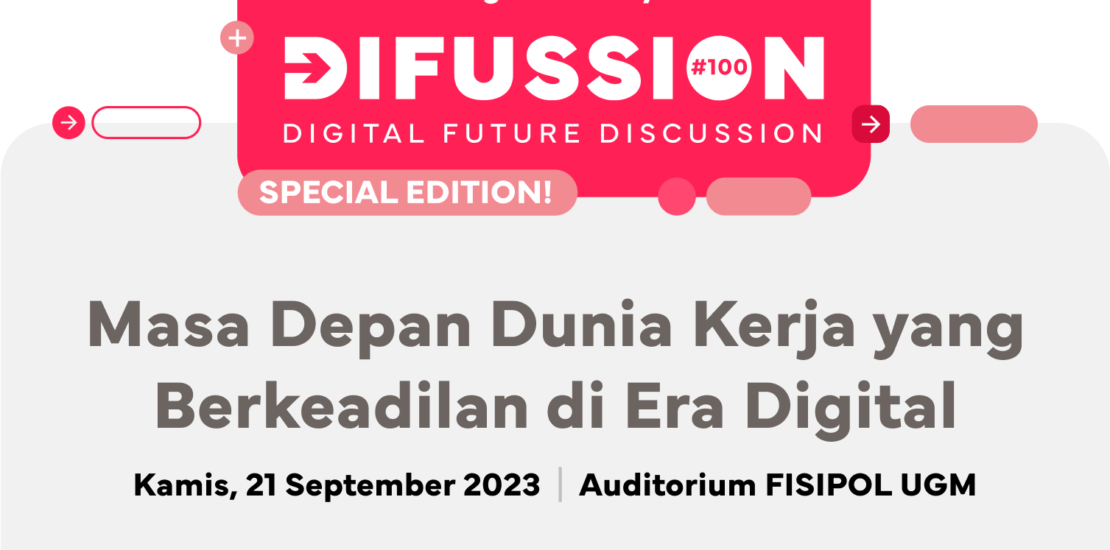


Yogyakarta, September 21, 2023 – Digitalization and technology have changed the way workers work, including in universities. Not only to achieve work efficiency and effectiveness, this also has an impact on the rights of the workers, covering their working conditions and protection. In response to these, Center for Digital Society (CfDS) UGM initiated a discussion forum entitled Difussion #100: “The Future of a Fair Work in the Digital Era” which was held on September 21, 2023 at the 4th Floor Auditorium, BB Building, Fisipol UGM. This event also invited experts in their fields, namely Suci Lestari Yuana, S.I.P, M.I.A. (Fisipol Workers Union), Alvi Syahrina, S.T., M.Sc. (Lecturer in Public Policy Management at Fisipol UGM), and Nabiyla Risfa Izzati, S.H., L.L.M. (Adjunct Researcher CfDS).
On September 1, the Faculty of Social and Political Sciences (Fisipol UGM) officially established Fisipol Workers Union (Serikat Pekerja Fisipol; SPF) to protect workers’ rights while voicing worker’s welfare on campus. Suci Lestari Yuana, as a representative of SPF, was invited to explain the vision and mission of this union. “SPF is one of the first work unions at UGM, and we hope we can empower more worker unions to be established on campus,” said Suci.
According to Suci, the work mindset is dominated by “technological determinism”. For instance, the world of education is starting to be controlled by platform governance, such as SIMASTER UGM and Sister Ristekdikti, SINTA, SCOPUS site, and many more. “As a result of digitalization, its side effects exist in our daily lives as workers, namely trust reduction, alienation, dehumanisation, exploitation of workers, and the list goes on,” added Suci. Through this union, Suci hopes all workers within Fisipol UGM will have a promising position over campus bureaucracy and government policy.
Alvi Syahrina introduced the New Way of Working (NWOW) concept which was born after the Covid-19 pandemic and the digital nomad trend. This concept is a form of fulfilling the interests of workers nowadays. According to her, people are still used to work from anywhere, as it has been permanently adopted in the new working culture.
“Organizations and companies should start to enforce the concept of NWOW in the dynamic digital era,” said Alvi. NWOW relies on the flexibility of time, place, pace, and work relations, as well as the use of technology. “However, we also need to anticipate how we will handle challenges in implementing NWOW, specifically in work culture, the performance and welfare of workers,” concluded Alvi.
Speaking of the challenges workers may face due to the digital technology advancement, Nabiyla Risfa Izzati highlighted the large role of artificial intelligence (AI) in shaping the future of the working culture. Nabiyla found that the future of work presents new career networking and job opportunities, particularly for the younger generation. Hence, some jobs that will emerge in the future will take the form of non-standard employment.
“Many new jobs are not well regulated in Indonesia and prone to be exploited. Not to mention the possibility that these jobs will slowly disappear due to technological advances,” said Nabiyla. She emphasized that the Indonesian legal landscape needs to guarantee and protect the future of the national scope of fair work. It is important for us to understand how to face the future of work, significantly about our rights and obligations under the Law of Employment.
[Boilerplate]
Center for Digital Society (CfDS) is a research center under the Faculty of Social and Political Sciences at Universitas Gadjah Mada. CfDS’s main focus is on issues related to the advancement of digital technology, specifically in e-government, digital society, digital literacy, digital business, and its lifestyle. Through our research and dissemination, particularly Difussion, we aim to educate people and provide information on how technology impacts us in every aspect of life. By collaborating with partners, CfDS strives to facilitate all sessions with speakers who are undeniably experts and qualified in their respective fields.
