- 04/05/2021
- Category: Press Release
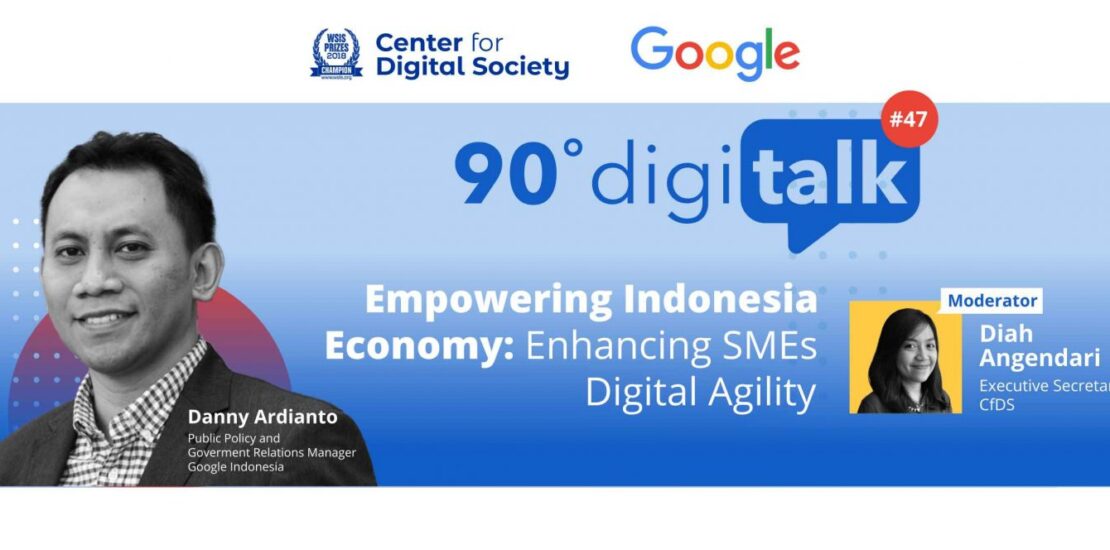
Google Meet, April 30th, 2021 – The growth of Indonesia’s SMEs for the past few years has created its phenomenon in Indonesia’s economic ecosystem, particularly in the digital economy. This phenomenon can be seen through digital migration that has been done by large numbers of SMEs in Indonesia. The accessibility and availability of digital technology throughout times might be one reason why this phenomenon happened in the first place. However, the COVID-19 outbreak also happened to be one of the factors which pushed SME owners to expand their business in the digital space. Therefore, enhancing digital agility shall be the main priority to accommodate this golden moment. Through Digitalk #47, the Center for Digital Society (CfDS) invited Danny Ardianto as the Public Policy and Government Relations Manager of Google Indonesia and Diah Angendari, the Executive Secretary of CfDS, the moderator of the discussion on “Empowering Indonesia Economy: Enhancing SMEs Digital Agility.” Digitalk #47 was held through Google Meet and broadcasted through the CfDS official YouTube Channel (https://youtu.be/-qYgJtFZgVY)
The Potential of SMEs Digitalization in Digital Economy Ecosystem
It has become public knowledge for most SME owners that the outbreak has given a very minimal space for the business process to take place directly. Hence, utilization of digital space and its technology are a few of the most rational options for these owners to keep their businesses afloat. Through e-commerce, they can have the chance to keep their businesses on track and optimize it to broaden their opportunities and business potentials market-wise. This idea is also supported by the growth of internet users per 2020. As stated by Danny in the discussion, “ 37% new internet users appeared in 2020, while 39% of them are willing to stay on the internet even if the outbreak has ended. The data shows how the number of internet users during an outbreak is far higher than pre-outbreak”. Therefore, the optimized usage of digital technology for business needs can positively impact the sustainability of the business itself.
Digital Agility as The Stimulus of Digital Economy
The achievable potential of digital technology should be encouraged with the continuous effort of digital agility enhancement. In order for businesses to stay thriving and sustain during an outbreak, Danny explained that digital migration is strongly encouraged, especially for businesses that run in conventional sectors such as agriculture, fisheries, manufactures, banks, and many more. For that fact itself, it should be understood that digital agility enhancement must be implemented massively. “Without accelerating digital agility, Indonesia’s Gross Domestic Income will only achieve the number of 7% per 2030. Meanwhile, doing the opposite will help the Gross Domestic Income to reach 16% per 2030”, Danny added.
Digital agility is categorized into basic and advanced. Basic digital agility focuses on the foundation skills needed to use digital technology, mainly targeted for non-digital workers. The skills include searching and receiving information, processing information, and making a decision based on the information gained through digital media. While, the advanced digital agility focuses on skills needed for digital workers to create digital innovations, which include but are not limited to design, automation, machine learning, and others.
Google in Equipping Indonesia’s Digital Economy Improvement
In the discussion, Danny stated that there are few key points to be done for achieving the maximum potential of digital technology in many business sectors. First (i), equipping digital agility and skills for the current workforce in digital and non-digital sectors. Second (ii), Preparing future workforce with adequate digital agility and skills to enter the digitally fast-growing industries and sectors. This generation of workforce is expected to help shape the industry itself. So aside from meeting the needs, they should be able to create the needs too. Third (iii), expanding the accessibility of digital technology both the infrastructure and digital literacy. Accessible and equally distributed facilities are unquestionably needed, but without the increase of digital literacy, then it can be expected how the facilities will be used poorly.
Grow with Google
Through their program “Grow with Google”, Google is trying to prepare Indonesians to face digital transformation, which mainly revolves around SMEs, college students, and job seekers, developers, and startups, students and teachers, creators, and journalists. Some of the programs and services provided by Google are Gapura Digital for SMEs; Kormo for college students and job seekers; Bangkit, Google Developers, Google Startups for developers and startups; Google for Education for students and teachers; and lastly, YouTube Creators and Google News Initiative for creators and journalists.
Writer: Dimas Ponco
Editor: Ruth T. Simanjuntak
