- 13/04/2021
- Category: Press Release
Google Meet, March 19, 2021. The covid-19 pandemic has vast impacts in Indonesia on various sectors of society, such as politics, economy, and society. From a political perspective, pandemic affecting the decrease of public satisfaction to government performance consistently. The economic impact is shown by the drop of GDP contribution in some sectors, for instance, infrastructure, trade, construction, and mining. On the other hand, social life has experienced a transformation by adjusting offline to online activities through the digital platform. It has prompted the government to recover the national economy by integrating policy with digital strategy since 2020.
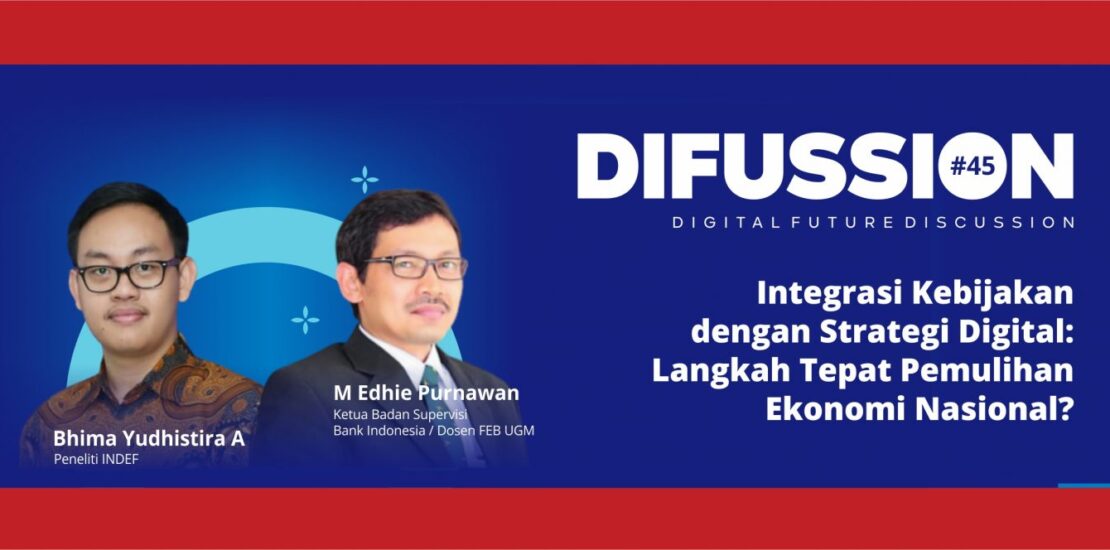
The discussion of economic recovery as the result of the Covid-19 pandemic would be the topic of DIFUSSION #45 with the theme “Integrating Policy Through Digital Strategy: The Right Move to Recover National Economy?”. CfDS had invited Muhammad Edhi Purnawan as the Head of Bank Indonesia Supervisory Board (BSBI) and the lecturer in FEB UGM. There was also Bhima Yudhistira Adhinegara as a researcher in INDEF. Moderated by research manager CfDS, Anisa Partita, DIFUSSION #45 was held via Google Meet and publicly accessed via on CfDS youtube channel.
What Happened in Indonesia for The Past Year Since the Emerge of Covid-19 Pandemic?
The World Economic Forum Global Risk Report 2021 states that the world would be facing global risks. Bhima explained that “the highest five global risks are in the digital realm, namely cybersecurity failure, and digital inequality.” The digital inequality can be seen when the traditional trade loses due to failure to pay its employee, causing the termination of Employment. The deterioration of traditional trade becomes the result of society’s fear of mobile, so they tend to do digital transactions. On the other hand, e-commerce and startup overgrow marked by the massive funding. Not only as an opportunity, but this phenomenon can also be a threat for SMEs when digital companies get funding from the foreign capital venture. It has the potential to dumping politic and predatory pricing.
There are also herd behavior and humanity crises that happened globally. Social media existence stimulates society’s trends, such as local pride, hype beast, cycling, and the cultivation of decorative plants. Besides, the health crisis has impacts on the economy because of the regulation applied by the government. PSBB policy taken to restrict mobility, influencing the GDP drop in the second quarter of 2020.
What Policies That Indonesia Government Has Taken?
The government had applied various policies to resolve problems as the consequences of the Covid-19 pandemic. There are Work From Home (WFH), fiscal and monetary expansive stimuli, and digitizing crucial aspects. It is needed to emphasize that WFH is a privilege. Moreover, it isn’t applicable for manual work, such as firefighters. For monetary policy, as an independent institution, Bank Indonesia had asked banks in Indonesia to open basic lending rates and the transparency of communication for creating an effective implementation of regulations. The Indonesian government had been digitizing crucial aspects, such as health, by doing 3T and digital finance to a digital bank. Indonesia’s government also digitized by transforming finance through digital literacy of finance, strengthening SMEs to create entanglement; financial market infrastructure, sharia, and other reform policies.
Are The Strategies Adopted by the Indonesian Government for Recovering National Economy Has Been Correct?
Digitalization consists of opportunity and threat. Therefore, there are crucial elements to be skilled to recover the economy. Edhie explained that there are a few requirements of
(1) being technological savvy in the form of understanding the digital knowledge and applications;
(2) fiscal implementation to be enjoyed by people who receive assistance through digital banks;
(3) macroprudential monetary and stimulus policies digitally.
On its implementation, the Indonesian government policies still have impacts on two sides, for example, Work From Home. WFH policy has the disadvantage of cutting work benefits so that employee guarantees are reduced. On the other hand, WFH encourages financial inclusion through fintech.
Writer: Septiana Noor M
Editor: Ruth Tarullyna Simanjuntak
