- 01/12/2018
- Categories: Commentaries, Press Release
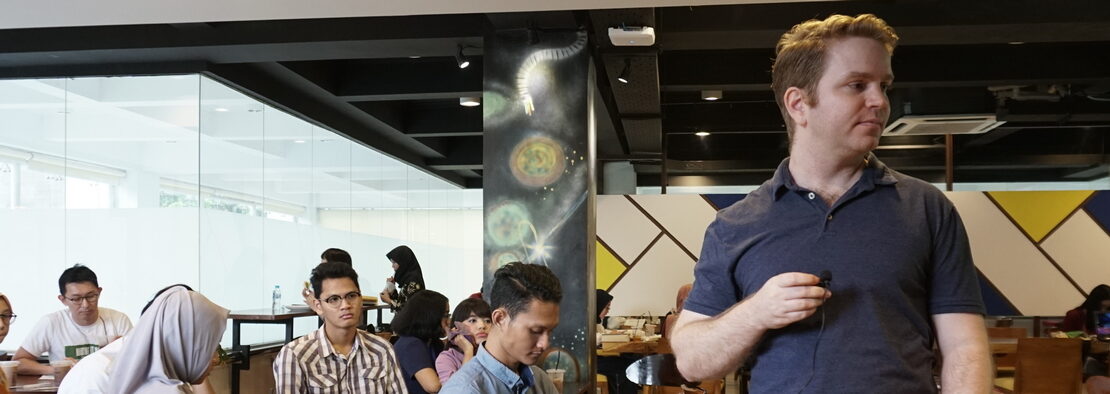
Yogyakarta, 29 November 2018 – Natural disaster is inevitable yet it actually can be prevented and mitigated. Or, we can minimized the impact of disaster on the society. The development of technologies, both disaster detection technology and ICT have become one of the ways to increase the quality of disaster management. There are some opportunities and challenges regarding the disaster management in Indonesia, which is located at the disaster-prone area such as tsunami or earthquakes. The issue of natural disaster and its mitigation through technology utilization became the main theme in CfDS’ monthly discussion series, known as Difussion #9: Technology for Disaster Mitigation (29/11).
Social Media as the Source of Information About Disaster
Social media is often used as a source of information in many issues since it offers the advantages of speed and great amount of the newest information’s flow. One account of social media that provides information about disaster is @Sutopo_PN (twitter) which is a personal account of Sutopo Purwo Nugroho, Head of Data and Public Relation Center of BNPB or National Disaster Management Agency of Indonesia. According to James (RSIS-NTIS Singapore Research Partner), Mr. Sutopo is a very good example in using social media to spread information about disaster and indeed, he can be titled as “Number one contact for disaster”.
Mr. Sutopo is there with the people through social media and receiving good response from the society. Mr. Sutopo succeeds in conducting public outreach and become an effective source of information. The challenge in searching information on social media is about the accuracy because there are too much information being shared and therefore, it is become harder to identify the right and correct information. The ‘share’ feature in social media that make people always share any information – although it is unverified – add the dilemma in the social media consumption in Indonesia. This problem makes social media account like Mr. Sutopo’s becomes more important and relevant because the account is already verified (verified account) and provide consistency, so the information from this account can be trusted. In addition, Mr. Sutopo is very active in clarifying and gives statement about disaster, hence the account is becoming more trusted and more popular among many people.
This kind of personal account is an alternative compared to account of organization such of from BNPB itself. Considering this kind of account is more attractive to people with personal contents that are not too serious and interesting to catch up with, Mr. Sutopo himself like to tweet and mention singer Raisa Andriana (@raisa6690) and finally got viral through hashtag #sutopomeetraisa. Mr. Sutopo is a public figure that spread positive and useful contents which are loved by many people. Therefore, a personal account from person who has authority such as Mr. Sutopo (as representative of BNPB) can be one of the strategies in disseminating information about disaster
Improvement of Disaster Management System Through Information Crowdsourcing
Management and mitigation of disaster in Indonesia is centralized trough BNPB or BMKG (Meteorology, Climatology, and Geophysics Body in Indonesia) that give information about disaster based on data. Even though the data and information about disaster from them are trusted, it will not be always accurate considering there might be error in the process of taking the data from the devices of the technology that also operated by human. Besides, the data is less contextual or maybe different from the people’s experience who suffer from the disaster and it still needed time in the distribution of the information itself. It is necessary to take consideration of data gathering from public. The data is collected through internet and social media and accommodated to be processed as the information crowdsourcing. This method gives space for public because the people who are at the location of the disaster will be faster (in giving information) rather than waiting for the official to get there. Information crowdsourcing is a form of data in bottom-up data ways about information of disaster.
Accuracy is still the most important element in disaster’s information, so we cannot rely on crowdsourcing data alone. We also need to obtain information from government’s body through method of data collection from disaster detector or something else. However, it can be added by the information from crowdsourcing to make information regarding disaster become more contextual. The data from crowdsourcing should be processed first and being analyzed to map what kind of policy and regulation that can be made in disaster management. Basically, data collection is important for disaster management system. In Sri Handayani’s view as the second speaker of Diffusion #9, top-down (data from government) and bottom-up (information crowdsourcing) will complement each other and can not stand alone for disaster management particularly.
The Fading Boundary Between Natural Disaster and Man-Made Disaster
Natural disaster occurs because natural phenomena happens and can not be prevented by human, and there is also disaster that occurs because of human action, for example; flood. The disaster that is caused by human activity or man-made disaster is known also as anthropogenic disaster. Unfortunately, with current situation the natural disaster and man-made disaster is harder to be distinguished because the human activity that hurt the earth and thus, the earth give its reaction through disaster.
One of the recent examples of natural disaster was the case of Palu and Donggala that started with an earthquake and then stopped for enough time before tsunami came. Here we can see, there was a loop-hole, when there should be time for early warning and people could save themselves from tsunami. From the discussion, we knew that there was research which already discover that the area of Palu and Donggala is prone to earthquake and tsunami but there were no any serious action to prevent and mitigate disaster. This
The development of technology should be able to prevent disaster or at least minimize the effect. One of the examples that can be used to prevent disaster according to Jaehyeon Park (Research Fellow-University California Los Angeles) is modelling to make future scenario of flood like in Jakarta. Although technology is already advanced, it is not enough to do disaster management alone as natural disaster already mixed up with man-made disaster, so it is necessary to combine between technology and human’s effort to do disaster management.
Reporter: Stefani Dyah
