
- 24/02/2018
- Category: Commentaries
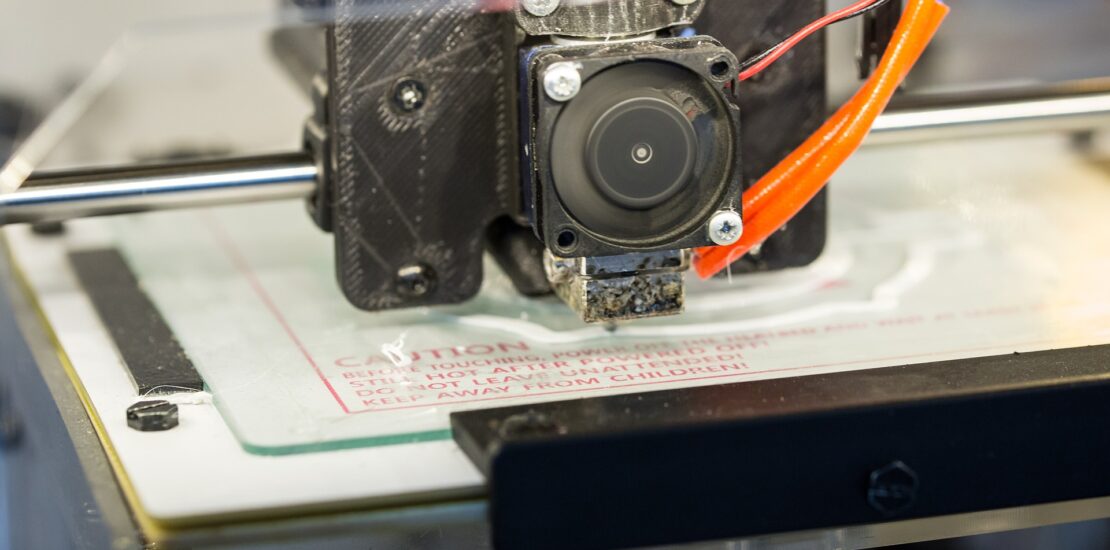
Have you ever imagined that you could make any object you want with just a few clicks? Using 3D printingtechnology, that is not an impossible thing to do. As a disruptive technology, the emergence of 3D printing technology has significant prospects to transform business, manufacturing, and even society in general.[i] Over the past few years, this technology has been used in many sectors, such as automotive, arts, aviation, electronics, health, and even for making food. For instance, the airline company Boeing, until 2014, has already made approximately 20.000 parts for ten different military and commercial planes by using 3D printing technology.[ii] In the health sector, this technology demonstrates a successful utilisation in the making of standard and complex customised implants and prostheses.[iii] The use of 3D printing shows many benefits as it can reduce the costs, accelerate the process, and enhance productivity. However, this revolutionary technology, comes with another substantial challenge for Intellectual Property (IP) protection, especially in the digital age context.
IP is protected by law in many forms. Copyright protects a creation or invention by granting the creator exclusive right to a creation, which emerges automatically after the creation is manifested in a tangible form.[iv] As for patents, it protects technological inventions of products or process, along with the improvements and developments.[v] Furthermore, trademarks rights protect signs which distinguish products or services to the others, and design rights protect industrial designs (in 2D or 3D) from being used by other people.[vi] Although copyright might be the major issue in the digital age, the other three categories described above might also be affected by 3D printing technology, as the 3D printing process – fabrication of a physical object from three-dimensional digital models using printing technology[vii] – may attract protection or infringes IP rights.[viii] There are at least three points in the fabrication process of a physical object using 3D printing technology that potentially infringe IP rights. These are the3D printing design file and the substance of the file (the artistic creation to be printed); the 3D printed object; and the online repositories where the design files are uploaded and shared.[ix]
First, the design contained in the 3D printing design file may attract copyright protection as an artistic work. Since artistic work is a form of data that can be read by computer programs, it is included in the 19 creations which are protected by Indonesian Copyright Law.[x] This also applies if the design contained in the file is classified as a patented object, or if the design is protected by design right/trademark.[xi] Therefore, unauthorised use of any IP protected materials might be constituted as an infringement. Second, the 3D printed object may also attract copyright protection as an artistic work in the form of sculpture, applied artwork or architecture work. Therefore, if the printed object or part of the object is protected by IP rights such as mentioned above, the act can be constituted as an infringement, either copyright, patent, trademark, or design right, as it was without permission from the rights owner. Third, 3D printing can also infringe IP rights based on the online repositories where the design files are uploaded and shared. Today, lots of online platforms share 3D printing designs for free, such as thingiverse.com or pinshape.com. Although these platforms can expose and enhance people’s creativity, it is likely problematic for the IP rights owners, especially if IP rights protect the shared designs or some parts of it. Furthermore, the act of sharing a potentially right protected object on the Internet without permission from the rights owner itself constitutes copyright infringement, not to mention other IP rights described above.
Problems that arise around IP in the digital age is not a new thing. Nevertheless, as the 3D printing technology has become mainstream, the possibility for IP rights infringement also rises. Today, as people have easier access to 3D printing designs, and that 3D printers also becomes more affordable, people can reproduce almost any object they want using 3D printing technology. It means that, just by a few clicks, many people could potentially be criminalised as they might infringe various IP rights in the printing process. This issue should be a concern for the government, not only to protect the creators’ right and the people’s creativity in the digital age but also for people in general to have a better appreciation for others’ creations.
Editors: Atin Prabandari, MA(IR) & Nabeel Khawarizmy Muna, SIP
picture: pixabay
[i] Dawson, F. (2014). How Disruptive is 3D printing Really? [online] Forbes. Available at: https://www.forbes.com/sites/freddiedawson/2014/09/30/how-disruptive-is-3d-printing-really/#4822d9214e44 [Accessed 7 Feb. 2018].
[ii] Gilpin, L. (2014). 3D printing: 10 Companies Using It in Ground-Breaking Ways. [online] TechRepublic. Available at https://www.techrepublic.com/article/3d-printing-10-companies-using-it-in-ground-breaking-ways/ [Accessed 7 Feb. 2018].
[iii] Ventola, L.C. (2014). Medical Applications for 3D printing: Current and Projected Uses. P&T: A Peer-Reviewed Journal for Formulary Management, 39(10), 707.
[iv] See Law No. 28 of 2014 concerning Copyright, Art. 1(1).
[v] See Law No. 13 of 2016 concerning Patent, Art. 1(1)
[vi] See Law No. 20 of 2016 concerning Trademarks and Geographic Indication, Art. 1(1). See also Law No. 31 of 2000 concerning Industrial Design, Art. 1(1).
[vii] Rimmer, M. (2017). The Maker Movement: Copyright Law, Remix Culture and 3D printing. The University of Western Australia Law Review, 41(2), 52. See also Noorani, R. (2018). 3D printing: Technology, Applications, and Selection. New York: CRC Press, 2-3.
[viii] See Daly, A. (2016). Socio-Legal Aspects of the 3D printing Revolution. London: Palgrave Macmilla, 21-22.
[ix] Ibid., 23.
[x] See Law No. 28 of 2014 concerning Copyright, Art. 40.
[xi] See Law No. 13 of 2016 concerning Patent, Art. 160; Law No. 20 of 2016 concerning Trademark and Geographic Indication, Art. 83(1); and Law No. 31 of 2000 concerning Industrial Design, Art. 9(1).
