- 20/02/2018
- Categories: Commentaries, Press Release
The phenomenon of the Fourth Industrial Revolution has been impacting human’s life in multiple aspects. Although the technology bring several negative effects, it cannot be denied that technology also brings new benefits and opportunities for the society. This encourages the needs for an integrated support system for digital transformation trends to evolve. Not just for a direct impact change, this trend also provides a wider use of an automatization. The importance of strategy and planning is increasing to guard the transformation effort. The initial approach that we can take now is to prepare a public policy that can adopt positive benefits, without negatively impacting the digital society.
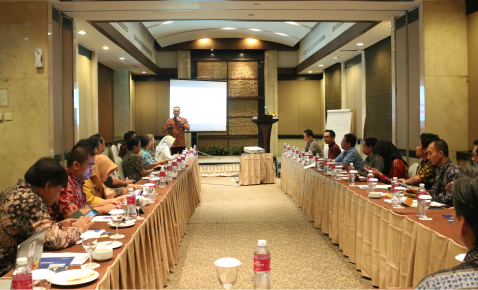
In collaboration with Microsoft Indonesia and the Ministry of Communication and Informatics of the Republic of Indonesia, Center for Digital Society (CfDS) UGM held a workshop entitled “The Fourth Industrial Revolution & The Future Of Public Policy In Indonesia” on Thursday (15/2) at Crown Plaza Jakarta. The event was attended by at least 25 high-ranking officials from various national government institutions in Indonesia, such as the Indonesian Ministry of Communication and Informatics (Kominfo), the Corruption Eradication Commission (KPK), the Supreme Audit Agency (BPK), the Ministry of Finance (Kemenkeu), and many others. The event was opened by Semuel Pangerapan, Director General of Informatics Applications, and then followed by three discussion sessions with various themes.

The first session was delivered by Dedy Permadi, the managing director of CfDS UGM, which carried “The Utilization of Technology in Maximazing Public Policy Implementation” as the opening topic. He gave examples of countries that already have integrated digital technologies and transformations, such as China, India, Japan and the United States. Learning from the experience of these countries, it is seen that public policy that integrates with technology will cause a positive impact, such as poverty reduction and economic progress. During the question and answer session, the audience agreed that opportunities for Indonesia existed, but the aperture within the support systems such as education sector and cooperation between institutions were often the main obstacles.
The discussion then continued with the theme of “Technology as a Resource for Disruption and Problem Solving”, delivered by Astrid Tuminez from Microsoft Asia Pacific. She said that digital transformation belongs to all parties, including the government. The fourth industrial revolution allows physical, digital, and biological constraints to blur, creating new threats such as cybercrime, but also providing opportunities such as cloud computing and big data. Unfortunately, Indonesia has not invested much money for such research, so that it can be said the challenge for Indonesian society is regarding the mindset, infrastructure and justice.
The discussion in this workshop emphasizes the need for the Indonesian government to formulate appropriate strategies and policies to synergize with the existing systems. The main recommendations that arise from this forum are training and education to develop the resources that Indonesia has. In addition, it is also necessary for the Government of Indonesia to find the right issues and concepts, and to start from small things followed by evaluation.
This workshop was part of a series from the collaborative program of triple helix workshop and dissemination research conducted by CfDS UGM and Microsoft. The agenda will be followed by a workshop entitled “Data Classification on Cloud Computing in E-Governance”, which will be held in March 2018.
