- 06/02/2018
- Category: Commentaries
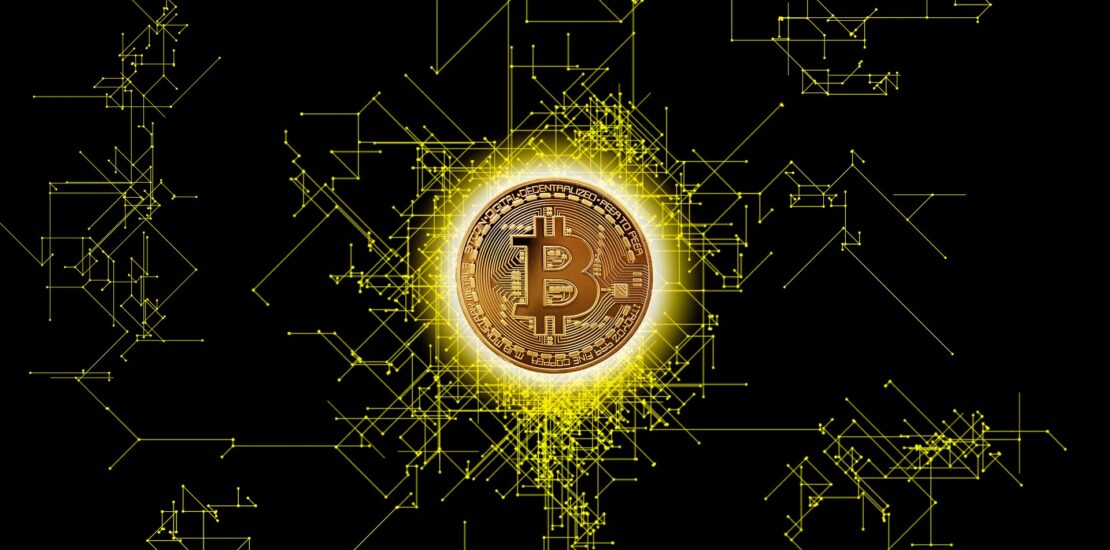
Over the past few years, netizens have been overwhelmed by various cryptocurrencies, one of which is known as Bitcoin. The rising value of Bitcoin makes information about this new virtual currency much sought through online search engines. The bitcoin-related search also leads to technological innovations that underpin these investments. One of these innovations is called ‘blockchain’ in which all transactions are bundled into blocks. Despite the technology being determinant in cryptocurrency, the technology is also present at the simplest way in almost every high-tech environment nowadays. The technology enables a way to manage, monitor, and store blocks of approved/validated data that are cryptographically encrypted.[i] These transaction blocks need to be approved by every party in the network before the transaction completes. Blockchain uses a broadcast network by using codes to propagate transactions and blocks. What is interesting is that this block will be added to the chain, ensuring the transparency of every transaction. The following illustration explains how a blockchain work.

Source: Financial Times[ii]
Blockchain doesn’t let any reversible actions in the transaction process. This mechanism makes blockchain a highly secure system in which a small change can disrupt the whole process. Blockchain theoretically offers an interconnected infrastructure that leads to generating significant efficiency gains, reducing duplicative record keeping, eliminating reconciliation, minimizing error rates and facilitating faster settlements.[iii] The blockchain concept is projected to bring a transformative impact to the global business infrastructure to achieve sustainable development by using more efficient systems than the current ones.[iv] It can also bring significant value to the business cycle, from trade finance to payments, securities settlement, and regulatory compliance. The blockchain technology can help transform the traditional business processes which are often bureaucratic, expensive and vulnerable because of the intervention of intermediaries to validate transactions.[v]
One of the advantages offered by blockchain is the smart contract facility.[vi] Smart contracts, encoded in a programming language, are embedded in the blockchain and are executed with the transactions. The implementation of smart contracts in blockchain can bring a significant benefit for ports especially in relations to managing the supply chain for container shipping. Blockchain provides each participant with end-to-end visibility based on the level of permission.[vii] All the documents for shipping containers can be fully digitized, and the containers can be tracked down. We can get information of when the ship arrives and what is in the container, so we can plan how to handle the containers more efficiently. By combining digital records and blockchain, costs can be sharply reduced and eliminated in the shipping cycle.
The blockchain is a promising system in the shipping industry, as it makes schedule organization, transactions tracking, information database, contracts review, orders making, and payments more efficient and secure.[viii] These exciting opportunities are accessible for all parties (seller and buyer of cargo, shipowner, charterer, bank, agent, customs officials, port authority, etc.) through a paperless, automated, and secure online environment. The Marine Transport International estimates that blockchain could save $300 per container regarding labor and processing associated documents. For one ultra-large container ship, which carries up to 18,000 containers, the savings amount to $5.4m.[ix]
As the “Jokowi” Joko Widodo administration implements the “Global Maritime Nexus” (Poros Maritim Dunia) as its top priority, five main pillars will help Indonesia realize this nexus. The third and fourth pillars contain efforts to encourage the development of maritime infrastructure and connectivity, one of which relates to the enhancement of the container shipping process.[x] To promote Indonesia as the maritime axis of the world, blockchain technology can also be used to overcome the problem of Indonesia’s maritime sector. The extraordinarily high costs of transporting goods domestically have made it cheaper for Indonesians to consume foreign goods than domestic ones, and have made the nation functions more as a collection of weakly integrated economies than as a unified market.[xi] Besides, there are existing threats such as widespread piracy, illegal fishing, and unauthorized movement of goods across Indonesia’s maritime route. With its accurate, secure, and transparent system, will the application of blockchain in Indonesia please all parties?
Editors: Atin Prabandari, MA(IR) & Nabeel Khawarizmy Muna, SIP
Picture: pixabay
[i] Newman, D. (2017). ‘Blockchain 101: How This Next Big Service Will Change the Future.’ Forbes. Available at: https://www.forbes.com/sites/danielnewman/2017/04/13/blockchain-101-how-this-next-big-service-will-change-the-future/#656eea0d4bd3 [Accessed 30 January 2018]
[ii] Wild, J., Arnold, M., Stafford, P., (2015). ‘Technology: Banks seek the key to blockchain’. The Financial Times. Available at: https://www.ft.com/content/eb1f8256-7b4b-11e5-a1fe-567b37f80b64 [Accessed 30 January 2018]
[iii] McLean, J. Banking. ‘Blockchain: Charting the Progress of Distributed Ledger Technology in Financial Services.’ Technical Report; Finextra Research Ltd. [Accessed: 30 November 2017]
[iv] Cocco, Luisanna et. al. ‘Banking on Blockchain: Costs Savings Thanks to the Blockchain Technology.’ [Accessed: 20 November 2017]
[v] Ibid.
[vi] Ibid.
[vii] Groenfeldt, Tom. (2017). ‘IBM and Maersk Apply Blockchain to Container Shipping.’ Available at: https://www.forbes.com/sites/tomgroenfeldt/2017/03/05/ibm-and-maersk-apply-blockchain-to-container-shipping/#458ec2283f05. [Accessed: 27 January 2018]
[viii] Cole International. ‘Blockchain technology and the container shipping industry’. Available at: https://www.coleintl.com/cole-resources/industry-insights-blog/514-blockchain-technology-and-the-container-shipping-industry.php.[Accessed: 18 January 2018]
[ix] Grey, Eva. (2017). ‘Could blockchain technology revolutionize shipping’. Available at: https://www.ship-technology.com/features/featurecould-blockchain-technology-revolutionise-shipping-5920391/ [Accessed: 24 January 2018]
[x] Official Website of the President of Republic Indonesia. ‘Indonesia sebagai Poros Maritim Dunia.’ Available at: http://www.presidenri.go.id/berita-aktual/indonesia-sebagai-poros-maritim-dunia.html
.[Accessed: 15 January 2018]
