- 04/05/2016
- Category: Commentaries
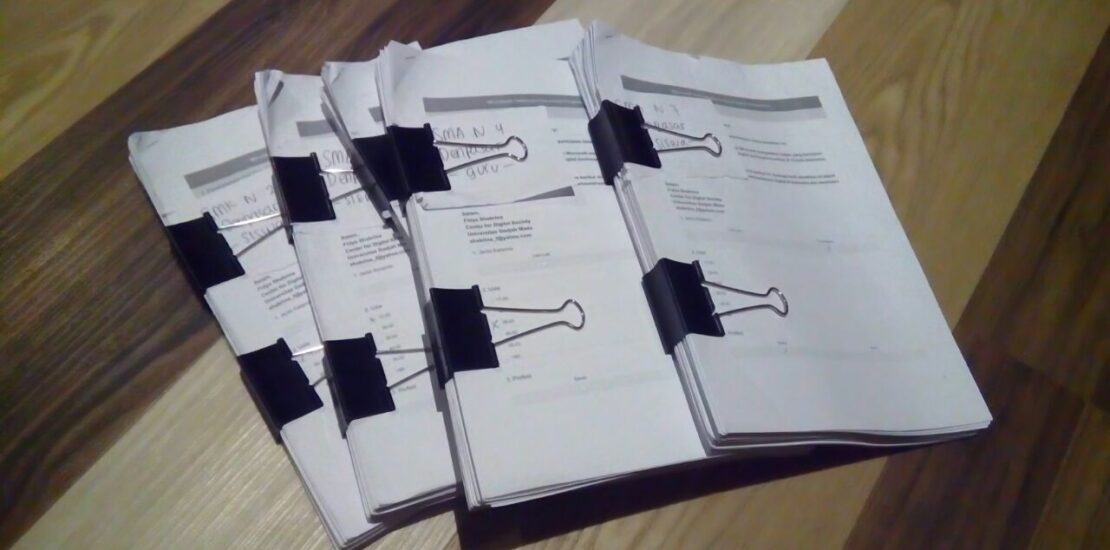
May the 2nd is annually celebrated as Education Day in Indonesia, commemorating the birth of Ki Hadjar Dewantara, the father of Indonesian education. Decades after Ki Hadjar Dewantara’s effort in establishing Indonesia’s modern education, Indonesian education’s face is still far from appropriate. The unstable and changing curriculum, lack of infrastructures, as well as less qualified educators remain the major problems. One of the most criticized aspect in Indonesia education is the National Examinations/Ujian Nasional (UN).
Despite its questionable effectiveness, UN draws more attention from the government in every year. Improvements in terms of tests quality and distribution method have been significant in recent years. Ministry of Culture and Elementary and Secondary Education Minister, Anies Baswedan, changed the national assessment system of national examinations from paper and pencil-based (UNBKP) to computer-based test (CBT). The CBT is not yet compulsory for all schools. Started with 594 schools in 2015, the number reached 4.402 schools (accounted for 927.000 out of 3.300.000 students participated in UN) in 2016.[1]
Just like two sides on a same coin, the emergence of digital technology in Indonesian education system brings prospective and unfavorable outcomes. From the bright side, we can see that first, the policy pushes school managers across Indonesia to catch up with the rapid technology development in digital world. Ministry of Education’s staffs, students, and school teachers are no longer only deal with paper-based but also digital and online file and document management. Or even further, parents are encouraged to be able to facilitate and be a complementary educators for the students by using technology as means. This, as well, supports the government’s vision on improving the quality of the human resources in mastering technology in order to compete in increasingly connected and tech-dependent world. Secondly, CBT program encourages the ministry and the schools to improve educational facilities. The schools with limited facilities are hoped to procure necessary infrastructures in order to meet the annual progress expected by the government. Mechanism such as financial support is also believed to provide help to schools in need. These facilities, later on, will also be functional in students’ daily learning process in regards to technology-related subjects. Third, as claimed by the government, CBT will cut the expense of printing tons of sheets as well as the distribution cost and time. When the National Exam in paper-based, budget to ensure the smooth run and success of the UN arguably, slightly, reaches 0.5 Trillion. Parties that involve is very large because it takes human resources over 700,000 organizers and supervisors from various circles, government, local government, schools, colleges, and police involve in securing and guarding the distribution of 35 million copies of the test papers, which are confidential state documents equivalent to more than 400 containers carrying the package. Besides, by implementing CBT, there will be less possibility for the documents to be leaked by printing agency or any actors involved during the procedure.
The undesirable circumstances appears following the implementation of CBT. For well-established schools, providing enough computers with unobstructed internet connection is not a big problem, but for most schools with financial shortage, this is a real big deal. It was reported that many schools faced problems of internet connection, down servers, lack of electricity supply, or even minimum number of available computers for students. Of the 208,000 primary and secondary schools in Indonesia, roughly 90,000, operate without Internet connectivity and 17,000 operate without electricity. Schools independently found solutions, most of the times, on their own expenses. Many students with low financial capability also found it troublesome to practice the new method since they did not possess computers or laptops at their home. The widespread leaks of test documents prior to the test date was also heard, even though the accuracy could not be confirmed.
Despite all of the obstacles in implementing CBT, the existence of CBT indicates that Indonesian government starts to consider digital technology as a solution to overcome problems occur on the field. This is something that worth to appreciate and expected to be followed by certain adjustments in other sectors. The growing progress on education program suggests that transition to complete digital management is feasible for Indonesia in distant future. It seems that Indonesia is being prepared to say good bye to the old-school way and praise the future.
This article os written by Carina Megarani and Gehan Ghofari, content writers at the Center for Digital Society. Reach them through cmegarani@gmail.com and gehanghofari@gmail.com respectively.
[1] R.P. Paramita, ‘Ujian Nasional berbasis komputer dinilai sukses,’ Beritagar, (online), April 10th 2016, , accessed May 3rd 2016.
