- 11/12/2022
- Categories: Commentaries, Orange Knowledge Programme
Author: Rizka Khairunissa Herdiani
Editor: Jasmine Noor Andretha Putri
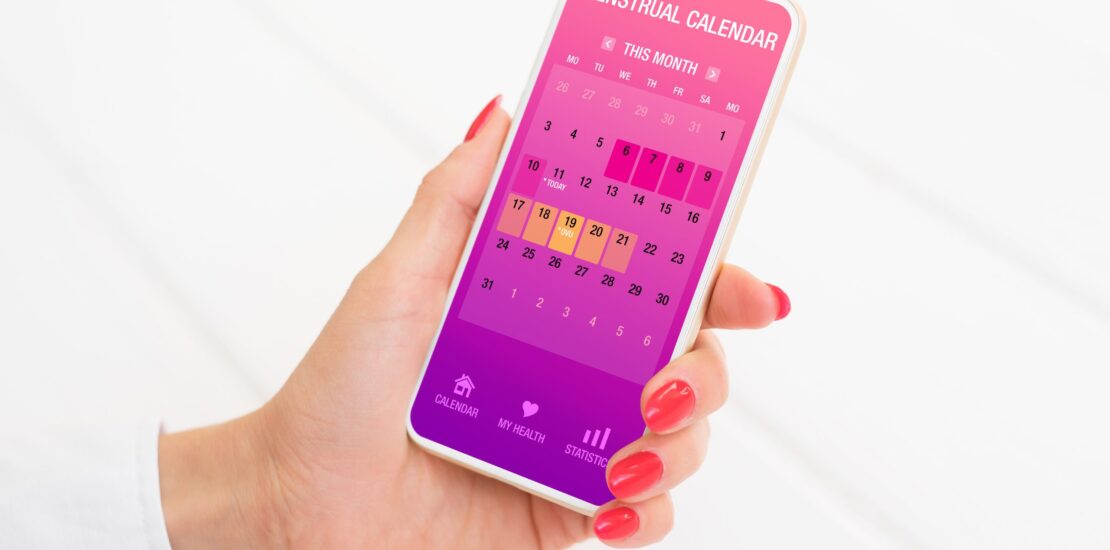
Health-related apps have been integral in assisting people by tracking their well-being in a more accessible and efficient way. Such is the case of period-tracking apps or “menstruapps”. The emergence of these apps was considered revolutionary. Not only do they provide easy access for women and those who menstruate a tool that tracks their menstrual cycles, but also provide a scope of features that is vast, ranging from monitoring sexual activities, current emotional and physical state, PMS symptoms, medication usage, and so much more.1
In hindsight, these “menstruapps” are something that should be praised since it revolutionizes the healthcare industry. From there, women are becoming more dependent on menstruapps. According to a research finding by Columbia University, period-tracking apps are the fourth most popular app category among adults in the ‘health apps’ category.2 As such, digitalizing period-tracking promises women more freedom and convenience in getting to know and taking care of their reproductive health. Moreover, the existence of these apps also promotes the normalization of “period talk” in public, thus the “feminist empowerment” nature of them.
Regardless, like any other apps in the market, the question of data security lingers heavily in the air as issues such as the commercialization of intimate data and government surveillance start to enter the realm of menstruapps. In other words, are menstruapps a part of bodily empowerment or another form of control over women’s bodies?
The (Undermined) Issue of “Menstruapps”
Data security has been an ongoing issue throughout the years with numerous cases of data exploitation through commercialization emerging here and there. Despite the surge of problems, the concern has yet to reach the subject of intimate data in period-tracking apps. What makes data in these types of apps intimate is the degree of sensitivity since it covers aspects beyond the period itself, such as sexual intercourse, masturbation, the use of emergency contraception, sleeping patterns, stress levels, physical symptoms, mood, or vaginal discharge. Looking at it, the degree of sensitivity and intimacy by quantifying such information requires explicit consent from the users.3 Although the consent given is directed by the apps’ developers for third parties (e.g., partners, healthcare providers, and researchers), it doesn’t erase the possibility that the consent itself is exploited by predatory advertisers. Such an instance can lead to the commercialization of intimate data since it parallels with the capitalist pursuit for new goods and markets, “a place where the inefficient, menstruating body ought to be disciplined.”4
Moreover, this type of data exploitation can lead to another pursuit of disciplining women’s bodies. Government control, particularly towards women’s bodies, is not a tale of the past. Policies made to persecute women over their bodies are still existing throughout the world, including those who seek abortion for safety and health circumstances.5 6 The overturning of the Roe v. Wade is an example of intimate data surveillance. The Roe v. Wade, 410 U.S. 113 is a legal ruling that declared the constitutional right to abortion in the United States which was decided since 1973.7 However, with the Roe v. Wade overturned, users are distressed by the possibility of their data being exploited by the government—with the help of private corporations—to map out users that seek an abortion.8 From there, these identified individuals are vulnerable to the possibility of persecution.
Current Regulations and Actions Surrounding Data Security in “Menstruapps”
Since period-tracking apps are a niche subject, discussions on data security in menstruapps are still lacking. Despite this, there has been analyses on data security and menstruapps from the feminist lenses, particularly on the subject of consent. According to one of these perspectives, the concept of consent is considered abstract since there are aspects that need to be considered such as context (the conditions where consent is brought into question), power (actors who has the authority to set terms on the subject of consent), and communication (the need for open discussion on consent betwen the data subject [user] and the data controller [app developer]).9 Thus, these aspects of consent need to be taken into account not only by the developers but also the policies and regulations revolving around personal data processing.
Adding to this, the General Data Protection Regulation (GDPR) can be set as an example in this case. As one of the current regulations that highlights consent on the utilization of personal data, GDPR emphasizes on the role of consent, particularly explicit concent, as a legal basis for personal data processing.10 As stated on Article 9(2) of the GDPR, data subjects must explicitly consent for the data controllers to process data in the special categories.11 Thus, in the context of menstruapps, explicit consent then became a crucial element in data processing due to the degree of sensitivity of its users’ intimate data.
However, many menstruapps developers has yet to implement explicit consent, particularly following the requirements set by the GDPR (“specific, informed, and unambiguous”) as stated in Article 4(11).12 Instead, most of them “bundled” the users’ consent of data processing with privacy policies or merely using the ticked off box option as an indication of consent. Such actions are considered as not freely given since there is no indication of intensive communication and concrete agreement on explicit consent (e.g. user’s complete consent or rejection towards intimate data processing) between the data subjects and data controller.
Despite this, one menstruapp has managed to actualize these two missing components when it comes to the users’ intimate data. The period tracker app Flo released the Anonymous Mode after the overturned of Roe V. Wade to combat abortion privacy concerns.13 The Anonymous Mode allows users to not store their personal data such as email addresses, name, and other technical identifiers. What makes this feature also effective is the separation of data content from IP address information by using a web standard known as “Oblivious HTTP” to transfer encrypted data between the user and Flo’s servers. Essentially, Flo can actually view what the data contains, but not where it originates from.14
Conclusion: To Keep or To Delete?
The issue surrounding intimate data security in period-tracking apps is finally taken into the spotlight since the recent overturn of Roe V. Wade. While most menstruapps developers still stick with their current privacy policies, Flo took a different route by launching the Anonymous Mode as a response to the staggering concerns surrounding abortion privacy. But regardless of this intiative, the usage of menstruapps hovers in the gray area since there is a user’s dilemma between the need of privacy and necessity. In other words, if you are very concerned about your data being used, might as well manually write down your cycles. Even in an app-driven era like today, there is nothing wrong with doing it the conventional way.
———————————————————————
1. Levy, J. and Romo-Avilés, N. (2019) “‘A good little tool to get to know yourself a bit better’: A qualitative study on users’ experiences of APP-supported menstrual tracking in Europe,” BMC Public Health, 19(1). Available at: https://doi.org/10.1186/s12889-019-7549-8.
2. Li, K. et al. (2020) “Characterizing physiological and symptomatic variation in menstrual cycles using self-tracked mobile-Health Data,” npj Digital Medicine, 3(1). Available at: https://doi.org/10.1038/s41746-020-0269-8.
3. Rizk, V. and Othman, D. (2016) “Quantifying fertility and reproduction through mobile apps: A critical overview”. Arrow for change, 22(1), pp.13-21.
4. Alaattinoğlu, D. (2022) “Rethinking explicit consent and intimate data: The case of menstruapps,” Feminist Legal Studies, 30(2), pp. 157–179. Available at: https://doi.org/10.1007/s10691-021-09486-y.
5. Llewellyn, A. (2018) Compounding trauma: Indonesia’s abortion law. The Diplomat. Available at: https://thediplomat.com/2018/08/compounding-trauma-indonesias-abortion-law/ (Accessed: October 12, 2022).
6. “Marginalized, Persecuted, and Imprisoned: The Effects of El Salvador’s Total Criminalization of Abortion” (2014). New York: Center for Reproductive Rights.
7. Jane Roe, et al., appellants, V. Henry Wade. (no date) Legal Information Institute. Legal Information Institute. Available at: https://www.law.cornell.edu/supremecourt/text/410/113 (Accessed: October 12, 2022).
8. Torchinsky, R. (2022) How period tracking apps and data privacy fit into a post-Roe v. wade climate, NPR. NPR. Available at: https://www.npr.org/2022/05/10/1097482967/roe-v-wade-supreme-court-abortion-period-apps (Accessed: October 12, 2022).
10. Information Commissioner’s Office (no date) What is valid consent? Information Commissioner’s Office. Available at: https://ico.org.uk/for-organisations/guide-to-data-protection/guide-to-the-general-data-protection-regulation-gdpr/consent/what-is-valid-consent/ (Accessed: October 12, 2022).
11. Information Commissioner’s Office (no date) What are the conditions for processing?, Information Commissioner’s Office. Available at: https://ico.org.uk/for-organisations/guide-to-data-protection/guide-to-the-general-data-protection-regulation-gdpr/special-category-data/what-are-the-conditions-for-processing/ (Accessed: October 12, 2022).
12. Information Commissioner’s Office (no date).
13. Wetsman, N. and Faife, C. (2022) Flo period tracker launches ‘anonymous mode’ to fight abortion privacy concerns, The Verge. The Verge. Available at: https://www.theverge.com/2022/9/14/23351957/flo-period-tracker-privacy-anonymous-mode (Accessed: October 12, 2022). 14. Flo (2022) Flo ‘anonymous mode’ now live, offering significant advancement in the privacy and security of Reproductive Health Data, Flo.health – #1 mobile product for women’s health. Available at: https://flo.health/press-center/flo-anonymous-mode-now-live (Accessed: October 12, 2022).
