- 25/09/2019
- Categories: Commentaries, Press Release
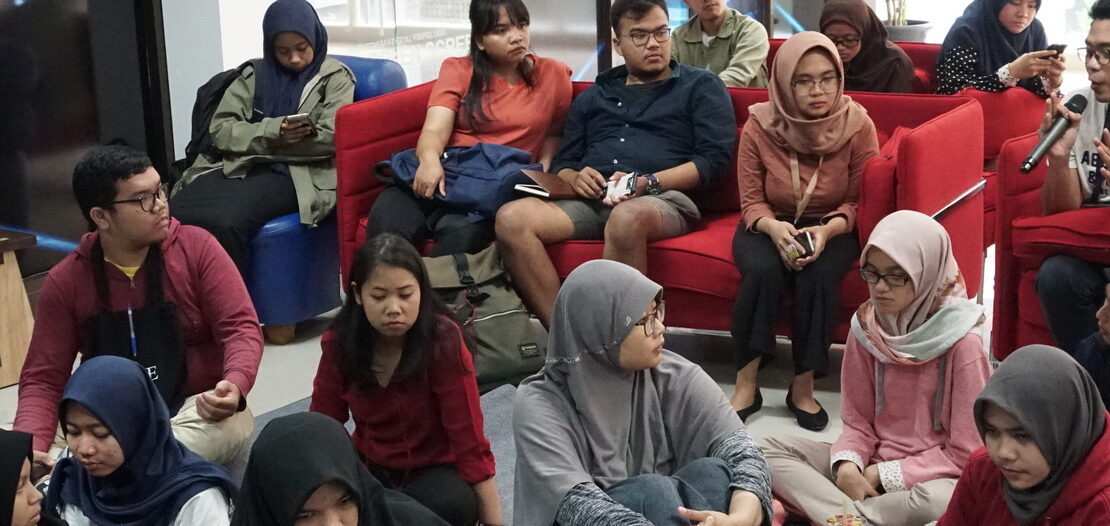
Yogyakarta, 24th September 2019 – In this digital era, the use of social media is affecting various aspects of our daily life. With the large number of users, social media can be used as a means of sharing information, entertainment, and communication with our colleagues. But in its use, it turns out that social media can also have negative impacts. In the 16th series of CfDS Digital Future Discussion (Difussion) that was organized at Creative Hub FISIPOL UGM, the positive and negative impacts of using social media were discussed with several examples of relevant case studies.
The Internalized Hatred Brought Online
Anaq Duanaiko as the Project Officer of Research began the discussion by flooring the issue of internalized hatred brought to online spaces. Anaq argued that internalized hatred is how an individual already has hatred that is deeply rooted and embedded in their ideology that might be caused by the culture of the group they live in. This is then brought into the cyberspace. He gives an example through the use of a dating application, where users can include any information that state their preferences regarding individuals that they consider to be ideal and want to interact with. However, the application cannot help users to see that the discrimination exists within that interaction system which in the end, it might project the internalized hatred itself.
Eco Chamber Phenomenom in Social Media
In the next session, Paska Darmawan as the Digital Intelligence Lab CfDS’ researcher explained about the phenomenom of echo chamber that may arise when an algorithm is set to be only in accordance with our interests. According to Paska, humans have tendency to only choose information that suits their interests. We also tend to only remember things that become our passion. In addition, humans also tend to perceive information in accordance with their own prejudices. Paska added that humans’ brain is prone to experience information overload, because we have limited thinking abilities. Consequently, we are only cherry-picking information that we only like. In the context of social media, these three tendencies make us to be not open-minded with myriad information out there and in the end, those tendencies will eventually make it easy for us to cause friction with other people who we considered to disagree with ‘our kinds of information’.
The Dark Side of Viral Challenges
In the next session, Wava Carissa as one of the researchers of CfDS Digital Intelligence Lab discussed about the dark side of the viral challenges on social media, such as #10ManequinChallenge and #10YearsChallenge. Viral challenges are often to be seen as non-problematic. But according to Wava, behind the existence of these challenges, there are so much data that can be utilized by interested parties and actors. Data taken from the viral challenges are indeed still scattered and have not been labeled. It is important to label the dataset since data labelling can help artificial intelligence (AI) to analyze the dataset itself. This is where the uniqueness of social media, where viral challenges help the AI to label and create patterns for scattered data, so that the data can be categorized and analyzed. However, Wava also emphasized that there are other more ethical means on doing data mining and data labelling. “There are several companies that conduct data-mining in ethical ways, such as Google CrowdSource and Amazon Mechanical Turks. In both applications, users can work on tasks related to train the AI, where every task completed will be given an incentive in the form of money” said Wava.
Author: Laili R.
Editor: Raka W.
