- 23/09/2020
- Category: Commentaries
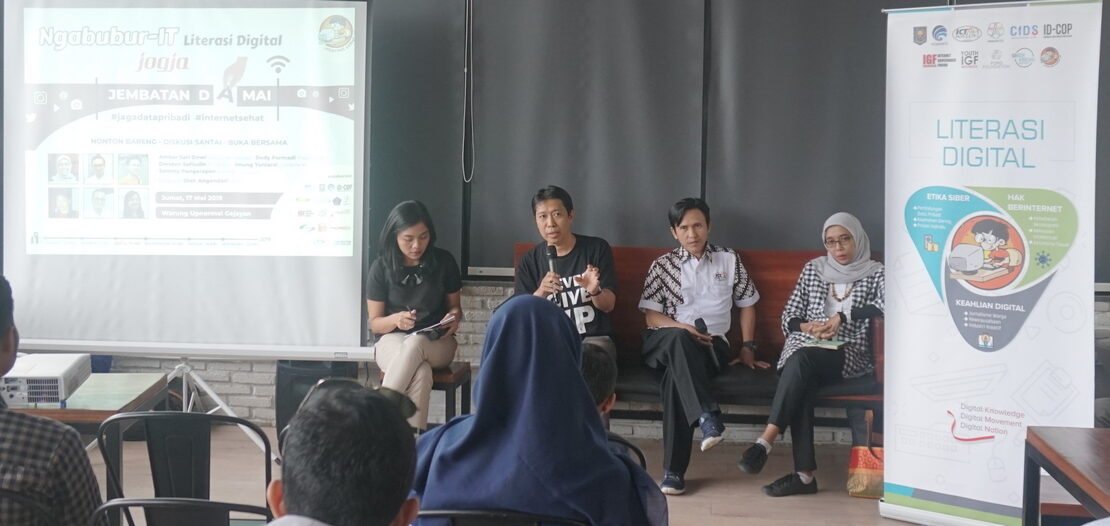
Yogyakarta, 17th May 2019 – Center for Digital Society (CfDS) UGM with ICT Watch held an event called “Ngabubur-IT: Jogja Digital Literacy” which was attended by more than 50 participants. The event began with an episode of the TV series Black Mirror: Nosedive, which illustrates the behaviour of people using social media with technological sophistication in the future.
According to Donny Budy Utoyo as the Chairperson of ICT Watch who also gave the opening speech, futuristic systems such as social ranking through social media have begun to run in China. “Now we can see social ranking through social media with points from our personal data or the number of our followers on social media, added with the use of algorithms. That is why regulations regarding the protection of personal data are considered important. Without the protection of the personal data bill, we must be ready for our data to be spread, without us having an effort to obtain legal protection. We must realize that our personal data is ours, not the government’s or any party’s. So, to use it, they need our agreement”, explained Donny.
Personal Data Protection and Privacy
Personal Data Protection and Privacy became the topic of discussion with four speakers, namely Imung Yuniardi (Director of Combine Resource Institution), Denden Soifudin (Community Development of ICT Watch), Ambar Sari Dewi (Sociology Lecturer of UIN Sunan Kalijaga) and Dedy Permadi (Managing Director of CfDS), and moderated by Diah Angendari (Executive Secretary of CfDS).

According to Imung, personal data is a data that can show or direct information to someone specifically. “All industries now use data. The more data we deposit, the more we became ‘selling commodities’ for business” he said. This was agreed by Denden, in which he also agreed, “When we are asked for personal data and we want to give, it means we are ready to accept the risk”. In the draft bill of personal data protection, there are two types of data that need to be protected, namely Population Personal Data such as Kartu Keluarga (family identity), Nomor Induk Kependudukan (identity number), place of birth, identity number of biological parents, as well as Sensitive Personal Data regarding beliefs or religion, personal financial data, medical history or any other personal data who are prone to trigger conflict. “Regarding privacy, we all want to enjoy it without being disturbed by others. In fact, our privacy guarantee is very weak. Even the existing laws are violated”, Imung added.
Social Media & Data Privacy
Responding to the previous issue, Ambar explained that the digital literacy movement needed socio-cultural aspects. For example, by formulating the concept of ‘private’ and ‘public’ which is done in a bottom-up and localized way. We also need to consider the characteristics of internet users in the campaign. The government can ask providers of social media platforms to provide localized security defaults. Similar things were also conveyed by Dedy Permadi regarding personal data on social media. “If we talk about personal data, the biggest challenge is social media. When we interact on social media, consciously or unconsciously, we share our own data, both ordinary and sensitive data. Then, the conversation rooms are utilized by social media algorithm designers. So, it eventually makes us to be addictive and dependent on using social media”, said Dedy.

The event ended with a question and answer session, then breaking the fast together. Information-sharing activities related to digital literacy are expected to add insight and increase public awareness of the importance of digital literacy and personal data protection.
Written by: Laili Rahmawati
CfDS (Center for Digital Society) UGM is a multi-disciplinary research center that is established under the Faculty of Social & Political Sciences University of Gadjah Mada. This research center is built upon the concern over the contemporary dynamics of socio-political condition of the world that is accentuated by the impeccable influence of information technology. The phenomenon triggers the new patterns and complexities in the society, and thus requires new approaches in managing such complexities. Our research and other activities are based on spirits that is aligned with our motto, productive, innovative, & influential.
