- 25/11/2018
- Categories: Commentaries, Press Release
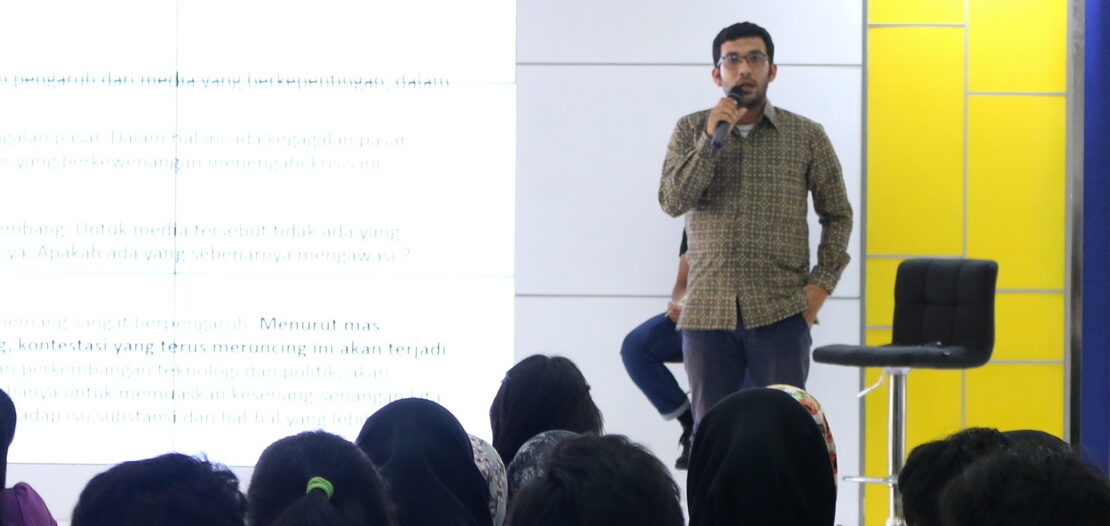
Yogyakarta – Nowaday’s politics easily reaches young voters through the social media channels. Even though television’s penetration rate is still far above the internet, non-traditional media such as social media and instant messaging applications are becoming millennial’s choices in gathering political information. The transition of campaign trends from mainstream media to digital media changed the perspective of political journalism; how did it shape public perceptions of their political choices? This issue was discussed in Digitalk # 24 titled “Well Informed Society: Social Media vs. Television” on Thursday, November 22, 2018. Center for Digital Society invited Muhammad Heychael, Coordinator of the Remotivi Research Division, a well-known media study center and media watchdog in Indonesia.
Heychael opened the discussion by presenting some of the results of media research in Indonesia. One of them is research from Nielsen in 2017 which shows that television and space media penetration still ranks the top with a 96% audience, while internet covers audiences only 44%. However, mainstream media such as television are currently experiencing low level of public trust. The National Survey Project revealed that the level of public trust in mainstream media was only 67%. This is compounded by the increasing penetration of internet users, reaching 143.26 million users per 2017 (APJII 2017). Some internet users use the internet to watch television via streaming. This fact encourages a shift in the trend of the use of media for means of political information, especially to reach the votes of young voters. The age of most internet users is 19-36 years as much as 93%.
Media Favoritism and Public Distrust
In the 2014 election, Indonesian people witnessed how the General Elections influenced favoritism of the media. The media that is expected to provide neutral and balanced information turned into a media campaign that only features one of the candidates. The media favor towards a particular candidate was determined by the political affiliation of the media owner. Unfortunately, almost all television channels in Indonesia owned by politicians/businessmen who participated in political contests at that time. As a result, television coverage became divided. This polarization influenced an individual’s trust in television journalism.
“Increasingly partisan media is the reason for strengthening public distrust of the media,” Heychael said.
Amid the decline in public confidence, internet penetration has increased, providing an alternative source of information to the public. The internet provides more choices to search for information, therefore the preference toward internet media is increasing. The fast flow of internet information marks the end of the era of journalism as a “gatekeeper”.
“In the past, it was the media that set the agenda and what issues were discussed by the community. Currently information is unlimited and can be accessed by anyone,” he added.
This democratization of information brings opportunities as well as challenges: the growth of hoaxes and disinformation on the internet.
Politainment: Politics as Entertainment
Social media changes the way people view politicians and political contests. Journalism on social media reduces politics as a mere spectacle without any weight of information. Hence, the term politainment emerged, which is a mixture of politics and the entertainment world. In politainment, the audience is led to see the characterization of the antagonists and protagonists in politicians so that voters choose based on how social media portrays their personality. “Social media is all about personality,” Heychael concluded. This causes social media as a public space to become cloudy. Voters who get exposure to news from social media cannot think rationally.
Social media platform algorithms support this by allowing echo chambers formed. Social media algorithms are set so that they continue to present the type of content that users often read. This is why individuals who only get news from one social media find it difficult to accept facts from other sources. The algorithm creates an echo chamber that repeats only one side of reality. It is difficult for individuals who have been exposed to hoaxes to accept facts and think rationally.
One participant asked about the sensitivity of the Indonesian people towards media alignments. Heychael is concerned that suspicion of the media is not based on sufficient knowledge. Some readers value the media from an ideological level, for example sorting between Islamic media and non-Islamic media. If the news is not in accordance with what the reader believes, it is considered as a non-Islamic media. This is very emotional, brutal and irrational.
“We enter an era of post-truth. If I hate you, your fact is wrong. All things are responded with emotion,” he explained. According to Heychael, this phenomenon can be counteracted by digital literacy. Journalistic ability is not only owned by journalists but must be owned by everyone.
This is what digital literacy brings to the table, every individual must be able to criticize, identify and look for credible news sources so that they are not swept away. Digital literacy needs to be taught early and incorporated into the education curriculum in order to create a well-informed generation.
Written by: Nabiila Nurfitri
