- 30/12/2017
- Category: Commentaries
The widespread adoption of handheld technology and online communication has led to momentous change towards how we behave and interact within the public domain. As digital developments continue to open up unprecedented possibilities, we consistently seek innovative alternatives as to how we usually carry out our day-to-day activities within the social sphere; alternatives that essentially attempt to harness the development of man-made technology for the use and benefit of mankind itself. The aim of this is to allow for much less labour and much more convenience in the process of fulfilling our needs – whether that be mundane daily routines such as obtaining home-to-work transportation, or perhaps more substantive matters such as raising funds for a social project. Subsequently, humans have shaped and molded the digital world in accordance with how we need it to assist us in our lives, and thus the presence of applications such as Go-Jek or Uber and websites such as GoFundMe or Change.org. But there is one particular aspect of this ‘mass digitalization’ that currently deserves more attention: activism through digital means, or more popularly referred to as digital activism.
Digital activism can be understood as the use and implementation of digital media in advocating a specific issue in order to entail social and/or political change. Such activism may then be manifested through several manners, in which McCaughey & Ayers identify three main categorizations.[i] The first is awareness and advocacy which focuses on the distribution and dissemination of information through the Internet. This activity aims to attract public attention towards an issue at hand and encourage subsequent action to tackle the issue, whilst also making use of digital means to coordinate collective action of advocacy and lobbying. An example of this is the Black Lives Matter campaign, which used social media to raise public awareness regarding policy brutality against black Americans. the second is action and reaction, a type of digital activism that focuses on online attacks and hijacks which aims to achieve a specific political or financial goal. The most popular form of this is ‘hacktivism’, a term used to describe activism executed through hacking computer networks, websites and servers. The worldwide ‘Anonymous’ group is broadly known for such activities. The third is organization and mobilization, which emphasizes on using digital technology to call for online or offline action. The nationwide political movements during the 2011 Arab Spring uprisings act as an example. Internet forums and Facebook groups were utilized to mobilize thousands of like-minded activists to demonstrate against their governments, aiming to topple their long-standing regimes that were considered authoritarian and highly undemocratic.
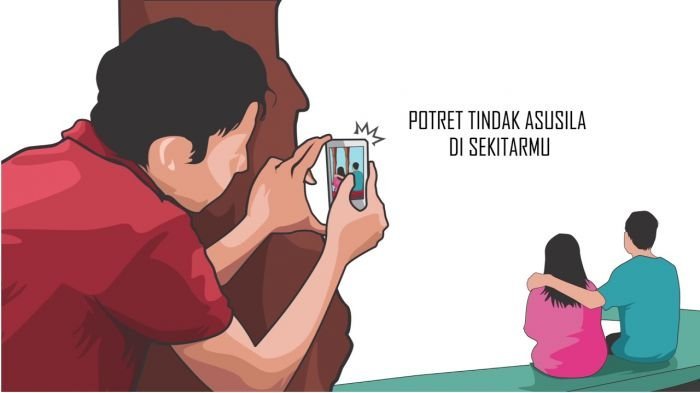
A more recent example of digital activism that falls under the category of organization and mobilization is an Indonesian online movement called ‘Cekrek, Lapor, Upload!’ (‘Photo, Report, Upload!’), abbreviated as CELUP. It was launched in mid-December 2017 and quickly gained widespread public acknowledgement soon after due to its controversial purpose and substance. Such a name might encourage a false first impression that it is a movement to capture some form of criminal or illegal activity, which could then be reported and given to the local authorities for further extensive use. To some extent this assumption is true. But instead of advocating against illegal activity, CELUP takes it one step further by encouraging individuals to act as the society’s ‘moral police’ themselves. The movement calls for internet users to fight against self-defined ‘immoral’ acts that they find in public space, particularly those of which include public display of sexual or romantic affection between two individuals.[ii]
The mechanism is simple: whenever you find two unknown individuals displaying ‘excessive’ forms of affection for each other in the public domain (such as hugging, kissing, or even sexual intercourse), CELUP encourages you to take a photo of these individuals without their knowledge and consent. Following this, you report the taken photo to the social media accounts of CELUP where they will then proceed to upload your discovery to the public. Reporters will then receive prizes according to how many photos they manage to send: a piece of merchandise for one photo, a keychain for three, and a T-shirt for five. The purpose of the movement is to ‘save the public space’ from inappropriate and immoral behaviour and to publicly shame the convicted individuals through CELUP’s social media accounts. The movement itself places its motives largely upon the constructed Eastern values of morality and decency found in Indonesia’s society; values of which frown upon sexual acts outside of legalized marriage.
But is this social campaign taking digital activism one step too far? Closer inspection of their social media accounts would provide arguments that support such a claim. First and foremost, although CELUP boldly included several logos of governmental institutions and established media outlets on their social media, the campaign is in fact merely a student-found movement that has yet to gain the formal recognition or support of any external bodies.[iii] This effectively deprives CELUP of any self-proclaimed authority that would otherwise allow it to legitimately receive reports from the public. Furthermore, the lack of any form of authority means that if CELUP were to upload the reported photos for internet users to see, without the agreement of the included individuals, this would then constitute as illegal acts of defamation under article 27(3) of Indonesia’s National Law No. 11/2008.[iv] The illegality of the campaign’s substance is further underlined by articles 310 & 311 of Indonesia’s Criminal Code (KUHP), which strictly prohibits acts of defamation and false accusations – particularly those carried out in public space.
Moving away from the legal dimension of the movement, the manner in which CELUP attempts to advocate against ‘immoral’ acts is, in truth, ironically immoral itself. Taking unauthorized footage of unknown individuals in the public space is considered highly unethical in most countries across the globe, even more so if it is then uploaded to the Internet and distributed to the mass without any form of consent. This opens up vast opportunities for violations towards the privacy of these individuals, where uploading such defamatory photos may bring severe long-term repercussions and unwanted consequences towards their personal lives. Previous cases of false online accusations have already proven how damaging these acts can be towards the involved individuals: some victims ended receiving alienation from the society and their workplace, while others have ended losing their jobs altogether with their psychological and mental state being deeply affected.
As noble as the intention may be, CELUP’s attempt at digital activism ultimately falls short, due to its absence of authority and its privacy-violating and highly unethical conduct. The movement did not last for too long though, as the public quickly grew aware of its presence and almost instantly recognized its distasteful nature. Having been launched only a few weeks ago, CELUP’s Instagram account rapidly became the target of widespread reports from users who were unhappy with the movement, thus resulting in the suspension of the account by 27 December. Nonetheless, the account still managed to gather more than 300 followers within around a week since its launch – despite being unable to post any photos of ‘immoral’ individuals before being suspended. The movement’s brief-lived popularity highlights how such self-validating and morality-based acts of vanity are still very much popular among Indonesians regardless of how they may violate the private matters of others. Fundamentally, the movement was born in a society where it is deemed acceptable to view one’s morality as superior to those of others, and thus mistakenly believing that such superiority gives one the right to act condescendingly disrespectful towards those considered immoral. It is agreeable that the swift suspension of CELUP may indeed illustrate the increasing critical awareness of Indonesians; but for a worryingly large portion of the society, protecting constructed moral values will still always trump the importance of respecting the private space of others.
Picture : tribunnews.com
References :
[i] M. McCaughey & M.D. Ayers, Cyberactivism: Online Activism in Theory and Practice, Routledge, 2013.
[ii] R. Apinino & A. Dhani, ‘Sejumlah Institusi Mengaku Dicatut Namanya oleh Kampanye CELUP’, Tirto (online), December 27 2017, https://tirto.id/sejumlah-institusi-mengaku-dicatut-namanya-oleh-kampanye-celup-cCmB.
[iii] D.N. Prastyphylia & B.C. Wisnumurti, ‘Kampanye CELUP: Demi Berantas Asusila, Rela Terobos Hukum Positif dan Etika’. http://www.plasticdeath.com/2017/12/kampanye-celup-demi-berantas-asusila.html.
[iv] D.N. Prastyphylia & B.C. Wisnumurti.
