- 12/07/2017
- Category: Commentaries
This open article is written by Dewangga Dura Dematar, who submitted his article to CfDS.
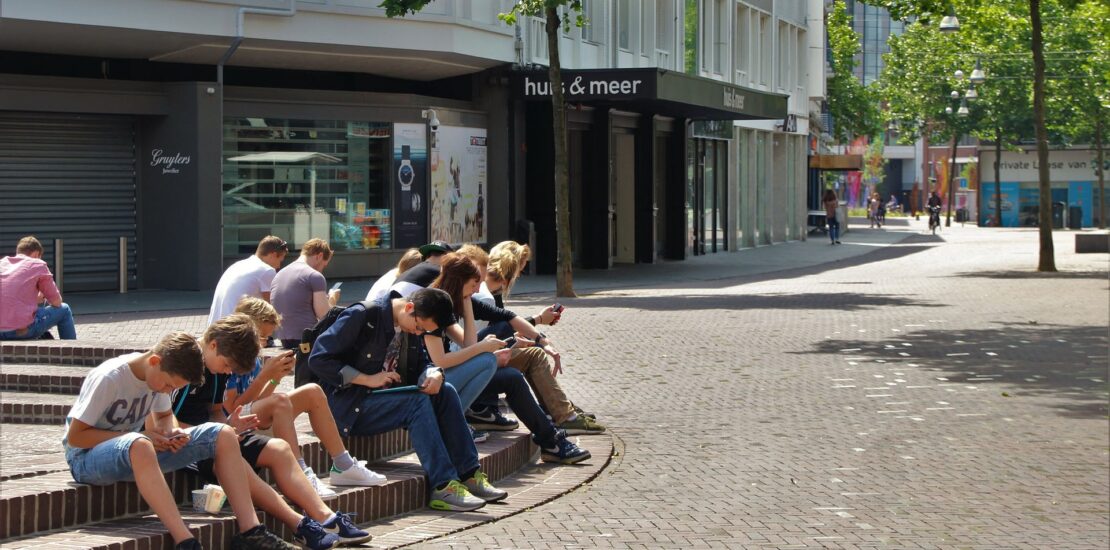
Our generation has notably known for our habit of staring at our phones at all times. This can happen in any occasions, from routine walking on the sidewalk every day, during concerts, and even during dates! We seem to often be entangled in a lot of pursuits of social media presence, instead of living the real social interactions. This behavior seems to be very universal these days, and have gathered people wondering, is our generation detaching from social activities and thus inevitably – and arguably – ‘failing’ the real world?
The verdict didn’t stop in that sentence. Scholars from all over the world are now researching on how our mental health may be affected by this ‘virtual endorphin boosting abuse.’[i] In the face of such search, an interview video featuring Simon Sinek commenting on Millennial’s behaviour in the workplace took claims that the root problem can be traced back to social media addiction and poor parenting.[ii] Sinek describes that the problem our generation has today is a highly gadget-addict generation that lives most of our time on our screens and is fully dependent on our parents’ influence in getting almost anything in our life. He describes that this addiction to social media will construct a virtual reality that will be shattered once we enter the real world that, in which he describes, will not agree if we ask our parents for promotion.
I would not say that Sinek was entirely wrong, but his description on how millennial behaves today is very limited and may be based on a stereotype generated from watching too much Travis Scott music video, for instance. There is, indeed, a certain portion of the population that behaves in the way he describes, but not everyone, or any generation, could really be labeled with a certain set of values.
In the 21st century, internet is now widely used and seen as a great leap in human civilization, but such leap or advancement are not necessarily experienced only by millennials, if we’re to say that internet and technological advancement is what causing all this so called mess. People in the 1950s who used to talk about their life in dinner table start to talk less in 1960s as they start to listen to Radio. By the time it reached the 1980s, people are having their attention captured by Television, and now it just transformed from Television to a mobile phone. My grandfather might not have a chance to enjoy watching funny cats YouTube videos, but he did experience a transition from radio to a 21-inch flat screen television. Every previous generation has experienced similar occurrences; transitioning with technology which comes with the price of less and less social/real human interaction. If we take a look at every generation carefully, what Sinek claimed as a generation that lives in fantasy, is actually a generation that has no significant differences than the preceding generations.
Parents that might have a constant fear that social media will cripple their son ability to perceive reality should not be afraid, it is actually a very positive media for them to interact with the community or to find easily people that are interested in the same hobby. The Internet, Social Media, and High-Tech Gadgets are actually helping our generation to perceive wider world both geographically and historically. What they say on the internet and what they write on the Facebook wall is actually a way for them to discover who they are and what is meaningful for them. Some millennials even take social media as their way of influencing others positively through social campaigns, and social movements for example.
People are still the same. Our desire and impulse to be known and to sugar-coat our personality have never changed. Human Nature is not changing significantly, but our institution does. We always fear something that is foreign to us. It happened before and it will happen again in the future. So, probably, rather than blaming a different set of interactions that our generation is prone to do, maybe we should take more time to realize that quality of our lives are independently affected by nothing but our decision. We should instead focus on making real positive impacts from this form of new social behaviors.
Picture: PIxabay
[i] Kuss, D. and Griffiths, M. (2011). Online Social Networking and Addiction—A Review of the Psychological Literature. International Journal of Environmental Research and Public Health, 8(12).
[ii] Fernando, G. (2017). Four main reasons for Gen Y’s unhappiness. NewsComAu. Available at: http://www.news.com.au/lifestyle/real-life/news-life/four-main-reasons-for-gen-ys-unhappiness/newsstory/360b4eff77c4f0e4d54a0ca65d73d72f [Accessed 2 Jun. 2017].
