- 23/09/2020
- Category: Commentaries
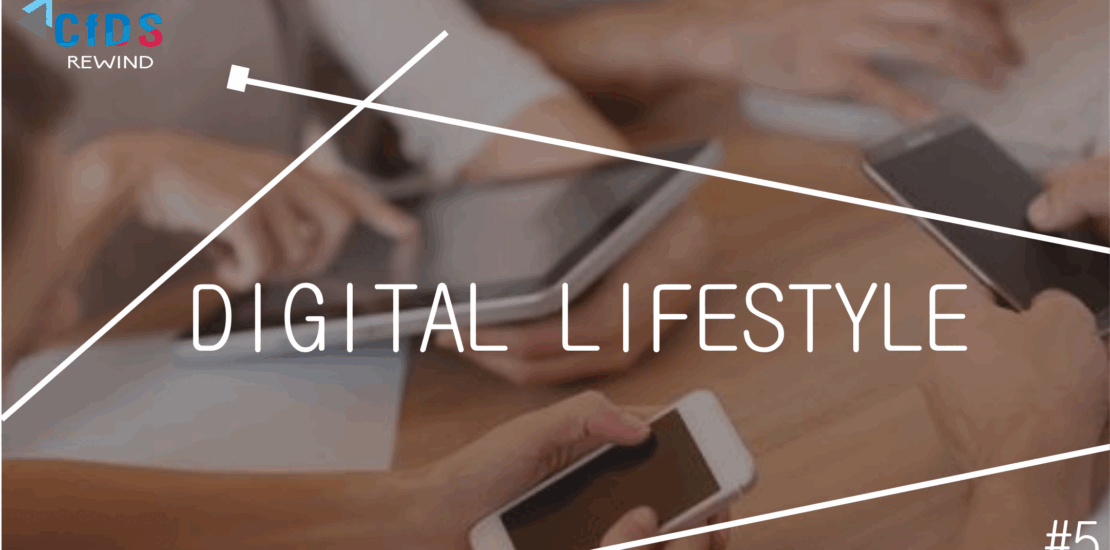
Cultural changes brought by the digitalizing world were subtle, but then it has been gradually adapted as part of our lives. As for in 2016 it is very normal and common to discuss about the choice of emoji someone chooses to react to certain things, or to walk with a front camera open as we record ourselves talking. This transformation is also known as part of the digital Lifestyle, a Lifestyle which is reflected by vast technological development, one of which we are all getting accustomed to. It has revolutionized how humans interact with each other. 2016 has marked an even further advancement in the lifestyle of society, driven by digital technologies.
Digital Lifestyle: From delivering goods into finding love
Words such as ‘ubering, gojeking, tinder-fishing’ have become actual meaningful words and this is not surprising. Some examples brought by Gojek, society-based startup dedicated in mobility services. They offers many form of services from the regular ojek (motorcycle driven public transportation) ranging from delivery service, grocery shopping service, and more.[1] Gojek has become one of the strong competitors in transportation-based startups, along with Uber and Grab. People nowadays could stay at home or work yet they can get their errands done by utilizing these services.
Aside from that, dating apps are also on the rise, as they have also provided a specific platform for modern people who are open for the idea of digital dating. Rosenfeld and Thomas pointed out that unlike in 1990, starting from 2012 societies all over the world openly accept the idea of online dating. This phenomenon had resulted in 60% of couples admitting to have met their spouses online.[2] In seeing the flourishing apps of Tinder, research had shown that compared to the tradition of face to face dating, people nowadays are more comfortable to interact through the internet first, prior to meeting their potential dates.[3]
Understanding Nowadays’ Complex Society and Adapting to Digital Lifestyle
What needs to be seen from this phenomenon is how these startups acknowledge the dynamics of modern society which aims for effectiveness and fast paced activities crammed into 8 hours of office work hours. Many claimed of having no time from getting quality food outside of workspace into more personal matters such as meeting new people for romantic reasons. Schiff, in ‘How an Economy Grows and Why It Crashes’, explains how society got even more complex in the condition of economic growth.[4] How the mode of productions becomes more set in fitting the speed of development is what we can see from Indonesia as an emerging market. The speed skyrocketed even in Indonesia’s neighbor such as Singapore, where the life pace has arisen into 30% compared to how it was in the 90s.[5] According to a Silicon Valley Psychologist Dr. Stephanie Brown, what dangerous about the speed is how everything is fast. Everything is impulse. Our sense of connection exists in the action, not an accumulated, deepening experience.[6] Unlike how Schiff described that the nature of competition might lead to economic crash which some scholars are predicting from these rising startups, there are other ways of seeing how their social approach altered how society accepted these new forms of services.
What is interesting about the innovations which are happening right now and taking part in our lives is that they are social based innovations which are made to accommodate the lives development had brought us with. As it opens more possibilities and opportunities, Khoshkish mentioned how the complex society provides diversified areas of contact and cooperation in the context of which they are equally and functionally diversified.[7] These contact and cooperation open up areas for modern society to face issues such as inequality and gap issues, more importantly it allows dismantling notion of social stratification which are highly attached to rigid social norms. Nowadays, people of services are more dignified and finding love through internet are common. Writer Colvile mentioned on how the fast paced society should not be seen as how humans are racing only towards our destruction. Society is always certainly polarizing as acceleration takes hold – between fast and slow, urban and rural, old and young.[8] In conclusion, we can put into illustration that the society had changed ourselves from riding a horse, diesel fueled car, into a fast sport car, fearing the sport car for its speed and possibilities to crash is a waste of time comparing to finding ways which could improve ourselves as better drivers.
[1] Gojek. (2016). GO-JEK Indonesia. Retrieved December 22, 2016, from <https://www.go-jek.com/>
[2] Rosenfeld, M. J., & Thomas, R. J. (2012). Searching for a Mate: The Rise of the Internet as a Social Intermediary. American Sociological Review, 77(4), 523-547.
[3] Marie Claire. (2016, November 21). Tinder: The Online Dating App Everyone’s Talking About. Retrieved December 22, 2016, from <http://www.marieclaire.co.uk/life/sex-and-relationships/tinder-the-online-dating-app-that-everyone-s-talking-about-112522>
[4] Schiff, P. D., & Schiff, A. (2010). How an economy grows and why it crashes: a tale. Hoboken, New Jersey: Wiley.
[5] Macrae, F. (2007, May 02). Pace of life speeds up as study reveals we’re walking faster than ever. Retrieved December 22, 2016, from <http://www.dailymail.co.uk/sciencetech/article-452046/Pace-life-speeds-study-reveals-walking-faster-ever.html>
[6] Brown, D. S. (2014, January 04). Society’s self-destructive addiction to faster living. Retrieved December 22, 2016, from <http://nypost.com/2014/01/04/societys-addiction-to-faster-living-is-destroying-us-doctor/>
[7] Khoshkish, A. (2013). The socio-political complex: an interdisciplinary approach to political life. Oxford: Pergamon Press.
[8] Colvile, R. (2016). The great acceleration: how the world is getting faster, faster. New York: Bloomsbury Publishing .
