- 03/10/2025
- Category: Press Release
Yogyakarta, September 25, 2025 – Online transportation platforms such as Gojek, Grab, and Uber have made mobility easier while creating new job opportunities. However, behind this flexibility, algorithm-driven systems also generate new vulnerabilities for drivers.

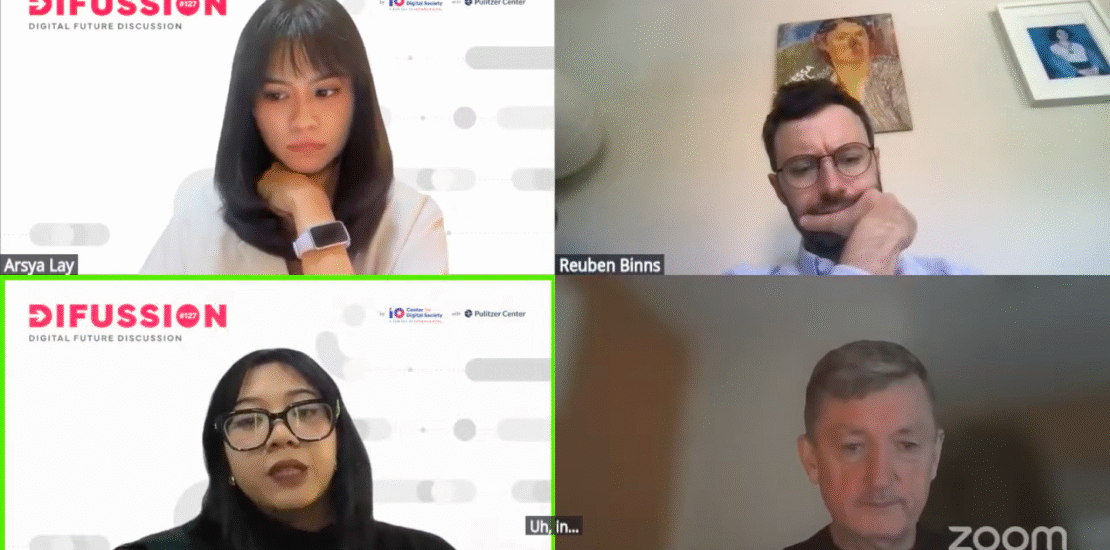
This phenomenon was the focus of Diffusion #127 “Algorithms at the Wheel: Global Perspectives on Ride-Hailing Work”, organized by the Center for Digital Society (CfDS) UGM in collaboration with the Pulitzer Center, University of Oxford, and Worker Info Exchange. The discussion featured three experts from Indonesia and the UK, examining how algorithms impact the welfare of ride-hailing workers.
The event opened with remarks from Maria Karienova, Program Manager for Artificial Intelligence (AI) Engagement at the Pulitzer Center, who highlighted the importance of addressing new challenges posed by AI in platform-based work. The session continued with Ayom Mratita Purbandani, CfDS researcher, who discussed the impact of algorithms on online drivers in Jakarta and Gunungkidul. She emphasized that algorithms are not neutral, but function as infrastructures that control labor. “In Jakarta, dense data makes algorithmic pressure more intense. Meanwhile, in Gunungkidul, data scarcity creates high uncertainty,” explained Ayom.
Meanwhile, Reuben Binns, Associate Professor at the University of Oxford, shared research findings on Uber’s dynamic pricing system in London. “Through dynamic pricing, Uber’s median cut has become larger, sometimes up to 50% per trip. Many drivers end up losing rather than earning, and they can no longer predict how much they will make for a certain duration or distance,” said Reuben.
Furthermore, James Farrar, Director of Worker Info Exchange, stressed the urgency of data accessibility and transparency for drivers to advocate for their rights. “There have been many cases where Uber used its technology to abuse its power over drivers. They deny basic workplace rights, while many drivers lack social protection or appeal mechanisms when their accounts are unilaterally deactivated,” James asserted.
Closing the discussion, Suci Lestari Yuana, Adjunct Researcher at CfDS, connected these findings with the ongoing ILO agenda to establish standards for decent work in the platform economy. “Algorithms determine who gets seen and who does not, and this amplifies inequality. That’s why we need to push for the framework of ‘Precarity by Design’ to ensure digital labor systems are fairer for workers,” said Suci.
The discussion highlighted that algorithms are not just technologies but critical determinants of working conditions. In both Indonesia and the UK, the challenges remain the same: transparency, fairness, and protection for platform workers.
Writer: Muhammad Alfasya Syabil Sholatar
Editors: Dhivana Anarchia Ria Lay, Masgustian
—
The full session is available at:
https://www.youtube.com/live/ul02J3QpsX4
—
Media Contact
Center for Digital Society
Faculty of Social and Political Sciences, Universitas Gadjah Mada
For more information, please contact +62 857-9931-2383 (Masgustian) or email cfds.fisipol@ugm.ac.id
The Center for Digital Society (CfDS) is a research center under the Faculty of Social and Political Sciences at Universitas Gadjah Mada. CfDS FISIPOL UGM focuses on studying digital society. Through various research and public discussions, CfDS FISIPOL UGM provides educational resources to the public on the impact of technology across social, political, and economic dimensions.
